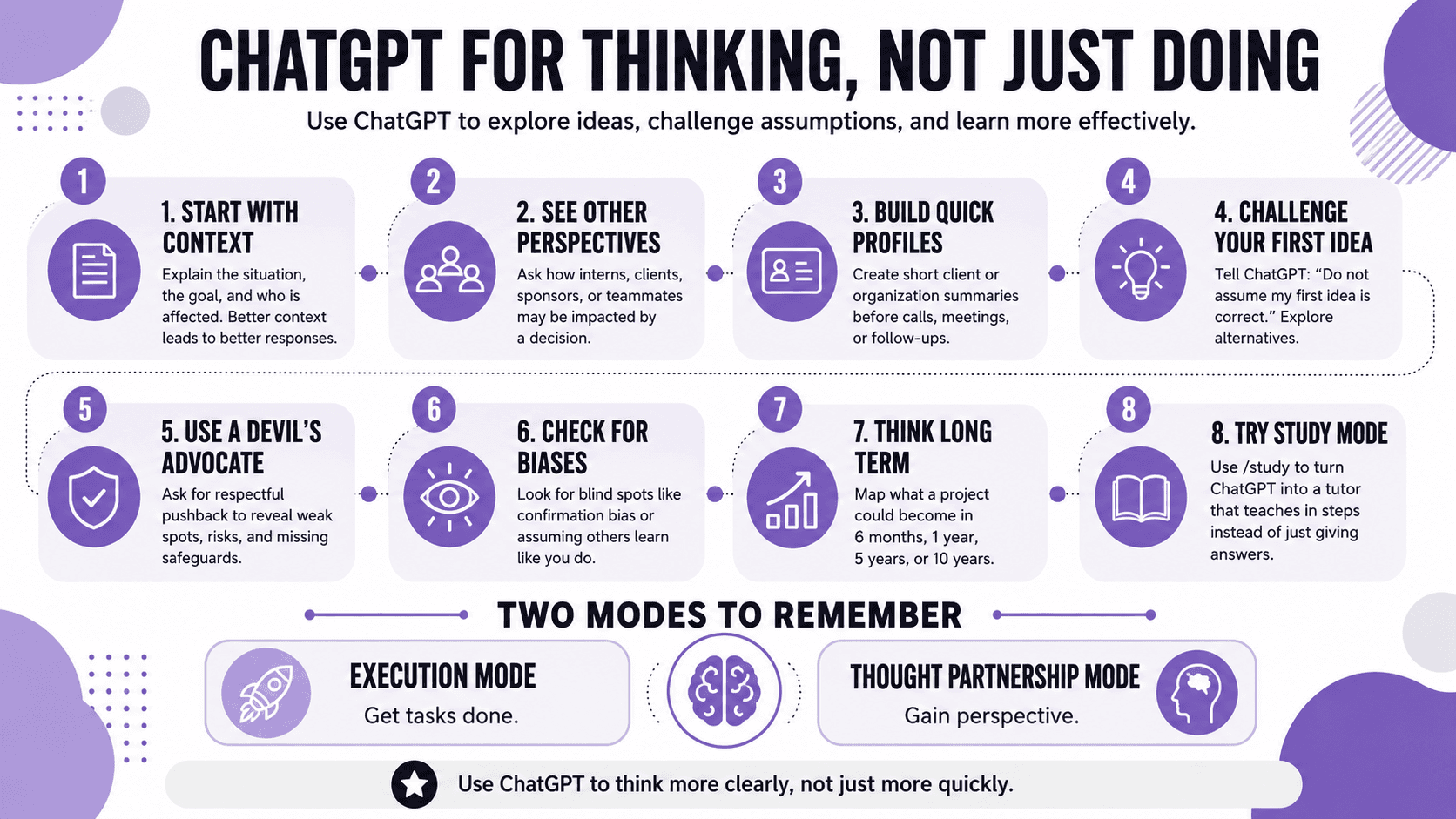

ChatGPT can be more than a tool for getting quick answers or finishing tasks. It can also be used as a thought partner, which means it helps you think through a situation without making the decision for you. This is useful when a choice may affect other people, because it can help you slow down and consider different perspectives. Instead of asking, “What should I do,” you can explain the situation and ask how different people might be affected. This helps you become more informed before you act.
For example, imagine you are running a summer internship program while several large projects appear at the same time. You might wonder whether to pause or cancel the internship so your team can focus on the new work. Before deciding, you can ask ChatGPT to think through how that choice may affect interns, co-instructors, sponsors, and your organization. This kind of prompt works best when you include context, which means the background details ChatGPT needs to understand the situation. The goal is not to copy ChatGPT’s answer, but to use its response to prepare better questions, messages, and next steps.
ChatGPT can also help you prepare for sales calls, client meetings, or conversations with organizations. You can ask it to create a profile, which is a short organized summary of who the organization is, what it does, what its goals may be, and how it connects to your work. This can save time because you do not have to search through every website or document by hand. If ChatGPT has browsing or web access available, it may pull useful details from online sources, but you should still check important information yourself. A profile is best used as a starting point, not as guaranteed truth.
Client profiles can also become a shared resource for a team. A business can keep a profile for each client, including their work, skills, past projects, and what has already been done with them. This helps another staff member quickly understand the client and continue the relationship without starting from zero. These profiles should be updated regularly, such as every six months or once a year, because clients and organizations change over time. Used this way, ChatGPT helps people stay organized and prepared.
When you already have an idea in mind, ChatGPT can help you challenge it. A useful phrase to include in your prompt is, “Do not assume my first idea is correct.” This matters because ChatGPT may sometimes be too agreeable and continue in the direction it thinks you want. If you ask it to explore alternatives, it may suggest options like running a smaller internship group, delaying instead of canceling, changing the structure, or finding a way for interns to support other projects. This helps you see that many decisions are not simply yes or no.
Another helpful approach is asking ChatGPT to act as a respectful devil’s advocate. A devil’s advocate is someone who challenges an idea on purpose so the idea can become stronger. For example, if you are creating an AI literacy program for young adults, ChatGPT might question whether learners could become overwhelmed, misunderstand the tool, or trust false information too easily. An AI hallucination is when an AI tool gives an answer that sounds confident but is wrong or made up. These challenges can lead to useful improvements, such as adding fact-checking, peer review, clearer learning goals, and stronger accountability.
You can do this kind of back-and-forth in text or voice mode. Voice mode can feel more natural because you respond out loud in real time, almost like a conversation with a coach or advisor. If ChatGPT becomes too gentle or agreeable, you can ask it to challenge you more directly. You can also upload a document and ask ChatGPT to identify weak points, unclear definitions, missing proof, or parts that need stronger structure. The purpose is not to accept every critique, but to notice ideas you may not have considered.
ChatGPT can also help you examine your own thinking by looking for cognitive biases. A cognitive bias is a thinking habit that can shape your judgment without you realizing it. For example, you may assume other people learn the same way you do, or you may look mostly for feedback that confirms what you already believe. This is called confirmation bias, and it can make you pay more attention to praise than to useful criticism. When ChatGPT points out possible biases, it can help you design better programs, make fairer decisions, and stay open to different types of feedback.
Another way to use ChatGPT as a thought partner is to explore the future of a project. You can ask what something might look like in six months, one year, five years, or ten years. This can help you think beyond the urgent work in front of you and consider what the project could become. For example, a learning program might later include student portfolios, partnerships, certifications, research data, or a larger platform. It can also reveal risks, such as mission drift, which means slowly moving away from the original purpose because too many new ideas get added.
ChatGPT also has a study feature that can help learners understand material instead of simply receiving answers. You can access it by typing slash study, written as “/study,” and choosing the study and learn option when it appears. Study Mode acts more like a tutor, which means it teaches step by step, asks questions, and responds to what you understand or do not understand. For example, you could upload a CDL guide, or another textbook or training document, and ask ChatGPT to teach the material because you are new to it. It can break the information into smaller parts, explain why the material matters, ask practice questions, and give memory hooks to help you remember.
Study Mode is useful because many people learn better through conversation, examples, visuals, or simple explanations instead of memorizing a textbook. If you are confused, you can say you are unsure, and ChatGPT can explain the idea another way. You can also use voice mode to study while walking or listening, although some features, like creating images, may require leaving Study Mode first. As with every ChatGPT response, you should check important information for accuracy, especially when studying for a test or using work-related materials. Overall, it helps to know whether you are using ChatGPT in execution mode, where you want a task completed, or thought partnership mode, where you want better questions, perspectives, and understanding.