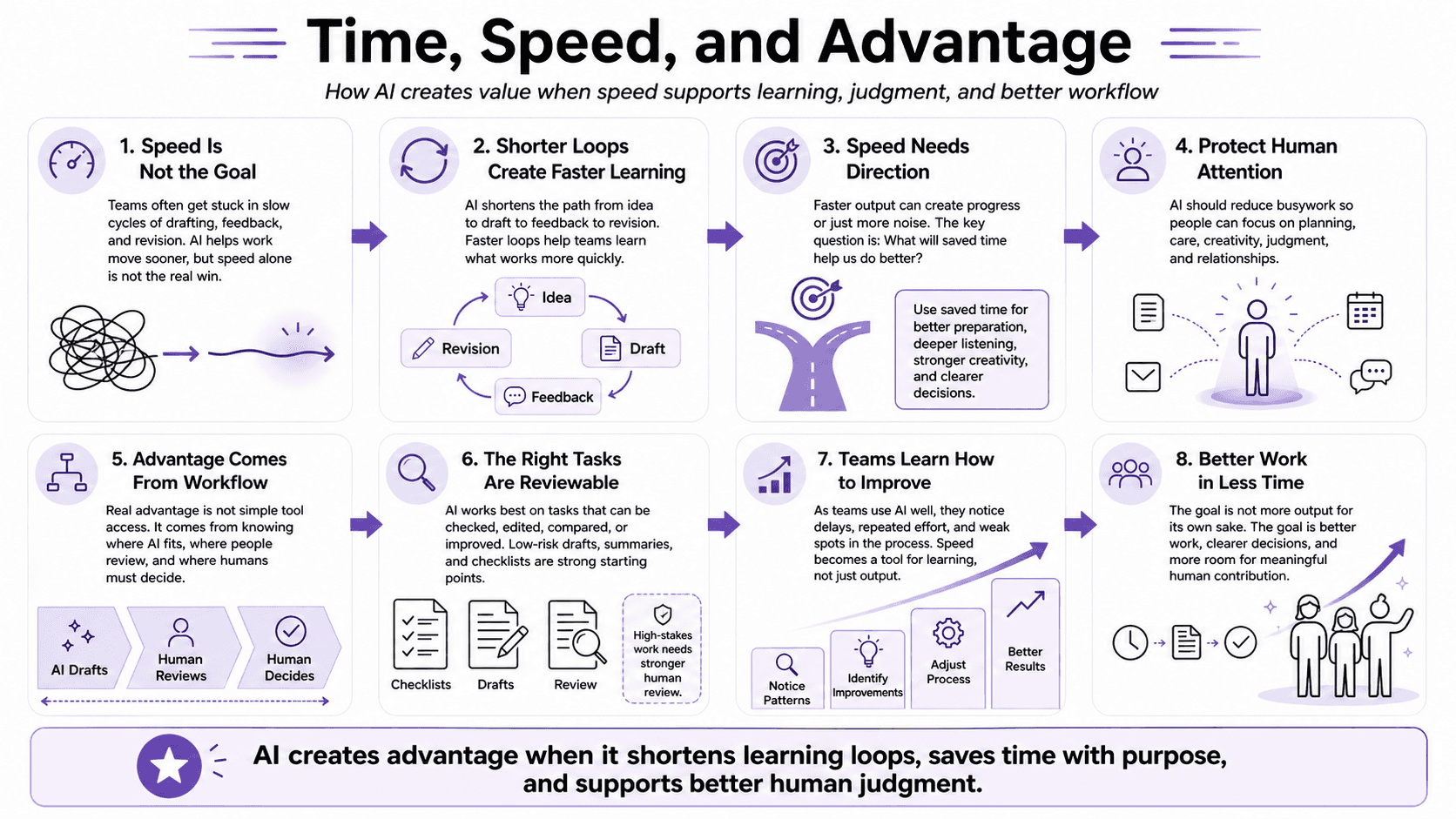
When teams first begin using AI, it is easy to focus on speed. Faster drafts, faster summaries, faster responses, and faster planning can all feel like progress. But speed by itself is not the goal. The real goal is better work, clearer thinking, and more useful learning. AI becomes valuable when it helps people move through the work with more focus, not when it simply helps them produce more.
A small team begins with a familiar problem. Their work is important, but everything moves slowly. A new idea takes days to become a draft. Feedback comes late. Revisions get pushed behind meetings, emails, and urgent requests. By the time the team improves the original idea, the moment has almost passed. They are not lazy or careless. Their work is simply trapped in a slow cycle.
AI can change the rhythm of that cycle. It can help turn rough notes into a first draft, summarize feedback, organize options, prepare a response, or compare different versions of an idea. This does not mean AI should finish the work by itself. It means people can reach the first usable version faster. When that first version appears sooner, the team has more time to review, discuss, adjust, and improve.
The real value is not just that work gets done faster. The real value is that learning happens sooner. A team can move from idea to draft, from draft to feedback, and from feedback to revision in less time. Each pass teaches them something. They learn what is clear, what is confusing, what the audience needs, what the customer is asking for, or what the project is missing.
For example, a community leader preparing a donor message could ask AI for three possible drafts. One may sound too formal. One may be too vague. One may have the right structure but need a more human tone. Instead of staring at a blank page, the leader now has material to review. The human still brings the mission, the relationship, the context, and the final decision. AI simply helps the person reach the review stage faster.
Faster is not always better. A team can use AI to create more emails, more reports, more meeting notes, more ideas, and more options than anyone can use. That kind of speed creates clutter. It fills the day with output, but not necessarily with progress. People may feel productive while still avoiding the harder work of choosing, listening, deciding, and following through.
This is why every use of speed needs a purpose. Before a team uses AI to save time, they should ask what that saved time is meant to support. Will it create better preparation before a meeting? Will it give staff more room to listen to people? Will it help leaders make clearer decisions? Will it reduce delays in serving someone? When the answer is not clear, the team may simply be moving faster in the wrong direction.
The best use of AI does not remove human attention from important work. It protects human attention for the places where it matters most. AI may help organize meeting notes, draft a first response, create a checklist, summarize comments, or prepare options. But people still need to notice what is sensitive, what is missing, what is unfair, what is inaccurate, and what requires care.
This matters because time saved can quickly become time filled. If a tool saves one hour, but that hour is immediately replaced with more noise, the team has not gained much. The better move is to decide where that hour should go. It might go toward planning, coaching, deeper review, relationship building, creative thinking, or clearer follow-up. Speed should make people more present, not more scattered.
Real advantage does not come from simply having access to AI. Many people can open the same tools. The advantage comes from knowing where the tool belongs in the work. A strong team understands which tasks can be sped up, which tasks need review, and which tasks must stay human-led. The tool is useful, but the workflow is what makes it responsible.
A better workflow might be simple. AI creates the first draft. A person checks the facts. Another person reviews the tone. The final owner decides whether it is ready. In another situation, AI summarizes repeated feedback. The team looks for patterns. A leader decides what action to take. In each case, the tool helps move the work forward, but people remain responsible for meaning, quality, and consequence.
AI works best when the output can be checked. A summary can be compared to the original notes. A draft can be edited for voice and accuracy. A checklist can be tested against the actual process. A set of ideas can be judged against the goal. These are strong starting points because the human can inspect the result and decide what to keep, change, or reject.
Tasks become more risky when people cannot easily tell whether the AI output is true, fair, complete, or appropriate. If the work involves legal claims, medical guidance, major financial choices, confidential information, employment decisions, or sensitive human situations, speed should not be the first concern. Those tasks may still involve AI for preparation or organization, but they require stronger human review and clearer boundaries.
Over time, a team that uses AI well becomes more aware of its own work. People begin to notice which tasks repeat, which steps create delays, which drafts always need the same kind of cleanup, and which decisions require more human care. AI becomes a mirror for the workflow. It shows where work can move faster, but it also reveals where the process itself needs improvement.
This is where speed becomes a learning tool. The team is not just trying to produce more. They are learning how to work better. They test a process, review what happened, make a small change, and try again. Each cycle gives them more clarity. The goal is not constant acceleration. The goal is a steady rhythm where people can act, learn, revise, and serve with more focus.
By the end of this shift, the team does not see AI as a shortcut around responsibility. They see it as a way to create better conditions for responsibility. The tool helps them get started faster, compare options sooner, reduce repetitive effort, and make room for stronger human judgment. They are not asking, “How much can we automate?” They are asking, “Where can this help us do better work?”
That is the heart of the advantage. AI can save time, but saved time only matters when it is used with purpose. Faster loops help teams learn. Clear direction keeps speed from becoming noise. Strong workflows show where AI fits and where people must stay involved. When those pieces come together, AI does more than make work faster. It helps people improve the work itself.