
Let’s explore what happens when people see a disruptive technology growing and still choose to watch from the sidelines. Watching can feel responsible because it looks cautious, mature, and measured. Sometimes caution is wise. But history shows that when a technology changes how value is created, waiting too long can become its own decision.
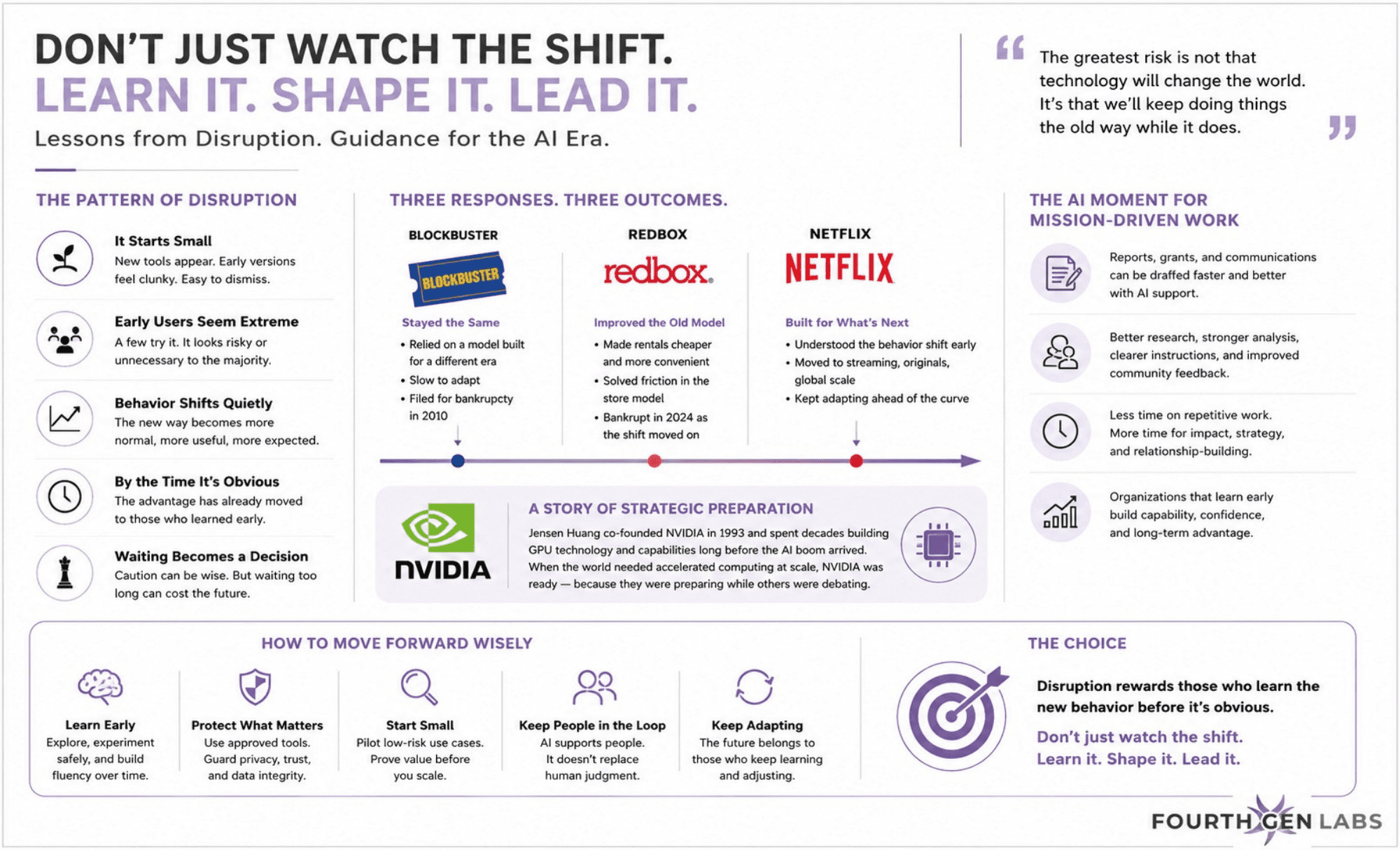
Disruption does not usually arrive as one dramatic moment. It often begins as something small, inconvenient, or easy to dismiss. A new tool appears. Early users seem excessive. The first version feels clunky. The established players have reasons to believe their current model is safer. Then, over time, the new behavior becomes normal. By the time the market agrees that the change is real, the advantage has already shifted toward the people who practiced early.
The Blockbuster, Redbox, and Netflix story is useful because it shows three different relationships to disruption. Blockbuster was once the familiar giant in movie rentals, with physical stores, customer habits, and a brand people knew. But the company’s model depended on customers coming into stores, browsing shelves, and returning physical media. As consumer behavior shifted, Blockbuster did not move fast enough to redefine the experience. In September 2010, Blockbuster filed for Chapter 11 bankruptcy protection.
Redbox saw part of the change more clearly. It understood that many customers still wanted physical DVDs, but they wanted cheaper rentals, easier access, and less friction. The kiosk model was a smart response to the weaknesses of the store model. A customer could rent a movie outside a grocery store or pharmacy without walking through aisles or dealing with the traditional rental experience. Redbox was not late to every shift. It found a better version of the old world.
But Redbox still remained tied to physical media at a time when the deeper shift was moving toward digital access. That matters because improving the old model is not the same as preparing for the next model. Redbox eventually faced the same larger pressure that had changed the industry around it. Its 2024 bankruptcy case in Delaware became part of a liquidation process, showing that even a smarter version of the old system can be overtaken when the underlying behavior keeps moving.
Netflix took a different path. It began in 1997 and became known for disrupting the Blockbuster video-rental model before growing into one of the world’s leading entertainment services. The real lesson is not only that Netflix used better technology. The deeper lesson is that Netflix understood the customer behavior shift earlier and kept adapting its operating model around that shift. It moved from physical delivery to on-demand streaming, then into original content, global distribution, and data-informed entertainment strategy.
The lesson is not that every company should become Netflix. The lesson is that disruptive technology rewards the people and organizations that learn the new behavior before it becomes obvious. Blockbuster had brand recognition. Redbox had convenience. Netflix built around the direction the world was moving. That is the difference between protecting yesterday’s advantage and building tomorrow’s.
You can see a similar pattern in the career of Jensen Huang and NVIDIA. Huang co-founded NVIDIA in 1993 and has remained its president and CEO since the beginning. Under his leadership, NVIDIA became central to GPU technology and later took center stage in the artificial intelligence boom. That did not happen because the AI boom suddenly appeared and NVIDIA got lucky. It happened because the company spent years building capabilities that became far more valuable once the world needed accelerated computing at scale.
That is what strategic preparation often looks like. It does not always look exciting in the beginning. It looks like paying attention before the reward is obvious. It looks like learning the language of a new tool while other people are still debating whether the tool matters. It looks like understanding the direction of change before the market has agreed on the playbook. By the time everyone understands the opportunity, the early learners already have context, confidence, and a clearer sense of what is possible .
That is where professionals and organizations are right now with AI. Some people are waiting for the perfect policy, the perfect training, the perfect tool, or the perfect proof that this is worth their attention. Meanwhile, others are quietly learning how AI is changing preparation, communication, research, analysis, documentation, training, and decision support. They may not be posting about it publicly. They may not be calling it transformation. But they are beginning to understand a shift that will affect how work gets done.
For mission-driven professionals, the cost of watching may not look like a company disappearing overnight. It may look quieter. It may look like spending too many staff hours on reports that could eventually be drafted faster. It may look like missing grant opportunities because the writing process takes too long. It may look like slower donor communication, unclear volunteer instructions, delayed board updates, or community feedback that gets collected but never fully analyzed. It may look like talented people burning out because too much of their time is trapped in work that could be better supported.
This does not mean every person needs to rush into AI or use it everywhere. Rushing can create its own problems. An organization that adopts AI without understanding can create confusion, privacy risk, low-quality work, or damage to trust. A staff member who puts sensitive client, student, donor, personnel, financial, or organizational information into an unapproved tool may create harm without meaning to. A leader who uses AI for quick answers without review may create polished work that is inaccurate, insensitive, or disconnected from reality.
That is why the real choice is not between watching and rushing. The better choice is preparation. Preparation means learning what AI is before depending on it. It means understanding why AI can feel powerful before trusting it. It means knowing what AI cannot replace before handing too much authority to it. It means recognizing that adoption is already happening before pretending this moment can be ignored. Preparation gives people a calmer, wiser way to respond to change.
The advantage is not simply that some people use AI. The advantage is that some people are developing a better understanding of the balance between human and machine. They are learning that AI can help with drafting, summarizing, comparing, organizing, and rehearsing. They are also learning that human judgment remains essential for trust, ethics, accuracy, relationships, and accountability. That balance is the real skill. A person who uses AI recklessly may move fast and still create risk. A person who refuses to learn about AI may preserve old standards while slowly losing pace. The goal is neither avoidance nor overuse. The goal is disciplined understanding.
This is already showing up in workplace research. Microsoft’s 2026 Work Trend Index reported that 58% of AI users said they were producing work they could not have produced a year earlier, rising to 80% among the most advanced AI users in its research. The same report found that the advantage is no longer only about access to tools. It is increasingly about how work is redesigned around AI, with human oversight, judgment, and direction still at the center.
That point matters because no one is going to hand every professional the perfect blueprint. By the time a clear blueprint exists, it is usually common knowledge. And once it becomes common knowledge, it is no longer a real advantage. The people who understand the shift earlier are better prepared to ask better questions. They can see risk more clearly. They can recognize opportunity more calmly. They can participate in shaping standards instead of only reacting to standards created by someone else.
For a consultant, this shift may eventually affect how discovery calls become client briefs and proposals. For an HR leader, it may affect how manager guides, employee communications, and policy explanations are created. For an operations leader, it may affect how messy handoffs become cleaner process maps and standard operating procedures. For a nonprofit director, it may affect board updates, grant outlines, donor messages, and program reports. For an educator, it may affect lesson supports, parent communications, discussion questions, and differentiated explanations for students. The point at this stage is not to decide exactly where to use AI. The point is to understand that the landscape of work is changing.
The main takeaway is that watching feels safe, but it can quietly become expensive. Rushing feels bold, but it can create risk when it is not guided by judgment. Blockbuster protected an old model for too long. Redbox improved the old model but remained tied to a behavior that was fading. Netflix and leaders like Jensen Huang show the other side of disruption: those who understand the direction of change early can build a kind of readiness that others struggle to catch. AI is creating that kind of readiness gap right now. This course is designed to help close that gap with understanding first, practice second, and responsible application after that.