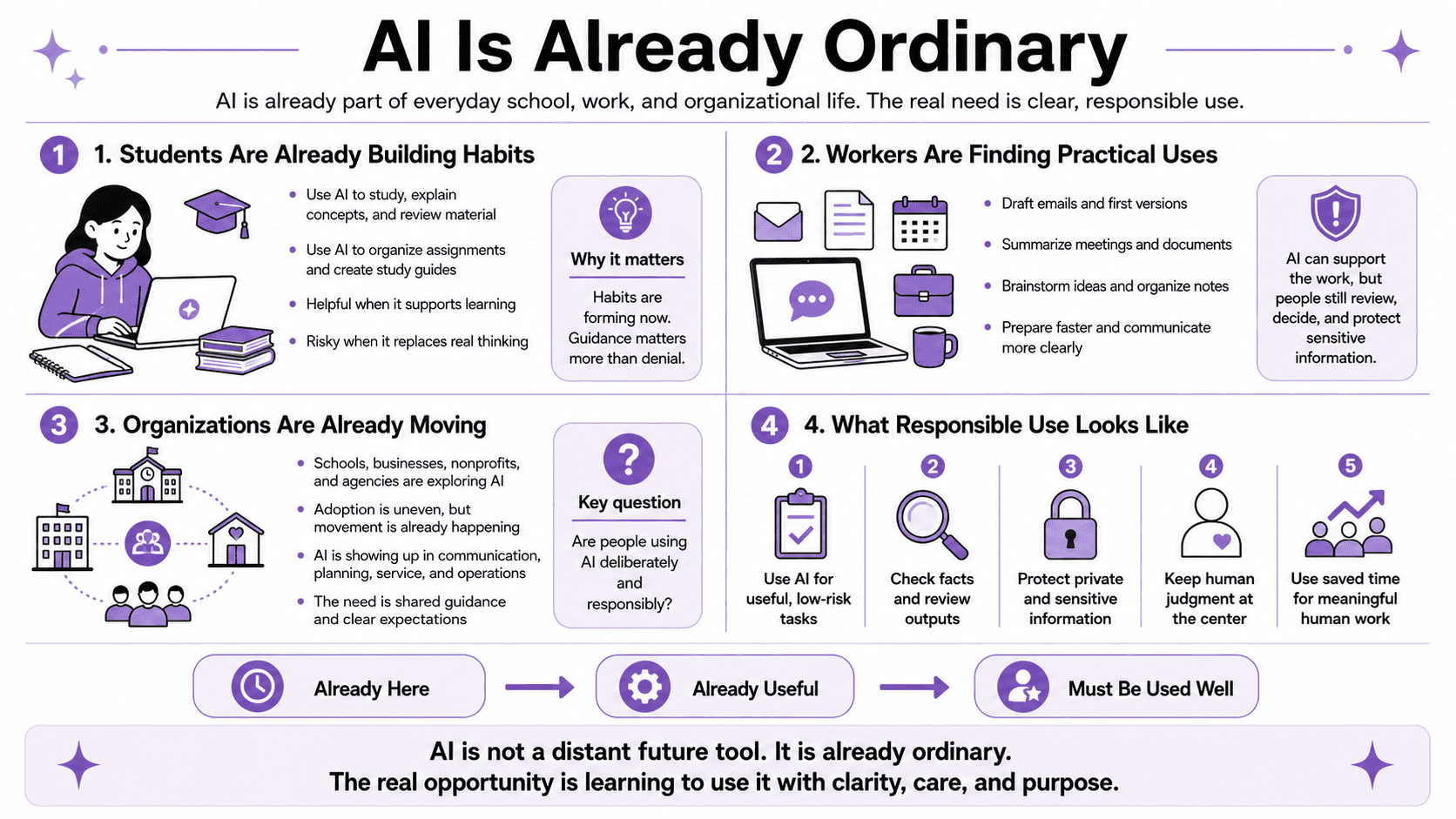
AI is no longer a distant idea, a technical topic only for experts, or something people may encounter someday. It has already become part of everyday life. People now use AI to answer questions, explain ideas, write drafts, summarize information, plan their day, organize messy notes, and move past moments of confusion. This matters because AI adoption is not waiting for everyone to feel prepared. It is already showing up in classrooms, workplaces, homes, nonprofits, businesses, and community spaces. The important question is no longer, “Will people use AI?” The better question is, “Will people learn to use it clearly, carefully, and responsibly?”
Students are one of the clearest examples of this shift. Many are already using AI to study, write, explain difficult concepts, check their understanding, organize assignments, and prepare for tests. A student who once had to sit alone with confusion can now ask AI to explain a topic in simpler language, create practice questions, compare two ideas, or turn scattered notes into a study guide. This can support learning when it helps students think more clearly, practice more effectively, and understand material more deeply. It can also become harmful when students use it to avoid thinking, hide weak understanding, or submit work they did not truly create.
Because students are already using AI, adults cannot lead well by pretending it is rare. Educators, parents, leaders, and employers need to guide the habits that are forming now. Students need to understand when AI can be used as a study support and when it crosses an academic or ethical line. They need to know that asking for an explanation is different from letting a tool complete the full assignment. They also need to learn how to check AI output, question it, and use it to strengthen their own thinking instead of replacing it. Clear guidance protects learning better than silence does.
Workers are also finding practical uses for AI in everyday tasks. Many people are not using it for dramatic or futuristic work. They are using it for ordinary responsibilities that already fill the day, such as drafting emails, summarizing meetings, preparing agendas, organizing notes, brainstorming options, writing first drafts, and making long information easier to understand. For a busy employee, AI can reduce the blank-page problem. It can turn rough ideas into a useful starting structure. It can help someone prepare faster, communicate more clearly, and move from confusion to action.
Some workplace AI use is official, approved, and supported. Some of it is quiet. A worker may use a public AI tool because it helps them move faster, even if the organization has not clearly explained what is allowed. That creates risk. Someone might paste sensitive information into the wrong tool. Someone might trust an answer without checking it. Someone might send a polished message that sounds correct but contains inaccurate details. This is why teams need shared expectations. AI can help with drafting, summarizing, and organizing, but people must still review the work, protect private information, and take responsibility for the final result.
Organizations are also adjusting to this shift. Schools, businesses, nonprofits, agencies, and teams are exploring AI across many functions. Some are training staff. Some are creating policies. Some are testing tools in small, careful ways. Others are moving slowly because they are unsure what is safe, useful, or appropriate. This uneven movement is normal, but it does not change the larger reality. AI is already entering the daily systems of learning and work. It is appearing in communication, planning, service, operations, research, teaching, documentation, and decision support.
The organizations that handle this shift well will not be the ones that simply chase every new tool. They will be the ones that create clarity. People need to know what AI is useful for, what it should not be used for, what information must stay protected, when human review is required, and when a task should remain fully human. Leaders also need to explain the purpose behind AI use. The goal should not be speed for its own sake. The goal should be better preparation, clearer communication, stronger service, wiser use of time, and more room for meaningful human work.
AI becoming ordinary does not mean it should be used carelessly. Ordinary tools can still create real consequences. AI can be wrong. It can sound confident while missing important facts. It can make weak thinking look polished. It can create privacy concerns when people share the wrong information. The responsible path is not fear, and it is not blind excitement. The responsible path is guided practice. People need to try AI on useful, low-risk tasks, review what it gives them, learn where it helps, notice where it fails, and keep human judgment at the center. AI is already part of everyday life. Now people must learn how to use it with purpose.