
If AI cannot replace judgment, then the next question is not whether people should ignore it. The better question is who is already learning to use it, where it is showing up, and what happens to professionals and organizations that wait too long to build their own responsible way of working with it.
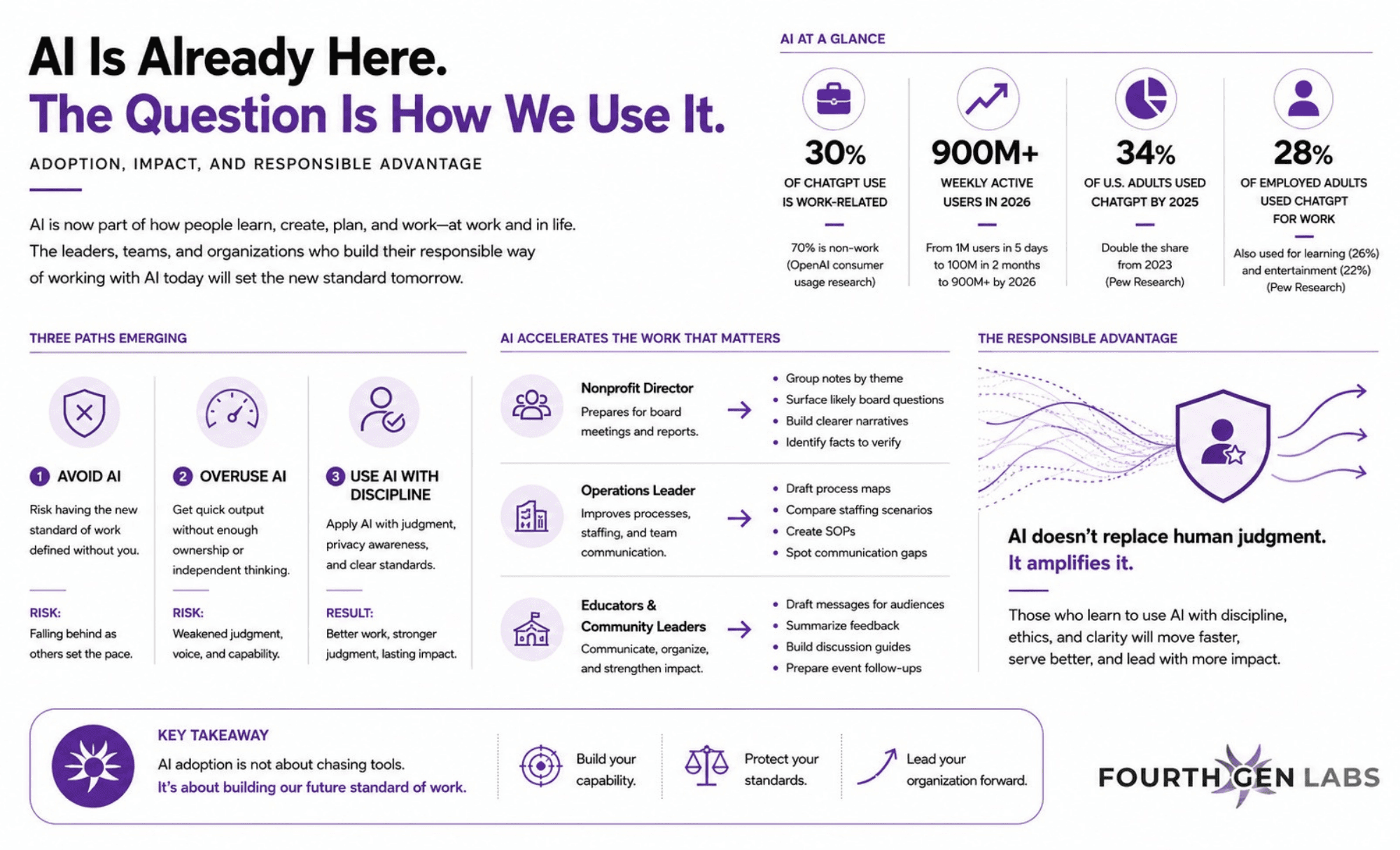
AI is no longer a tool used only by technical experts, early adopters, or people experimenting after work. It is becoming part of everyday life. People use it to learn, write, plan, compare options, explain confusing ideas, organize personal tasks, prepare for meetings, brainstorm business ideas, study, code, research, and make decisions. OpenAI’s consumer usage research found that about 30% of ChatGPT use is work-related and about 70% is non-work. That means AI is not only entering the workplace. It is entering the way people think, learn, create, and manage life outside of work as well.
The growth curve helps explain why this matters. ChatGPT reached 1 million users in five days, 100 million users within two months, and more than 700 million weekly active users by 2025. OpenAI later reported more than 900 million weekly active users in 2026. The public reporting has moved between different measures over time, including monthly users and weekly active users, but the larger point is clear: this is not slow adoption. This is one of the fastest shifts in technology behavior most professionals have ever lived through.
That speed is important because AI adoption is not only about using a new tool. It is about people discovering new ways to get work done. In the early days, skepticism made sense. The tools were impressive, but they often required a lot of back and forth. A user could spend so much time correcting, clarifying, and reshaping the output that the time savings did not always feel worth it. Today, the tools are more capable, more connected, and more useful across real workflows. The question is no longer simply whether AI can produce useful output. The deeper question is how work should be structured when AI can help people draft, summarize, analyze, prepare, and create faster than before.
This is why the question “Is this even valuable?” is becoming less useful. The more useful question is “Where is this already changing the baseline?” Pew Research found that 34% of U.S. adults had used ChatGPT by 2025, about double the share in 2023. Among adults under 30, that number was 58%. Pew also found that 28% of employed adults had used ChatGPT for work, while 26% of U.S. adults had used it to learn something new and 22% had used it for entertainment. Those numbers show a pattern that is bigger than workplace productivity. AI is becoming a normal part of how people explore, prepare, and solve problems.
For mid-career professionals, educators, nonprofit leaders, community leaders, managers, and executives, this creates a quiet but serious gap. A person who knows how to use AI well can move through the early stages of work faster. They can turn meeting notes into decisions, turn rough ideas into an executive brief, test a message against possible objections, compare strategic options, and prepare for conversations with more clarity. The same person without AI may still be capable, experienced, and intelligent, but they may be spending too much time on work that could now be accelerated.
This does not mean the AI user is automatically better. A person can also overuse AI and weaken their judgment, their voice, or their ability to think independently. There are really three categories emerging. There is the person who avoids AI completely and risks having the new standard of work defined without them. There is the person who overuses AI and gets quick output without enough ownership. Then there is the person who uses AI with discipline, judgment, privacy awareness, and standards. That third person is the one this course is trying to develop.
Consider a nonprofit director preparing for a board meeting. Without AI, she may spend hours reviewing program notes, donor updates, community feedback, budget concerns, and staff recommendations before drafting the first version of the report. With AI, she can ask for the notes to be grouped by theme, ask for possible board questions, create a clearer meeting narrative, and identify which facts still need to be verified. The advantage is not that AI makes the decision for her. The advantage is that she gets to a better starting point faster and has more time for judgment.
Or consider an operations leader inside a growing organization. He may need to update a messy process, prepare a staffing recommendation, respond to repeated service issues, and create clearer handoffs between teams. AI can help turn scattered notes into a draft process map, compare two staffing scenarios, write a first version of a standard operating procedure, and identify where communication is breaking down. If he waits for someone else in his industry to figure this out first, he will eventually learn from someone else’s playbook instead of building his own.
The same pattern applies in education and community work. A school leader might use AI to prepare a parent communication, summarize survey feedback, draft a staff discussion guide, or create multiple versions of an explanation for different audiences. A community program manager might use AI to organize listening session notes, outline a grant narrative, create volunteer instructions, or prepare a follow-up message after an event. In each case, the value is not that AI replaces the human relationship. The value is that it can reduce the friction around preparation, communication, and organization so the human can give more attention to trust, clarity, and care.
This is the deeper reason adoption matters. AI is not arriving evenly. Some people are using approved tools with training and support. Others are using public tools quietly because they help them move faster. Some organizations have clear policies, while others have no shared expectations at all. Consumer use is spreading into work, with people bringing familiar tools into professional settings before every organization has fully caught up. That creates opportunity, but it also creates risk when people use AI without boundaries, privacy awareness, or review.
The competitive advantage is becoming more visible. Microsoft’s 2026 Work Trend Index found that 58% of AI users said they were producing work they could not have produced a year earlier, and that number rose to 80% among the most advanced AI users in its research. The same report showed that many workers can feel the shift before their organizations have fully built the structures to support it. That tension matters. People are experimenting, but many workplaces have not yet created enough shared language, policy, training, and standards to help them use AI well.
This is why responsible adoption is better than random experimentation. Responsible adoption means you do not use AI everywhere just because you can. It means you identify where AI can help, where it could create risk, and where human judgment must remain fully in charge. It also means being careful with sensitive information. If the task involves private client details, student information, donor records, personnel issues, financial records, legal matters, or confidential organizational data, the question is not only “Can AI help?” The question is “Can I use AI here safely, legally, ethically, and with approval?”
The core discipline for this lesson is the AI Adoption Map. Before trying to use AI everywhere, identify one part of your work where AI could create immediate leverage. Look for a repeated task, a decision that requires preparation, a communication pattern that takes too much time, or a workflow where information keeps arriving messy and unclear. Then ask three questions: where can AI help me move faster, where can AI help me think better, and where must human judgment remain fully in charge? This turns adoption from a vague trend into a practical leadership decision.
The main takeaway is that AI adoption is no longer something to watch from a distance. People are already using it to reshape learning, communication, planning, analysis, creativity, and execution. You are not behind because you have questions, and caution is not a weakness. But this is a decision point. The goal is not to panic, chase every tool, or outsource your thinking. The goal is to carve your own responsible path before someone else defines the standard in your lane.