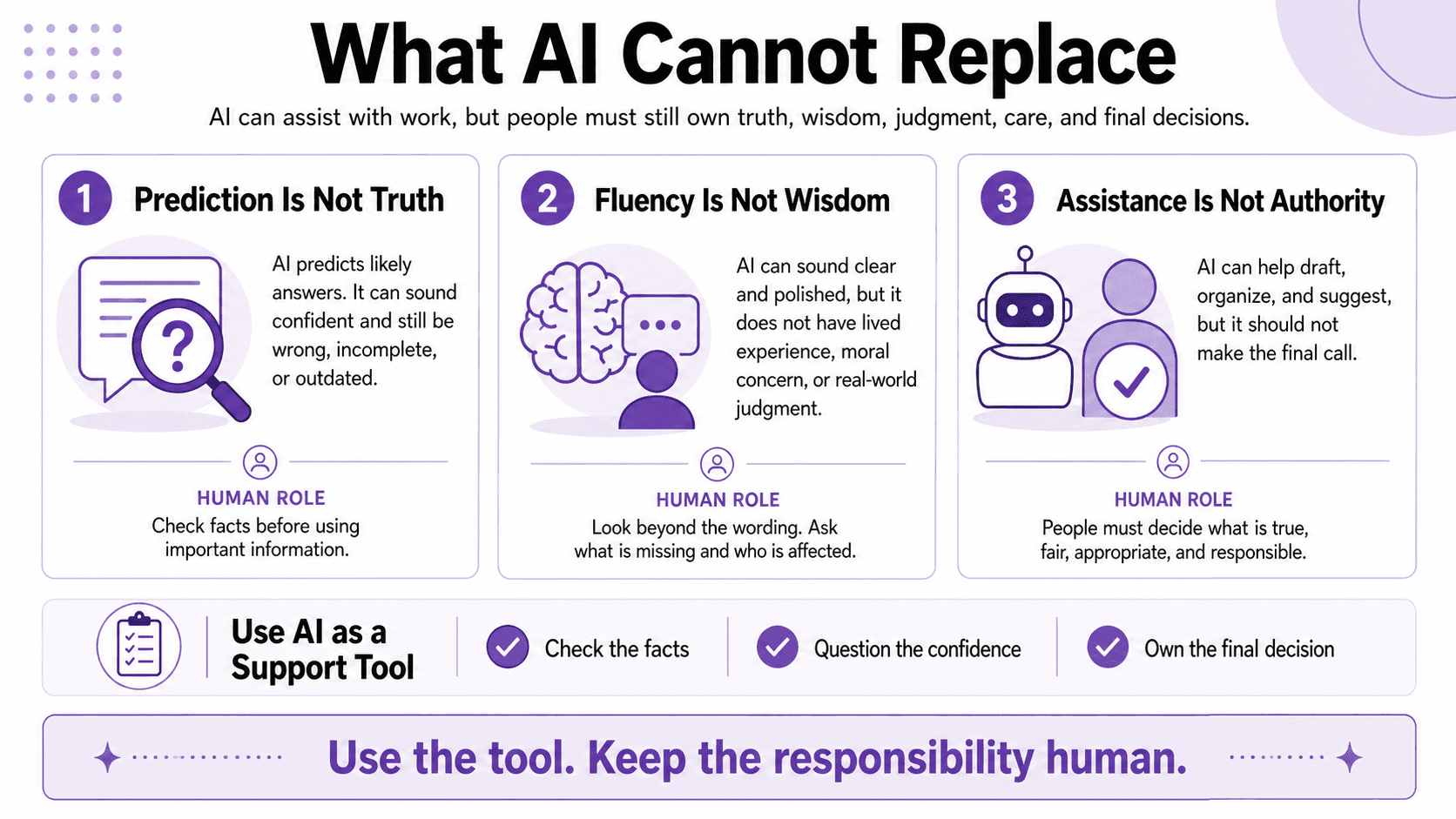
AI can be a powerful support tool, but it should never replace human responsibility. This lesson focuses on an important truth: AI can help people work faster, think through ideas, and create useful first drafts, but the person using it remains responsible for what happens next. Learners should understand from the beginning that AI is not a substitute for judgment, ethics, care, or accountability. It can assist with the process, but it cannot carry the responsibility for the outcome.
AI can be useful because it helps people move faster. It can draft an email, summarize notes, organize ideas, suggest options, and create a first version when the blank page feels difficult. That kind of support can save time and reduce friction. But speed is not the same as responsibility. AI can help with the work, but it cannot own the result. The person using it still has to decide whether the output is true, useful, fair, appropriate, and ready to be used.
AI works by recognizing patterns and predicting what output is likely to fit the request. That is why it can sound natural, confident, and well informed. It has been trained on many examples of how people write explanations, plans, messages, lists, and recommendations. When someone asks for help, AI uses those patterns to create a response that appears to match the request. This can be powerful, but it also creates a risk. A response can sound right without actually being right.
Because AI predicts, it can produce answers that are wrong, incomplete, outdated, or unsupported. It may give a false date, invent a detail, leave out needed context, or make a claim that sounds polished but has no solid backing. The danger is not only that AI can be wrong. The greater danger is that it can be wrong with confidence. People are more likely to trust an answer when it is written clearly, even when the answer has not been checked.
A responsible user treats AI output as a starting point, not as proof. When the output includes names, dates, numbers, quotes, policies, health guidance, legal claims, financial details, or decisions that affect people, those parts need to be verified. The question should not only be, “Does this sound good?” The stronger question is, “Can I confirm this, and am I willing to stand behind it?” AI can help prepare information, but important information still needs human review before it is shared or used.
AI can write in a smooth, thoughtful, and professional way. It can explain a difficult idea, soften a message, create a plan, or give advice that sounds balanced. But polished language is not the same as wisdom. AI does not have lived experience. It does not know what it feels like to lead a tense meeting, comfort a grieving family, rebuild trust with a team, serve a community, or face the consequences of a hard decision.
This means people should slow down when an AI response sounds especially impressive. A smooth answer can hide missing judgment. It may overlook the emotional weight of a situation. It may miss the history between people. It may suggest something that works on paper but would damage trust in real life. Human wisdom comes from context, care, memory, values, and accountability. AI can help organize thinking, but people must bring the deeper understanding.
AI should be treated as support, not as the final authority. It can help prepare a draft, organize options, summarize a meeting, compare ideas, or suggest next steps. But the human still has to decide what is true, what is fair, what is kind, what is safe, and what fits the situation. This is especially important when the work affects relationships, reputation, money, health, employment, safety, or trust.
For example, AI might help a manager draft feedback for an employee. It can make the message clearer or less harsh. But it cannot know the full history of that employee’s work, the tone of the relationship, the promises already made, or the impact the message may have. The manager must check the facts, adjust the tone, protect dignity, and take responsibility for the conversation. The tool may shape the words, but the person owns the decision.
The safest way to use AI is to keep the human role visible from beginning to end. Before using it, the person should know what kind of help they want. During use, they should guide the tool with clear context and boundaries. After the output appears, they should review it carefully, revise what is useful, and reject what is inaccurate, unsafe, insensitive, or beyond the tool’s proper role.
The heart of responsible AI use is simple: use the tool, but do not hand over your judgment. Let AI help with speed, structure, drafts, and options. Let people remain responsible for truth, wisdom, care, ethics, relationships, and final decisions. AI can multiply meaningful work when humans stay awake, thoughtful, and accountable. It becomes dangerous only when people mistake assistance for authority.