
In the last lesson, Ruthie Rose, began noticing that many of her choices were driven by default values she inherited early, long before she had the chance to decide what she truly believed. This lesson builds on that awareness by naming what happens next in real life: when old values start slipping and new ones have not fully formed yet. Transitional values are the values that emerge during seasons of change, especially when your current patterns no longer match your current needs. They often feel shaky at first, but they are the start of alignment taking shape.
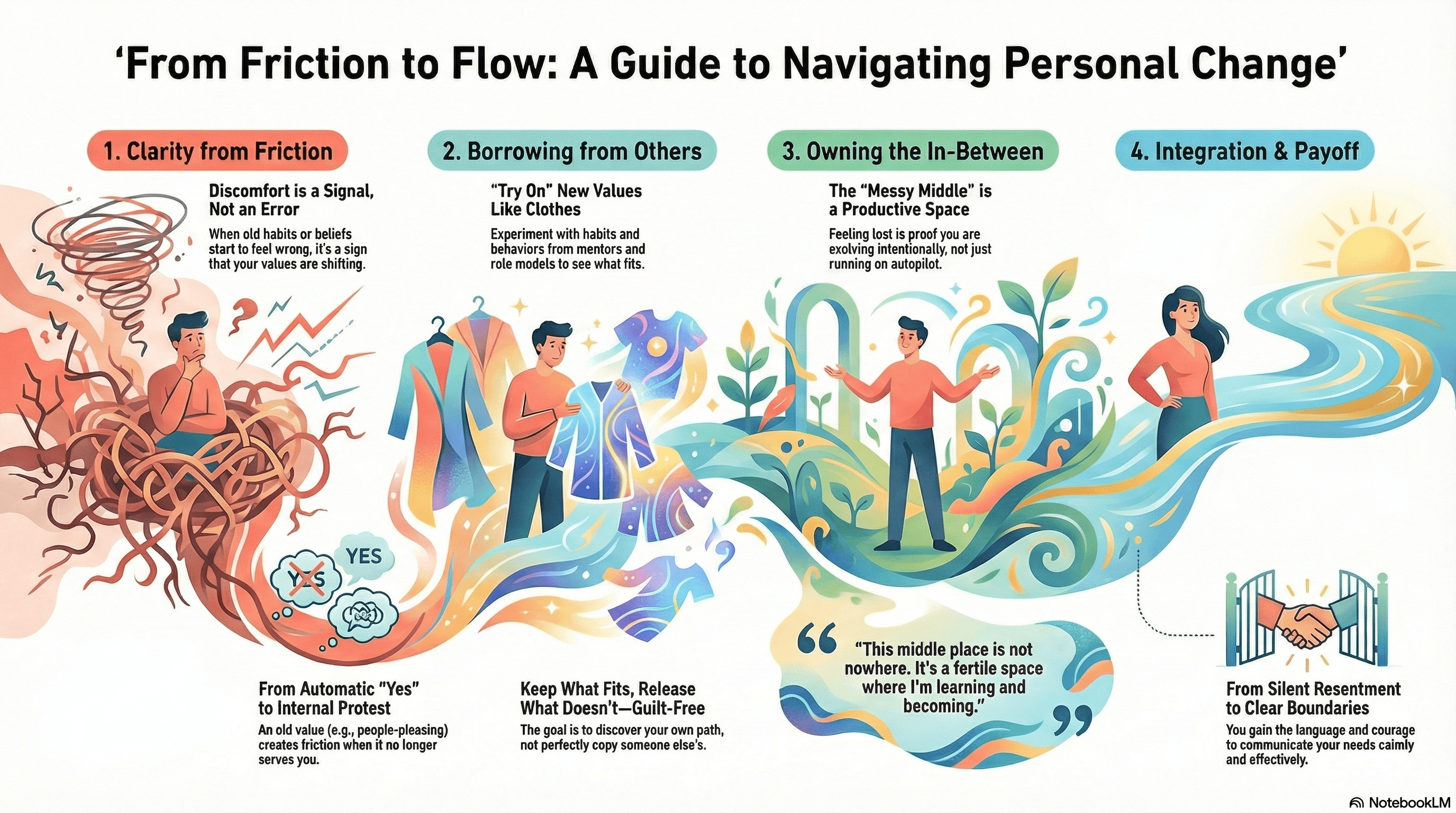
Ruthie learns quickly that transition rarely arrives with neat instructions. It shows up as friction, the internal resistance you feel when you try to operate the old way and your body or spirit pushes back. She notices it when she automatically says yes to extra work but feels resentful afterward, or when she agrees to a family expectation and then feels depleted for days. The key is to stop treating that friction like a personal flaw. Transitional values form when old ways of operating are no longer needed, so the discomfort is not proof you are failing; it is proof you are waking up. For Ruthie, friction becomes a signal that something new is being asked of her, like rest, honesty, spaciousness, or self respect.
To use friction as clarity, Ruthie has to learn the difference between growth discomfort and misalignment discomfort. Growth discomfort often has an aftertaste of expansion. You feel nervous, but also relieved, proud, or more like yourself once you follow through. Misalignment discomfort has an aftertaste of shrinkage. You feel heavy, tense, and drained because you violated your own needs to keep the peace or keep control. Ruthie begins paying attention to patterns: what decisions leave her energized versus exhausted, what conversations she replays in her mind, what commitments make her feel trapped. The goal is not to eliminate discomfort, but to let discomfort teach you where your values are shifting so you can stop forcing what no longer fits.
As Ruthie practices this, she realizes that transitional values rarely arrive fully formed. They arrive like a draft, and drafts require testing. This is why borrowed values are so common in transition. When you do not yet trust your own emerging voice, you borrow language, boundaries, and frameworks from people who seem grounded. Ruthie watches a colleague calmly decline a meeting without apologizing, and she borrows the phrasing: “I cannot commit to that right now, but I can offer this instead.” She listens to a mentor describe how they protect their mornings, and she experiments with guarding her first hour of the day. Borrowing is not weakness; it is how you gather options while your own values are still taking shape.
The discipline here is to borrow without becoming someone else. Ruthie learns to test alignment by asking simple questions after she tries something new: Did this make me feel more honest or more performative? Did it nourish me or did it drain me in a new costume? Would I keep this practice even if no one praised me for it? Sometimes what she borrows fits immediately, like speaking more directly or honoring her limits. Sometimes it does not, like adopting a rigid routine that makes her feel controlled rather than cared for. The lesson is to release what was only meant for a specific season without judgment, because not everything you try is meant to become a permanent value.
Owning the in-between is the part most people try to skip, and it is where Ruthie has to be the most patient with herself. The in-between feels uncomfortable because your language and identity are still forming, so you can feel like you are constantly explaining yourself, even to you. Ruthie notices she is no longer the version of herself who overextends to be liked, but she is also not yet fully confident in her new boundaries. This can create loneliness, pushback from others, and self doubt that whispers you should go back to what was familiar. Owning the in-between means telling the truth about where you are without rushing to prove that you have arrived. It is letting the tension be evidence that you are paying attention and growing intentionally.
To support herself in this season, Ruthie practices self nourishment as a stabilizer, not a reward. She begins treating rest, solitude, and honest reflection as part of the work, because clarity does not form in constant noise. She keeps a short values check in that asks: What felt heavy this week, and what felt clean? Where did I abandon myself, and where did I honor myself? What did I borrow that helped, and what did I borrow that did not fit? She also chooses one small boundary to practice consistently, because repetition builds identity. Transitional values become real when they move from insight into action, especially in ordinary moments where the old you would have defaulted.
Ruthie is not expected to have everything figured out, and neither are you. The point is to recognize that transitional values are supposed to feel like a bridge, not a destination. Friction is not a warning that you are doing life wrong; it is a cue that you are ready to live differently. Borrowing from others is a normal part of learning, as long as you keep what aligns and release the rest without shame. Owning the in-between is how you protect your growth from panic and performance. This is the foundation for the next step, identifying non-negotiable values, because you cannot choose what you stand on until you understand what is shifting beneath you.