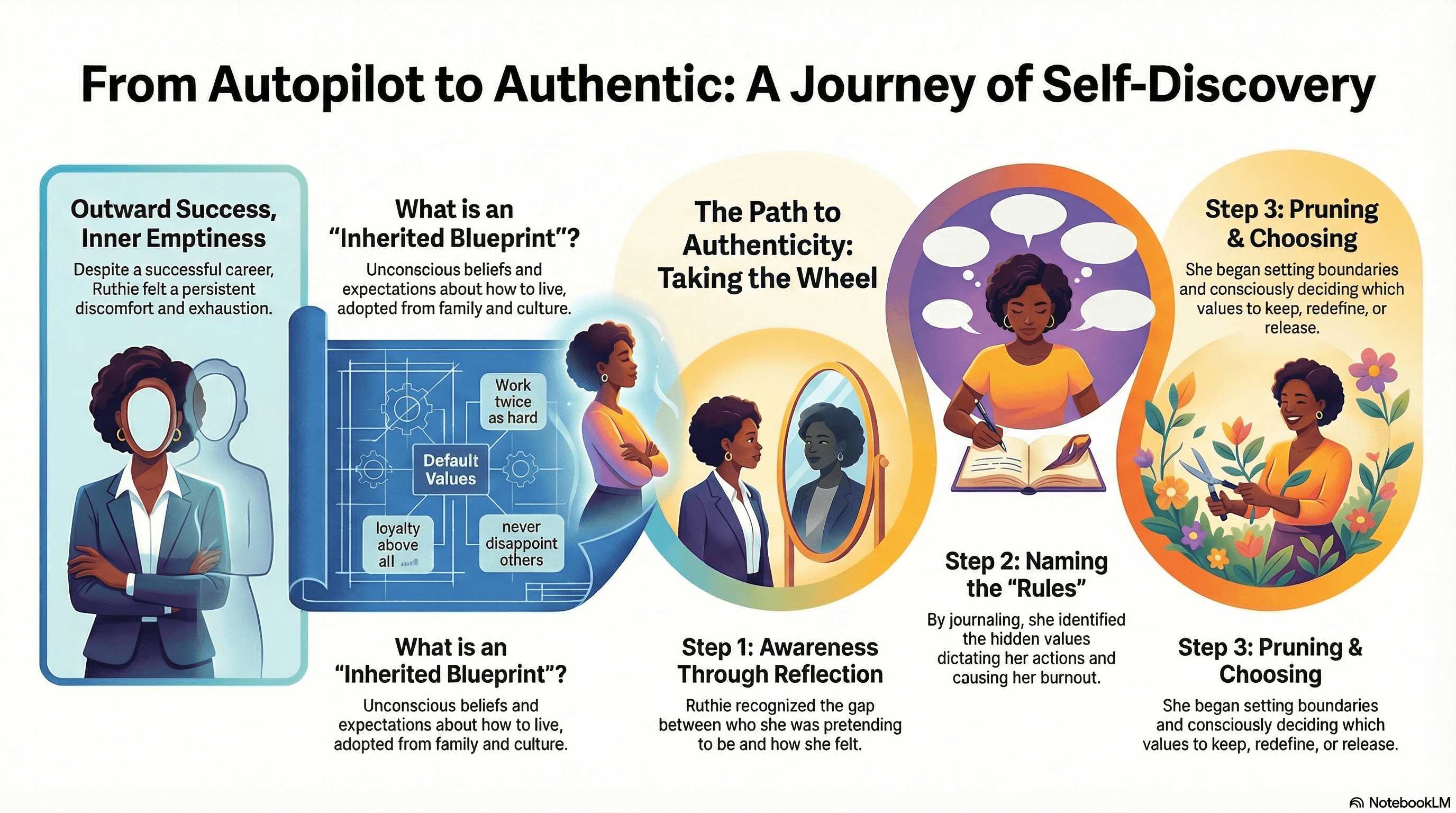

Default Values is where you will begin identifying what has been quietly driving your decisions long before you ever had language for it. Default values are the beliefs and priorities you absorbed early, often before you were old enough to choose them, and they can keep you moving on autopilot even when your life looks successful on paper. The character we are following is not falling apart, but she is noticing something important: her wins do not feel like wins anymore, her rest feels loaded with guilt, and her choices feel more like obligations than alignment. This lesson exists to help you do what Ruthie is learning to do: slow down, name what is running in the background, and reclaim your ability to choose what you stand on.
Default values form in environments where belonging mattered more than self-definition. You did not wake up one day and decide that being “easy to deal with” mattered more than being honest, or that productivity proved your worth, or that saying no was disrespectful. Those rules arrived through family roles, cultural expectations, religious messages, survival strategies, and what earned you praise or protection. Because they were given so early, many default values do not feel like values at all. They feel like reality. They sound like “that’s just how you do things,” or “that’s how we were raised,” or “I do not have a choice.” The first shift in this lesson is recognizing that a default value is not necessarily wrong, but it is unexamined, and anything unexamined can quietly become a life sentence.
Inherited Blueprints are the specific values you absorbed from your earliest systems. For Ruthie, the blueprint includes excellence as safety, loyalty as love, and strength as identity. She learned that respect looks like compliance, that being dependable earns approval, and that carrying more than your share is proof of character. These values helped her thrive in school, advance in her career, and be seen as the one people can count on. They also helped her survive in spaces where Black women are often judged more harshly and given less room to be human. This is why the lesson holds two truths at once: you can be grateful for what your inherited values protected, and still acknowledge that some of them may now be restricting your growth.
To identify your inherited blueprints, you have to study patterns, not just opinions. Look at what you get praised for and what you get criticized for, because praise and criticism are both teachers. Ruthie notices she is praised for being “so strong” and “so reliable,” but rarely for being rested, joyful, or creatively alive. She also notices what triggers guilt. When she takes a break, guilt shows up like an alarm. When she says no, her body tightens as if she is doing something dangerous. Those reactions reveal the blueprint. A practical way to start is to finish this sentence in multiple ways: “In my family, a good person is someone who…” and “In my community, you should always…” and “I feel anxious when I…” The answers are often your default values speaking.
Expectation Leads to Control when a value stops being a guide and starts being a cage. A value like loyalty can become self-abandonment when you stay in situations that drain you just to prove you are committed. A value like hard work can become burnout when you cannot stop without feeling worthless. A value like respect can become silence when you cannot tell the truth without fearing punishment. Ruthie sees this when she keeps accepting extra work, not because she has capacity, but because she cannot tolerate being seen as “not enough.” She tells herself she is being responsible, but the result is resentment, exhaustion, and a shrinking sense of self. This is the moment where a learner stops romanticizing their default values and starts assessing their cost.
You will know a default value has become controlling when it produces chronic tension instead of clarity. Pay attention to your body and your relationships. Do you feel resentment after saying yes? Do you feel fear when you consider setting a boundary? Do you keep overexplaining your needs because you believe they are inconvenient? Ruthie catches herself minimizing her achievements so no one feels threatened, then feeling invisible when she is overlooked. She notices she can solve complex problems at work, yet struggles to give herself permission to rest without justifying it. These are not random personality traits. They are value-driven behaviors. The point is not to shame yourself for them. The point is to see the mechanism clearly so you can decide whether it still deserves authority in your life.
Awareness Before Change is the foundation of this course because growth that skips awareness usually becomes performance or rebellion. You do not need to burn down your life to evolve. You need to name what has been managing it. Ruthie begins journaling her default values as statements, then tracking where they came from and how they show up today. She writes things like “My worth is tied to output,” “Rest must be earned,” and “Saying no makes me selfish,” then asks two questions: “Who taught me this?” and “What does it cost me now?” This practice turns fog into facts. Once a value is visible, you can keep it, refine it, or release it. You can also replace it with a chosen value that fits who you are becoming, such as “My worth is inherent,” “Rest is maintenance,” or “Boundaries protect my integrity.”
Default Values are not a problem to solve, they are a system to understand. This lesson asks you to separate what you inherited from what you now choose, to appreciate what once protected you without allowing it to dictate your future. Ruthie’s journey shows that clarity is not loud, it is honest. When you name your inherited blueprints, recognize where expectation has turned into control, and commit to awareness before change, you reposition yourself from autopilot to alignment. Take one default value this week, write it as a sentence, trace its origin, and tell the truth about its current impact. That single act of awareness is the beginning of choosing your seat, instead of earning it.