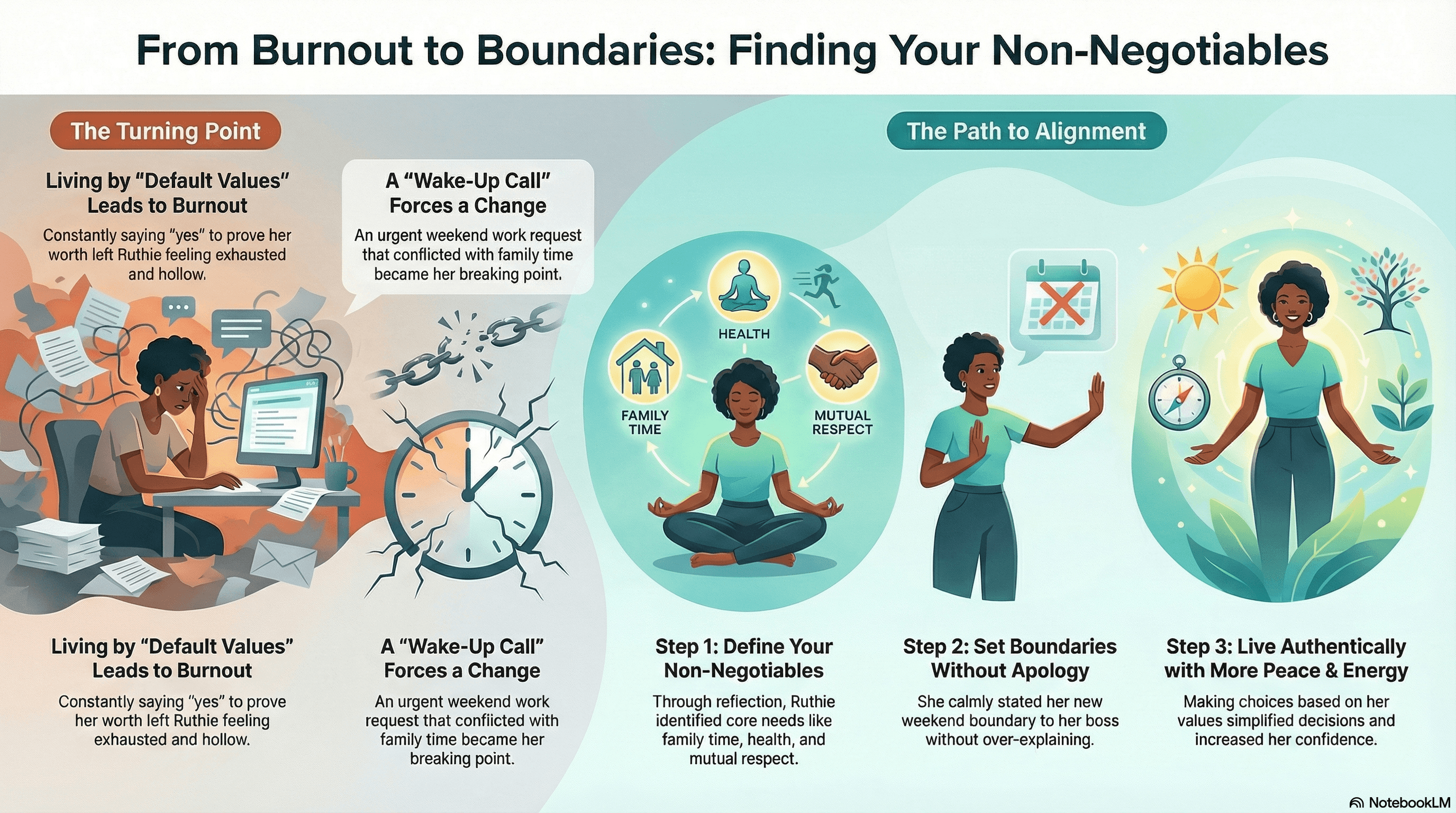

Lets learn how to identify the values you choose on purpose, the standards that define your boundaries, shape your decisions, and protect your peace. We will continue to follow Ruthie Rose, who is no longer willing to live on autopilot. She is successful on paper, but she is tired of feeling internally disconnected, and she is ready to reposition how she shows up with clarity and self-respect.
Non-negotiable values are different from the values you inherited and the values you tried on during transition. Default values often come from family, culture, and survival, and they can run your life quietly if you never examine them. Transitional values often form when old ways stop working and you are testing what fits, even if it feels awkward or uncertain. Non-negotiables are what remains when the noise clears. They are the values you will not bargain with, because you understand the cost of compromising them, and you refuse to keep paying that price.
For Ruthie, the clearest non-negotiables were not formed in childhood; they were earned. She learned them through lived experience, reflection, and consequences. She remembers the season when she kept saying yes at work while her body kept saying no, and she ignored the signals until she was depleted. She also remembers missing moments at home that she can never get back, and realizing she had been calling it “responsibility” when it was actually self-abandonment. That is how non-negotiables form: you face a truth you cannot unsee, and you decide you will not keep betraying yourself to maintain comfort, approval, or access.
To identify your own non-negotiables, start with the patterns that keep hurting you. Pay attention to what consistently triggers resentment, exhaustion, or a feeling of shrinking. Ask yourself where you keep overexplaining, where you keep tolerating what you would never advise someone you love to tolerate. Ruthie used a journal and wrote down the moments that made her think, “I cannot do this again,” then she traced each moment back to the value that was violated. When you do this, you separate preferences from values by looking at what you are willing to protect even when it costs you something, such as time, convenience, money, or someone’s temporary disappointment.
Once non-negotiables are clear, boundaries stop being a performance and start being a practice. Boundaries without apology are not loud, hostile, or defensive. They are calm, respectful, and specific because they are rooted in self-respect rather than fear. Ruthie did not need a long speech to justify why she would no longer work every weekend. She simply stated her limit and offered what she could do instead. When you know what you stand on, you do not need permission to stand there, and you do not need to beg to be understood.
This is where many people get stuck, especially when they have been conditioned to keep the peace at their own expense. Ruthie carried the extra weight many Black women carry in professional and family spaces: the fear of being labeled difficult, ungrateful, or too much. That fear tempts you to soften your boundaries until they disappear, then call it “being considerate.” Non-negotiables interrupt that cycle. They remind you that clarity is not cruelty, that saying no is not disrespect, and that your nervous system may protest at first because it is used to old patterns, not because your boundary is wrong.
When your non-negotiables are clear, consistency in action becomes easier. You stop negotiating with yourself every time someone asks for access, time, or emotional labor. Ruthie noticed she had more energy because she was no longer leaking it through indecision, guilt, and recovery from overextending. Her choices became more aligned because she was filtering decisions through what she values most, instead of reacting to urgency or people-pleasing. Consistency is not rigidity; it is integrity in motion, where your behavior matches what you say matters.
Non-negotiable values are the standards you choose on purpose after life has taught you what compromise really costs. They are earned through experience and confirmed through truth, and they create boundaries that do not require apology or approval. When you live from these values, your decisions become more consistent, your energy stabilizes, and your peace becomes something you actively protect rather than something you hope for. Use Ruthie’s example as a mirror: name what you will no longer compromise, practice one calm boundary that honors it, and let your repeated actions prove to you that you can be both kind and firm while becoming who you are.