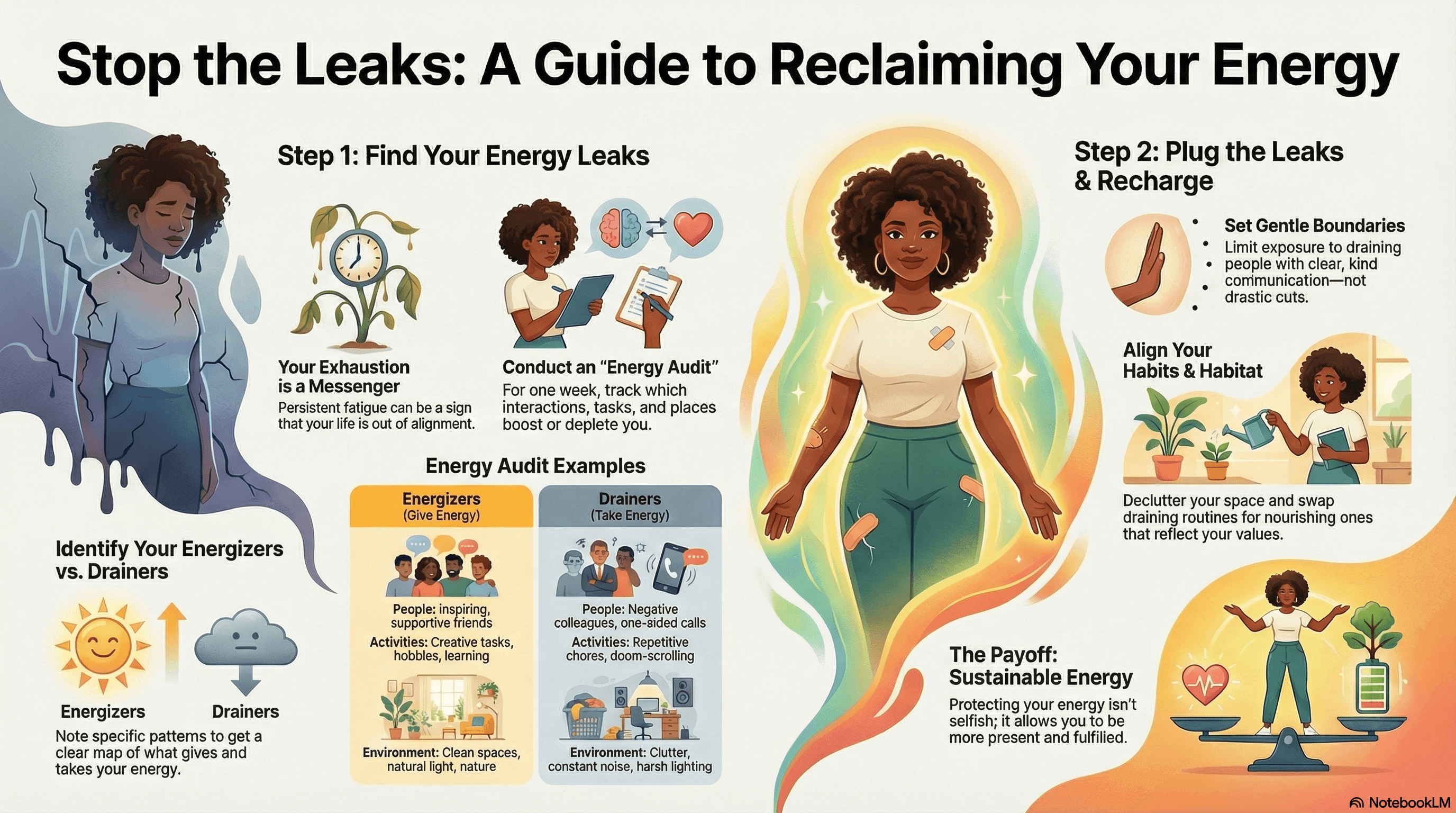

Energizers and Drains is where you will learn how to tell the difference between what truly feeds your life and what quietly pulls from it. Ruthie Rose is now entering a season where she is no longer willing to live on empty just because her life looks stable from the outside. She is not chasing a new version of herself for show, she is learning how to recognize what is real by paying attention to her energy. In this lesson, you will practice evaluating people, behaviors, and environments through the simplest and most honest lens available: how you feel after you engage. When you learn to read your energy like a signal instead of a mood, you gain clarity that does not require permission from anyone else.
Ruthie’s first clue was how often she felt tired even when she did everything “right.” She could sleep, eat reasonably well, handle her responsibilities, and still feel like she was dragging herself through the day. That is the difference between being tired and being depleted. Tired can be solved with rest, but depletion often points to misalignment, tension, or overexposure to things that take more than they give. To start building this awareness, notice what happens in your body and mind after certain moments: do your shoulders drop, do you breathe deeper, do you feel focused, or do you feel tight, scattered, and irritated. Ruthie realized her energy was not just a feeling, it was feedback that something in her daily life needed to be examined.
To make the feedback clear, Ruthie ran a simple energy audit for one week, and you can do the same. She kept a small note in her phone and wrote down two things after key moments: what she did or who she interacted with, and what her energy felt like afterward. She noticed patterns quickly because energy leaves a trail when you pay attention. A short meeting with a coworker who complained constantly left her heavy and foggy for hours, while a lunch with a friend who laughed easily left her lighter and more motivated. The goal is not to create a perfect schedule, the goal is to name what is happening so you stop guessing. If you feel stuck, start with three daily check-ins, morning, mid-day, and evening, and write one sentence about what gave you life and what drained you.
When Ruthie looked at people through the lens of energy, she stopped forcing herself to call everything “fine.” She noticed that certain conversations required her to shrink, perform, or manage someone else’s emotions, and she always felt a low-grade exhaustion afterward. She also noticed that some people were not necessarily harmful, but they were consistently heavy because the relationship had become one-sided, rushed, or built on obligation. An energizing connection does not mean a person is perfect, it means you feel more like yourself in their presence, you feel seen, and you do not feel punished for being honest. A draining connection often leaves you replaying the conversation, doubting yourself, or feeling responsible for keeping the peace. A common mistake here is labeling someone as “bad” instead of simply acknowledging the impact, because the lesson is about your well-being, not about building a case against others.
Ruthie also learned that drains are not limited to relationships, they can hide inside routines, commitments, and environments. She noticed that starting her morning by immediately checking her phone put her in a reactive mindset before she even stood up, and her energy felt scattered all day. She noticed her cluttered workspace created a quiet stress that made every task feel harder than it needed to be. She noticed that back-to-back obligations without a break made her irritable even when the obligations were meaningful. At the same time, she identified energizers she had underestimated, like sunlight on her face during a short walk, music in the car, a clean kitchen at night, and fifteen minutes of silence before bed. This is the point where many people wake up to a hard truth: you can love your life and still be living in ways that erode you.
To deepen the practice, Ruthie started asking two direct questions about anything that touched her day: what does this cost me, and what does it give me. Some things cost energy but give meaning, like caring for a child or finishing a project that matters. Other things cost energy and give almost nothing back, like gossip-filled group chats, endless errands that could be simplified, perfectionism that adds hours to tasks, or saying yes out of guilt. Drains often feel small in the moment, but they add up through repetition, which is why they can be so dangerous. Energizers are also often small, which is why they get ignored, even though they are the very practices that restore your capacity. If you want clarity fast, look for the moments you consistently avoid, rush through, or resent, because those are often the places where your energy is waving a red flag.
Recognizing drains does not require dramatic cuts, and Ruthie’s growth came from intentional adjustments that protected her energy while keeping her integrity. Instead of ending friendships, she shortened draining phone calls and stopped answering when she did not have capacity, then followed up when she could be present. Instead of quitting responsibilities, she simplified routines, created buffer time between commitments, and stopped volunteering for tasks that were rooted in people-pleasing. Instead of confronting everyone, she used calm language and clean decisions, like “I cannot make that tonight” or “I can do thirty minutes, then I need to go.” She also redesigned her environment with small changes that made a big difference, like clearing her desk, changing the lighting, and setting a boundary with her devices. The common mistake is swinging to extremes, ghosting people, cutting everything off, or making announcements that create conflict, when most change can happen quietly through consistent choices.
This lesson is about learning to trust what your energy is already telling you and using that truth to live with more clarity and self-respect. Ruthie Rose did not become a new person overnight, she simply stopped ignoring the evidence of her own experience and began tracking what nourished her versus what depleted her. When you treat energy as feedback, expand your evaluation beyond people to include habits and environments, and make intentional adjustments instead of drastic moves, you start rebuilding your life from the inside out. The outcome is not a perfectly protected life, it is an honest one, where your time and attention are invested in what helps you feel steady, alive, and aligned.