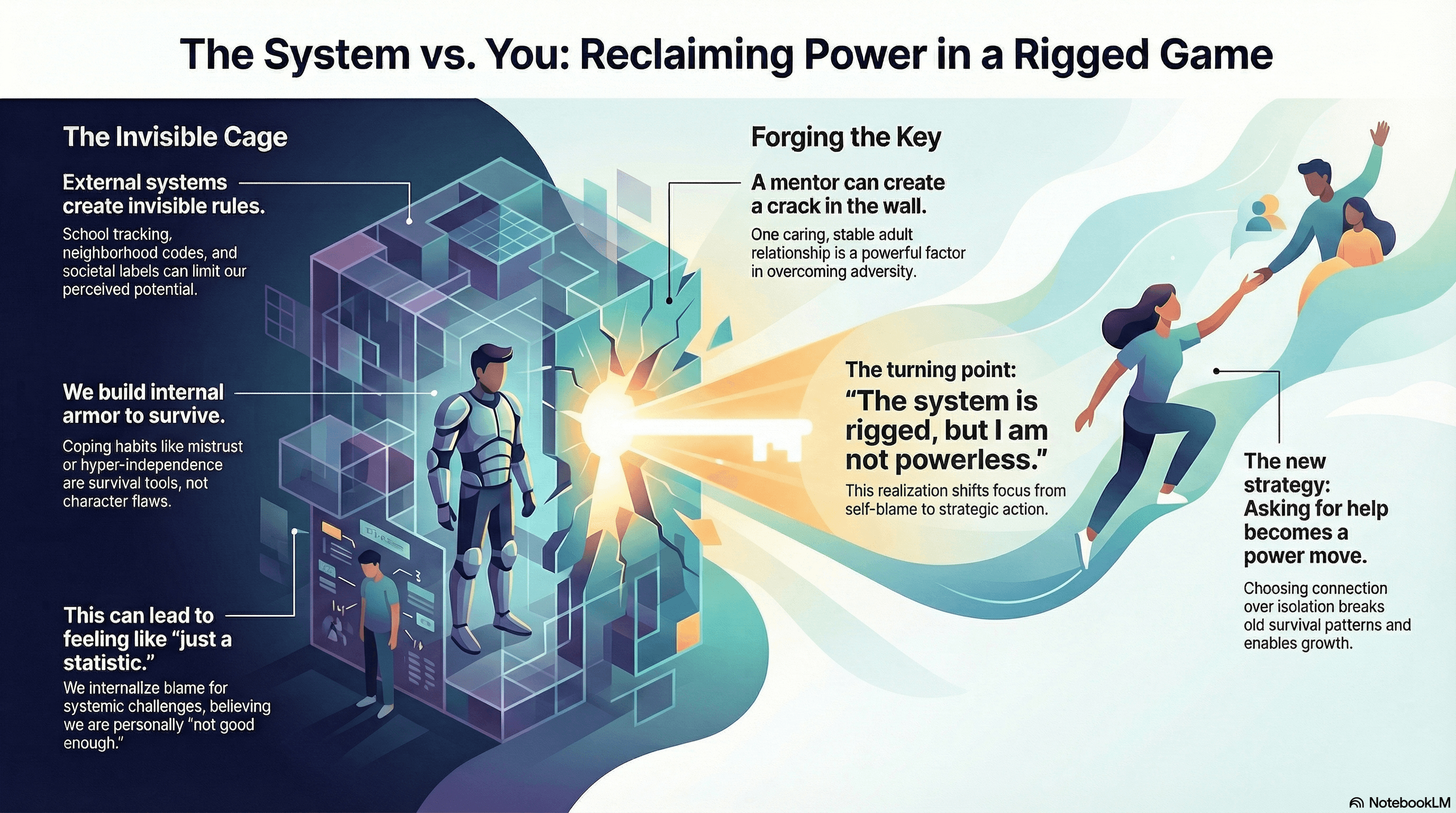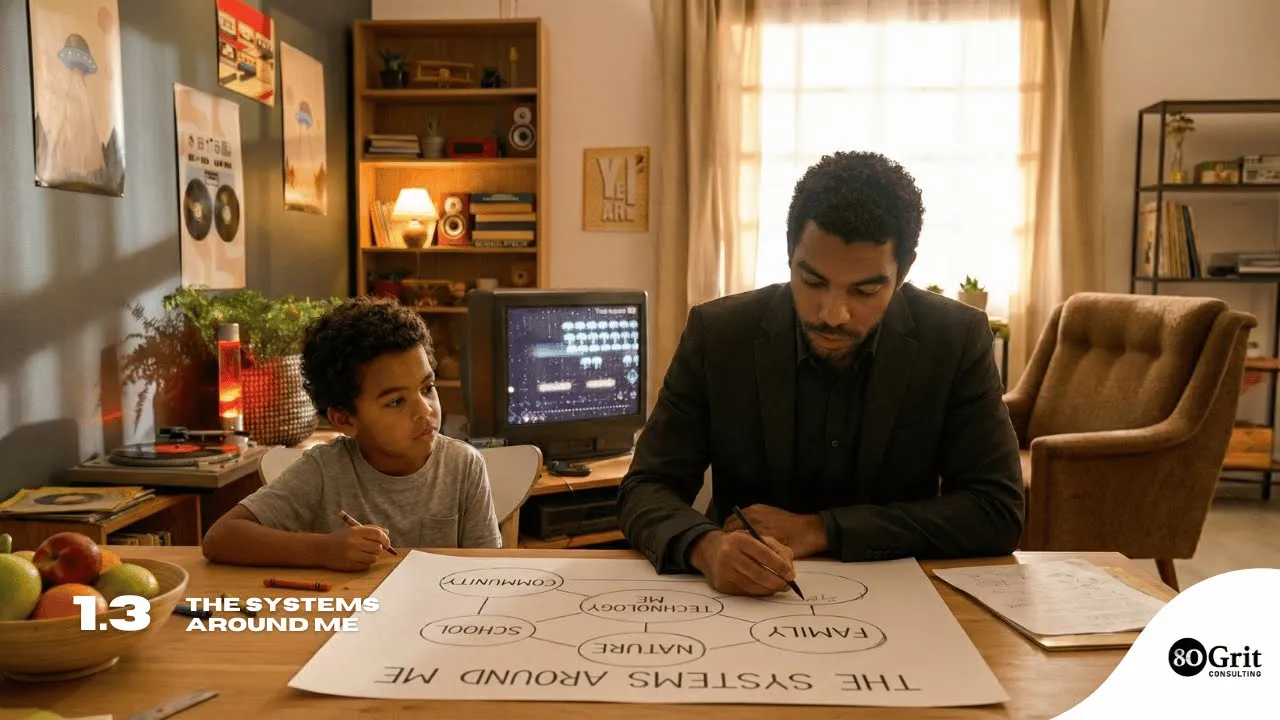

Welcome to Lesson 1.3, The Systems Around Me. Up to now, you have been looking at your personal rooms and your personal messages. In this lesson, the camera pulls back. You start seeing the bigger gameboard that surrounded you long before you knew the rules. Race, school, neighborhood boundaries, money, the justice system, church culture, and street codes all shaped what felt possible, what felt safe, and what felt like destiny. The goal is not to blame. The goal is to get honest context so you can stop carrying shame for conditions you did not create.
A system is simply a set of rules and patterns that affects people’s lives, often without asking for permission. Some systems are official, like school policies, policing, housing, or social services. Some are unofficial, like street rules, family reputation, or the expectations placed on boys and girls in certain environments. When you grow up inside these systems, they can feel like nature, like this is just how life is. Naming them helps you separate “what happened around me” from “what is true about me.” That separation matters because it’s hard to heal what you keep personalizing as a character flaw.
Start with schools, because school is often the first place you learn how power works outside your home. Some schools have updated books, stable teachers, and counselors who talk to you about college like it’s normal. Other schools deal with crowded classrooms, constant discipline, and low expectations that get disguised as “being realistic.” Even when nobody says it out loud, the message can be clear: certain kids get prepared for options, and other kids get prepared to stay in their place. Add neighborhood realities on top of that, like where you can walk safely, what streets belong to who, what happens if you get caught in the wrong place at the wrong time, and suddenly your world gets smaller. Your choices start getting presented as narrow lanes instead of wide roads.
This is where the label “statistic” does damage. A statistic is supposed to be a number in a report, but it can become an identity when people treat you like your ending is already written. When you hear it enough, you might stop asking bigger questions. Why apply if nobody expects you to get in. Why try if failure seems guaranteed. Why trust adults if adults keep leaving. The systems do not just limit resources. They also limit imagination. They train you to shrink your hope so you will not be disappointed, and that shrinking can follow you into adulthood even when your environment changes.
Now shift to the internal systems you built to survive inside that bigger gameboard. When the outside world feels unstable, your mind and body create patterns to stay safe. You might become hyper independent, believing you cannot rely on anyone. You might become a grinder, always working, always proving, because rest feels dangerous. You might shut down emotionally, because feelings never felt safe to express. You might try to control everything, because chaos once cost you too much. The key point is this: these are systems, not personality. They were protective strategies, not evidence that you are broken. If they were built, they can be updated.
Here is the turning point of this lesson: mentors and community supports can show up like rule breakers. A coach, a teacher, a big brother figure, a neighbor, a program, or a community house can introduce a new set of rules. They might be the first person to say, “You are not what they predicted.” They might show you a path you did not know existed and then help you walk it with real steps, not motivational talk. Mentors do not erase the rigged parts of the board, but they can help you learn how to play your hand with strategy, with support, and with options. That is where agency starts growing. Not in denial of the system, but in learning how to move inside it without letting it name you.
This lesson also asks you to honor both harm and help at the same time. Some systems harmed you, no question. They limited resources, narrowed choices, and sometimes punished you for being who you were in the wrong place. At the same time, parts of your environment may have held you in unexpected ways. Neighborhood moms who fed you. A teacher who noticed your talent. A church member who gave you rides. A friend’s parent who created a safe room for you to breathe. Holding both truths keeps you from turning your entire past into a single label. It lets you grieve what was unfair while also respecting what kept you going.
As you read this, practice naming what shaped you without turning it into a life sentence. In your journal, write about one external system that affected your path and describe the rule it taught you, even if nobody said it out loud. Then write about one internal system you built in response, like “I do everything alone” or “I stay on guard.” Finally, write one moment of harm and one moment of help from your past, and let them both be true in the same story. This is how you release shame and gain clarity. You stop arguing with your history and start learning from it.
To wrap up, this lesson is about seeing the bigger board and reclaiming your power on it. You name the external systems that shaped your options, you identify the internal systems you built to survive, and you learn to hold harm and help together without forcing your past into all bad or all good. When you can do that, you stop believing you were born to lose. You start seeing that you were navigating a tough setup with limited cards, and you still found ways to keep moving. That is the foundation for the next part of this journey, where you begin changing what no longer serves you and choosing who you will be on purpose.