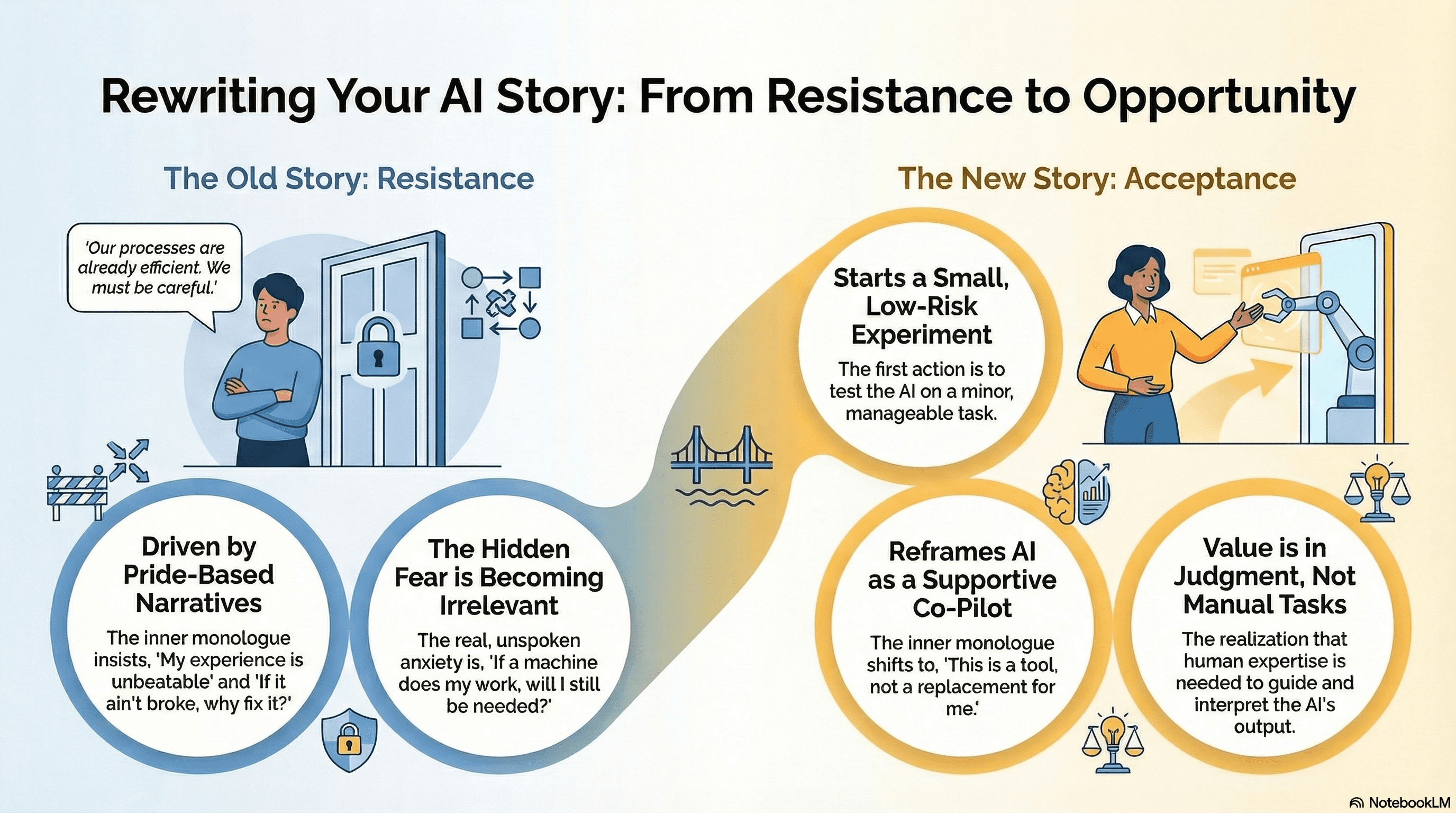

Resistance to AI is rarely about technical risk alone. It is often driven by internal stories that protect a leader’s ego and professional identity. For “Mark,” these stories were rooted in pride and masked fears of losing relevance, control, and status.
Shifting this resistance follows three steps:
Identifying the Narrative: Noticing automatic, self-justifying thoughts (“If it ain’t broke, why fix it?”) as stories, not facts.
Uncovering the Fear: Naming the deeper emotions beneath those stories, such as fear of being obsolete, exposed, or sidelined.
Reframing the Story: Creating a new narrative that separates identity from tools and casts AI as a supportive asset instead of a threat.
Leaders who move through this process shift from defensive observation to active, curious participation.
The Manifestation of Resistance: Pride-Based Narratives
Resistance to AI often first appears as reasonable-sounding objections. Mark’s opposition to an AI pilot program was framed as concern about data security, accuracy, and disruption to well-functioning processes. Underneath, a different narrative was at work.
Internal vs. External Justifications
Mark’s internal monologue showed that his stance was driven less by risk management and more by pride and attachment to familiar methods.
Internally, he told himself, “This is hype,” “We’ve managed fine for 20 years without an algorithm,” and “If it ain’t broke, why fix it?” These lines reassured him that his experience alone was enough and protected his status as the expert. Externally, he converted those feelings into corporate language. He raised questions about “data security and accuracy” and advocated a “wait-and-see approach,” appearing as a careful steward while still slowing or blocking change.
These justifications arrived almost automatically and felt like objective assessments. In reality, they were protective narratives designed to preserve his identity.
Uncovering the Emotional Core: The Fear Beneath the Story
Movement started when Mark’s narratives were challenged and he was asked what, exactly, he was afraid of. A candid conversation with a trusted colleague, Jenna, became the turning point.
Acknowledging Deep-Seated Fears
When Jenna asked how he actually felt about AI, his rehearsed objections began to slip. He admitted that his resistance was less about the tool and more about what it seemed to say about his value.
Several fears surfaced:
Losing relevance: “If a machine handles the work I excel at, then what? Does the company still need me as much?” His identity was tied to the detailed reports he had built his reputation on.
Looking foolish: He remembered struggling with a new dashboard and fearing he would look clueless in front of younger colleagues.
Losing control: The idea of an AI influencing decisions felt like a quiet threat to his authority.
Being sidelined: He worried that key conversations would move toward the people leading AI initiatives, not toward him.
Change often registers first as loss—of pride, control, or familiarity. By saying these fears out loud, Mark reduced their grip. They shifted from invisible drivers of behavior to emotions he could see and manage.
The Path Forward: A Deliberate Reframing Process
Once the fears were visible, Mark could challenge his old story and build a new one. This reframing work separated who he was from the specific tools he used.
From Limiting Beliefs to Empowering Narratives
Mark started by writing down his automatic thoughts: “AI will mess up,” “My experience is unbeatable,” “I don’t need this.” Seeing them on paper made them easier to question. Many were exaggerated or untested.
He then contrasted his old internal script with a more constructive one:
“I don’t need AI. I’m the expert; it will just get in the way” became “AI is a tool. I decide when and how to use it.”
“If I let it in, I’ll lose my edge” became “If I learn to use it, I can free time for strategy and judgment.”
The belief “My value is doing things manually the way I always have” became “My value is my judgment, pattern recognition, and leadership.”
The assumption “I can’t adapt to this new technology” became “I’ve adapted before; this is another evolution.”
By rehearsing the new story, he created an internal script that supported experimentation instead of avoidance.
Decoupling Self-Worth from Professional Tools
The crucial insight was that his identity did not live in any particular report, spreadsheet, or workflow.
Mark realized that his decades of experience made him uniquely capable of interpreting and challenging AI-generated outputs. His insight did not disappear when a machine drafted a report; it moved up a level. He also saw that people respected him for what he knew and how he led. Refusing to grow with the tools around him undermined that leadership. Modeling learning reinforced it.
AI shifted from “ego threat” to tactical option. The guiding question changed from “Does this diminish me?” to “Does this help us do better work?”
Outcomes of the Mindset Shift: From Observer to Participant
Once Mark’s internal story changed, his behavior followed. He contacted the AI pilot team and offered his department for a low-risk experiment: using the tool to draft a weekly sales report.
The AI’s draft was solid and highlighted trends he had not yet noticed.
The tool took care of repetitive groundwork, while Mark focused on interpretation and strategic recommendations.
His role moved from sole author to editor-in-chief, which felt more engaging and less draining.
His inner voice shifted from “This thing is challenging my worth” to “This is helping me deliver higher-value work.” His team noticed. One colleague said that seeing him try something new made it easier for others to do the same.
Conclusion: The Power to Rewrite the Story
Mark’s experience shows that the real barrier to AI adoption is often not the technology itself, but the story a leader tells about what that technology means. Pride-based narratives, fueled by fears of losing relevance and control, can quietly lock leaders into outdated patterns.
Becoming an adaptive, AI-savvy leader starts with honest self-examination: noticing internal scripts, naming the fears beneath them, and deliberately constructing a new narrative that preserves identity while embracing new tools. When leaders do this work, AI stops being a verdict on their past and becomes a lever for their future.
The payoff is both personal and organizational: less anxiety, more experimentation, stronger leadership, and a culture better prepared to evolve. The real transformation is not simply from non-user to user, but from prideful observer to active participant in shaping how new technology is used.