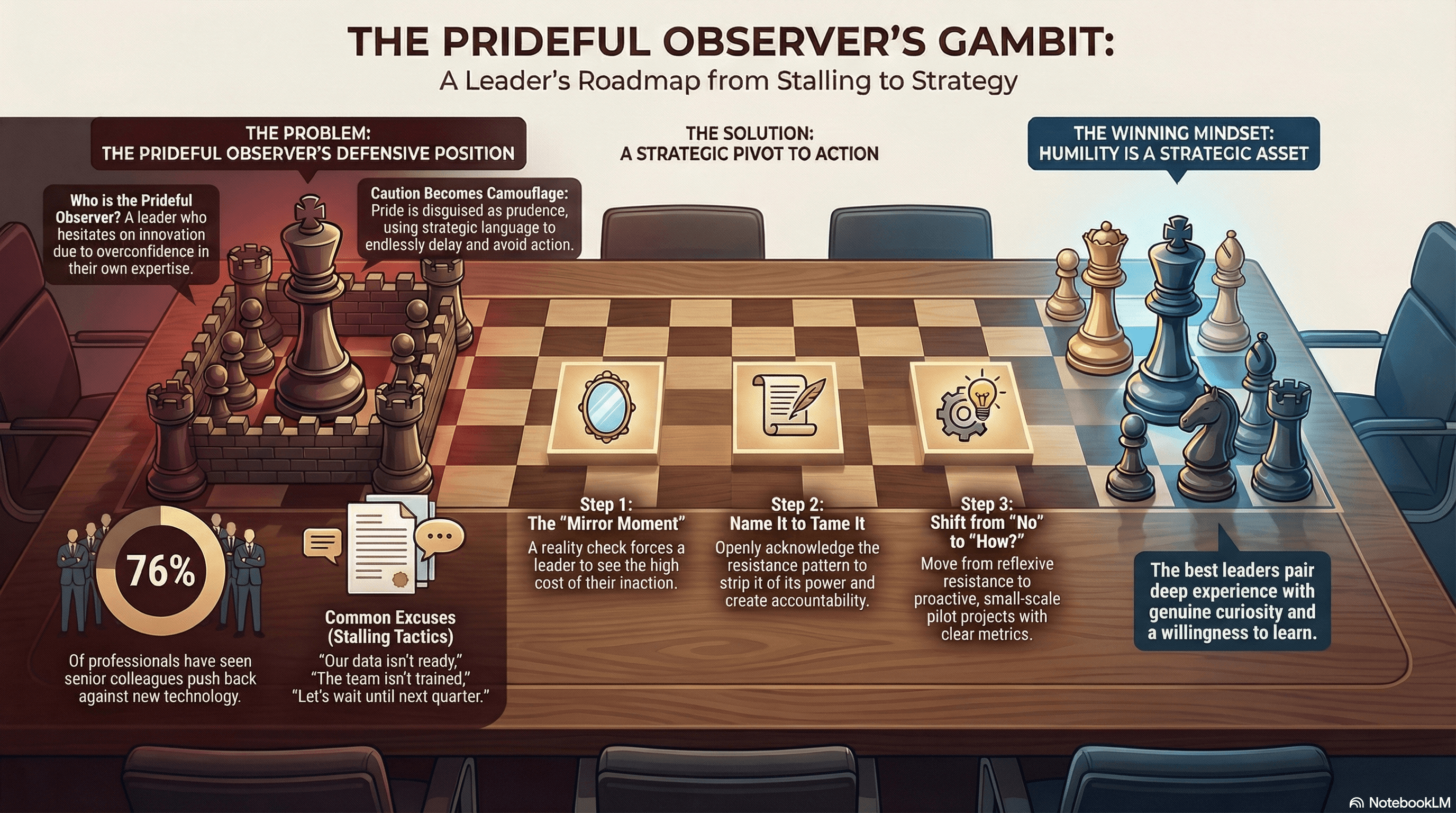

This briefing outlines the “Prideful Observer,” a leadership archetype defined by reluctance to adopt new technologies and innovations. The hesitation does not come from ignorance, but from overconfidence in personal expertise and a desire to protect familiar methods. Prideful Observers often frame resistance as responsible prudence, using strategic-sounding objections about risk, ROI, or timing to stall progress.
This posture is different from legitimate caution. Healthy skepticism tests new ideas through controlled experiments and evidence-based learning. Prideful resistance instead produces paralysis by analysis, endless study, and “wait and see” decisions that quietly lock the organization into the past. The turning point usually comes during a “mirror moment” – an episode of self-awareness when a leader sees the pattern and its cost. Once named, the Prideful Observer mindset can be replaced with a stance that combines experience, humility, and a willingness to learn, preserving both personal and organizational relevance in an AI-driven landscape.
The Case of Stephen: Pride in the Boardroom
Stephen, a CFO with a 30-year track record in risk management, is a classic Prideful Observer. In public, he champions concepts like AI-driven fintech. In practice, he slows or blocks concrete initiatives. When presented with an AI pilot for fraud detection, he responds, “We have to be careful… our existing system has served us well. Let’s not rush into something unproven.”
Underneath is an unspoken belief: “I already have the answers.” The Prideful Observer stands on the sidelines of innovation, convinced that hard-won expertise and past success are enough. Resistance is subtle, wrapped in the “mask of responsible prudence.” Concerns about regulation, data quality, or ROI are used to send proposals to committee, call for “more research,” or table decisions to a later quarter. The underlying message: “Our way has always worked. These new tools can’t really teach me anything.”
Wider Patterns Across Industries
This pattern appears across sectors, especially among veteran leaders who feel their experience is being devalued. Manufacturing managers quietly sidestep AI-driven maintenance proposals that would challenge long-standing routines. Senior clinicians verbally support innovation but privately dismiss AI diagnostic tools, insisting no algorithm can match their intuition. Cultural resistance and emotional friction are now often bigger barriers to AI adoption than the technology itself.
The Critical Distinction: Caution vs. Pride
A central challenge is distinguishing healthy skepticism from ego-driven resistance. The language can sound similar, but the outcomes differ.
Hallmarks of Healthy Skepticism
Legitimate caution is active, investigative, and oriented toward progress with guardrails. A leader practicing healthy skepticism will:
Probe and pilot: Test new tools through low-risk, time-bound experiments.
Demand evidence: Ask for data, baselines, and clear ROI.
Use frameworks: Apply structured approaches such as “start small, measure results, then scale.”
Solve constraints: Treat regulation, privacy, or security as design constraints to work within.
Signs of Prideful Resistance
Prideful resistance is defensive and inward-facing, aimed more at protecting status and comfort than at protecting the organization. Common signals include:
Reflexive avoidance: Quickly spotting reasons to say no, rather than ways to test and learn.
Paralysis by analysis: Keeping initiatives in permanent “further study” mode.
Strategic camouflage: Repeating familiar objections such as “Our data isn’t ready,” “The team isn’t trained,” or “Let’s revisit this next quarter.”
Permanent shielding: Using valid concerns (regulation, ethics, brand risk) as a fixed shield instead of a problem to be solved.
The quiet goal is to delay adoption until the technology is so mature that it poses zero personal risk to the leader’s reputation. By that time, any competitive advantage has usually shifted to someone else.
The Turning Point: The “Mirror Moment”
For many leaders, change begins with a “mirror moment” – a jarring instance of recognition. For Stephen, it happened at a strategy offsite when an external consultant described executives at a failed firm as “proud observers – supportive of innovation in name, but never in action.”
The consultant asked, “Can anyone share a time when caution was actually code for complacency?” Silence followed. Stephen noticed several colleagues glance his way. Soon after, he learned that a competitor had successfully launched an AI fraud detection system much like the pilot he had stalled. The message was clear: his delays carried a real cost, and his “prudence” was primarily protecting his own relevance, not the company’s future.
Taking Ownership and Shifting Culture
After this realization, Stephen chose to act rather than retreat into defensiveness:
Naming the pattern: In a team meeting he said, “I realized I’ve been that proud observer – hesitant to greenlight new ideas not just out of caution, but out of ego.” Naming the pattern made it discussable and less powerful.
Redefining caution: He drew a line between stalling and healthy skepticism, committing to pilots, evidence, and time-bound decisions instead of open-ended delay.
Restarting action: He asked the VP who originally proposed the AI fraud project to bring back a focused pilot with clear success metrics and guardrails.
Modeling humility: He invited his team to hold him accountable when they saw him slipping back into old habits, giving others permission to experiment and to challenge legacy assumptions.
An Actionable Framework for Leaders
The Prideful Observer is not a fixed personality; it is a pattern any experienced leader can fall into. To counter it, leaders can use the following principles:
Name it to tame it: Acknowledge Prideful Observer tendencies in yourself and your culture so they can be addressed directly.
Separate pride from prudence: Preserve legitimate caution – small steps, measurable pilots, clear guardrails – while refusing to hide behind endless “what ifs.”
End “wait and see”: Treat inaction as a strategic decision with its own risks; organizations that cling to old playbooks often pay the price for being late.
Spot your excuses: Listen for phrases like “we need more research” or “what we have works fine” and test whether they reflect real constraints or simple discomfort with change.
Remember what is at stake: Clinging to past methods can erode both organizational relevance and personal credibility; when environments shift and leaders refuse to, they are eventually bypassed.
Embrace a learner’s mindset: Pair experience with curiosity. Admitting you are learning is not weakness; in the age of AI, it is a competitive advantage.