
In this lesson, you will learn how to use the idea of “rooms” as a practical tool for understanding your habits, your stress responses, and the ways your childhood environments still shape your choices today. We will follow James as a consistent example, but the goal is for you to map your own story with clarity and compassion. This is not about blaming caregivers or romanticizing the past. It is about noticing what your body learned, naming the rules you picked up, and deciding which rules still serve you.
A “room” is any environment that trained you over time, not just a physical place with walls. A room can be a living room, a church pew, a classroom, a block, a relative’s house, a kitchen table, or even a car ride that happened so often it became predictable. Your brain and nervous system learn through repetition. When a space repeatedly feels safe, threatening, conditional, or unpredictable, your body creates shortcuts to help you survive there. Those shortcuts often become automatic habits in adulthood, even when the original environment is long gone.
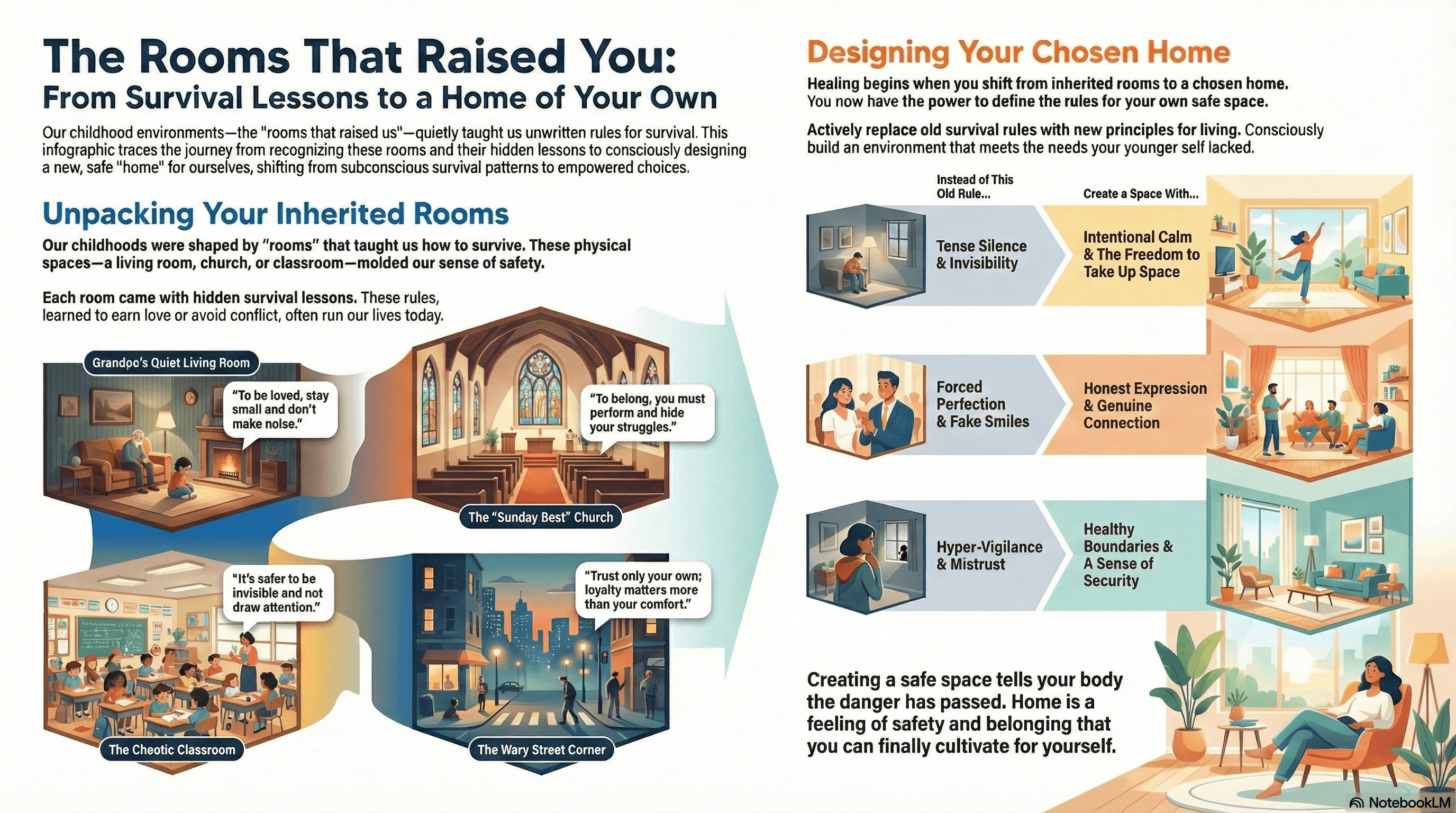
For James, Grandpa’s living room trained the first shortcut: stay quiet, stay small, stay safe. The room was steady and calm, but belonging came with conditions that rewarded stillness and punished disruption. Over time, James learned to manage tension by minimizing himself, lowering his voice, holding his breath, and waiting for the mood to pass. In adult life, this can show up as conflict avoidance, difficulty expressing needs, or feeling guilty for taking up space. The key learning is not “I am weak,” it is “My body learned a strategy that worked then, and it still tries to protect me now.”
The next room in James’s story is the church back pew, which taught a different strategy: perform wellness to stay accepted. In that environment, the body learns to hide discomfort behind a polished presentation. You might relate to this if you have a habit of smiling when you are stressed, saying “I’m good” when you are not, or over-functioning so nobody sees you struggle. This is how conditional approval can create people-pleasing and perfectionism. The important takeaway is that performance is not character, it is protection.
Then comes the noisy classroom, where James learned how to survive attention by avoiding it. In unpredictable group spaces, many people develop hyper-awareness, scanning faces and tone for signs of danger, ridicule, or sudden correction. When you cannot fight or leave, the nervous system often chooses freeze, shutdown, or mental checking out as a way to get through the moment. As an adult, this can look like staying quiet in meetings, hesitating to share ideas, feeling invisible, or going blank under pressure. If this is familiar, treat it as data about what your body learned, not a verdict about your ability.
The corner store and the block taught James two connected lessons: stay alert and stay loyal. In environments where threat is possible, the nervous system learns to prefer false alarms over missed danger, which means you might feel on edge even when nothing is happening. Loyalty can also become complicated, because belonging may require silence, compliance, or staying connected to people who cost you peace. In adulthood, this can show up as difficulty trusting new people, holding onto relationships past their expiration date, or feeling intense guilt when setting boundaries. The deeper skill here is learning the difference between healthy loyalty and survival loyalty.
Now we move from insight to application, because awareness without change can turn into frustration. Start by listing three to five rooms that raised you, then for each one write the primary feeling, the body signal, and the rule you learned. For example, “quiet room, tight chest, do not make noise” or “performance room, forced smile, do not show struggle.” Next, identify where that rule shows up today, especially in work, relationships, and moments of stress. Finally, choose an updated rule that fits your adult life, such as “I can speak calmly and still be safe” or “I can be honest without performing.” This is how you begin rewriting the operating system, one rule at a time.
The rooms that raised you taught you how to survive, and those lessons were often intelligent adaptations to real conditions. By naming your rooms, tracking what your body learned, and connecting those lessons to present-day patterns, you gain the power to choose differently. James’s journey shows that growth is not pretending the past did not matter, it is recognizing what it installed and deciding what to keep. Your next step is to design “your room” through boundaries, environment, and daily practices that help your nervous system feel safe enough to relax. When you do that consistently, the past remains part of your story, but it stops running your life.