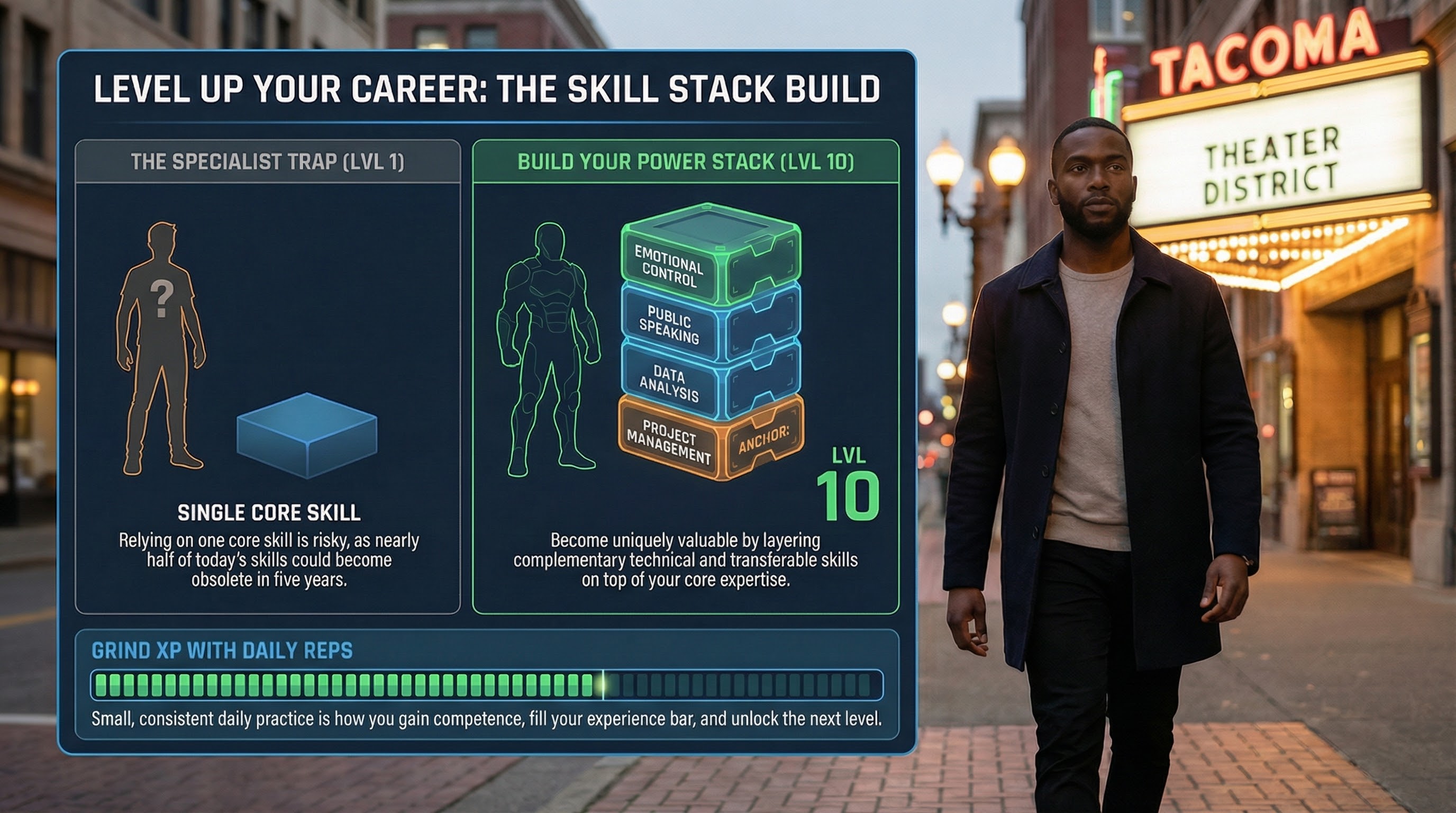

Most people hit a point where effort stops working like it used to. You are showing up, staying busy, and trying to improve, but the results feel random. It can feel like you are pushing on a door that will not open, and that feeling messes with your confidence because you start wondering if you are missing something everyone else figured out. This lesson is about that exact moment. Skill stacking is the shift from hoping growth happens to building growth on purpose, one skill at a time, until you become the kind of person who can handle the next level without waiting for permission.
The first step is to stop guessing what you need and start mapping it. When people say, “I want a better job” or “I want to level up,” the goal is real but it is not clear. You cannot train for “level up” because it is not a skill. So you start with a future version of you and ask one simple question: what does that person do well, consistently, in real life? If you want to lead, what does that actually look like? It might mean you can run a meeting, give clear direction, handle conflict, and make decisions under pressure. If you want to switch careers, it might mean you can build a portfolio, speak the language of that industry, and solve problems the way that field expects. When you describe the future version of you in actions, you turn a vague dream into a list of trainable skills.
Once you have that list, the second step is to identify the gaps between where you are and where you want to be. This is where most people waste energy, because they keep trying harder at the skills they already have. Skill stacking is different. It says, “If I keep doing what I am good at, I will keep getting the results I already have.” The gap is not an insult, it is a target. For example, you might be strong at getting work done, but weak at communicating your thinking. Or you might be creative and smart, but inconsistent under pressure. Or you might know your field, but lack the technical skill that would make your work stand out. The point is to name the few gaps that matter most right now, not everything you could improve in your entire life.
After you map the gaps, you build a stack that travels. This matters because titles come and go, environments change, and people’s opinions shift. Skills stay with you. The smartest stacks include skills that compound, meaning they make everything else you do more effective. Communication is one of those, because you can be brilliant and still get overlooked if you cannot explain your ideas. Emotional control is another, because pressure does not care how talented you are, it will expose what you cannot manage in yourself. Problem-solving is another, because every job and every relationship eventually becomes a series of problems that need calm thinking. Then you add the technical skills tied to your specific goals, so you are not just well-rounded, you are also useful in the exact rooms you want to enter.
A common trap here is collecting random credentials because it feels like progress. Certifications can be helpful, but only if they lead to real capability. If a credential does not change what you can produce, it is not building your stack, it is decorating it. A better question is, “What can I show?” Output is proof. If you are building communication, can you deliver a clear update without rambling? Can you write a one-page summary that makes sense to someone outside your world? If you are building a technical skill, can you create a simple project, a dashboard, a mock proposal, or a case study? When you focus on output and repetitions, you stop needing other people to validate you, because your work speaks for you.
Now you make the stack real by training every day on purpose. This does not mean you need hours of free time. It means you pick a small focus, stretch just beyond comfort, and get feedback quickly. For example, if your gap is speaking, your daily practice might be a two-minute voice memo where you explain one idea clearly, then listen back and adjust one thing. If your gap is problem-solving, your daily practice might be writing down a problem you faced that day and listing three possible approaches before you pick one. If your gap is a technical skill, your daily practice might be completing one tiny task that builds toward a larger project. The reason daily training works is simple: your brain changes through repetition, not inspiration.
Finally, you plan for life so your growth does not depend on motivation. Motivation is nice, but it is unreliable. Skill stacking requires a simple plan for the days when you are tired, busy, or discouraged. This is where you use if-then responses. If you miss your normal practice time, then you do a smaller version later. If you feel overwhelmed, then you reduce the task to the next smallest step. If you are tempted to quit because you did not do it perfectly, then you focus on showing up the next day instead of judging yourself. The goal is not a perfect schedule. The goal is keeping the chain alive so growth becomes inevitable.
By the end of this lesson, the big idea to remember is that your next level is not a mystery, it is a set of skills. You map what the future version of you does well, identify the few gaps that matter most, and choose skills that travel and compound instead of chasing random validation. Then you train daily with a small focus, real repetitions, and fast feedback, while using simple plans to stay consistent when life gets messy. Confidence grows when you can do what the moment requires, and skill stacking is how you build that ability on purpose.