
You know that feeling when you finally hit “done,” your document looks sharp, and you walk into a meeting confident, only to get one question that makes your stomach drop: “Walk me through how you got to these recommendations.” That moment exposes a new reality of modern work. When AI can help generate clean, professional writing fast, a polished page is no longer the same thing as proven thinking. This lesson is about making sure you can defend your work with clarity and confidence, even when the final draft looks flawless.
The core problem is simple: great writing is easy to produce now, but trust is not. When someone reads your proposal, strategy, report, or plan, they are not only judging the words. They are judging whether you understand what you are claiming, whether you can explain your reasoning, and whether you can stand behind the decisions inside the document. If you cannot show how you got there, the output can start to feel like a fragile shell, even if it sounds smart. In high-stakes work, credibility comes from being able to explain your process, not just presenting a clean result.
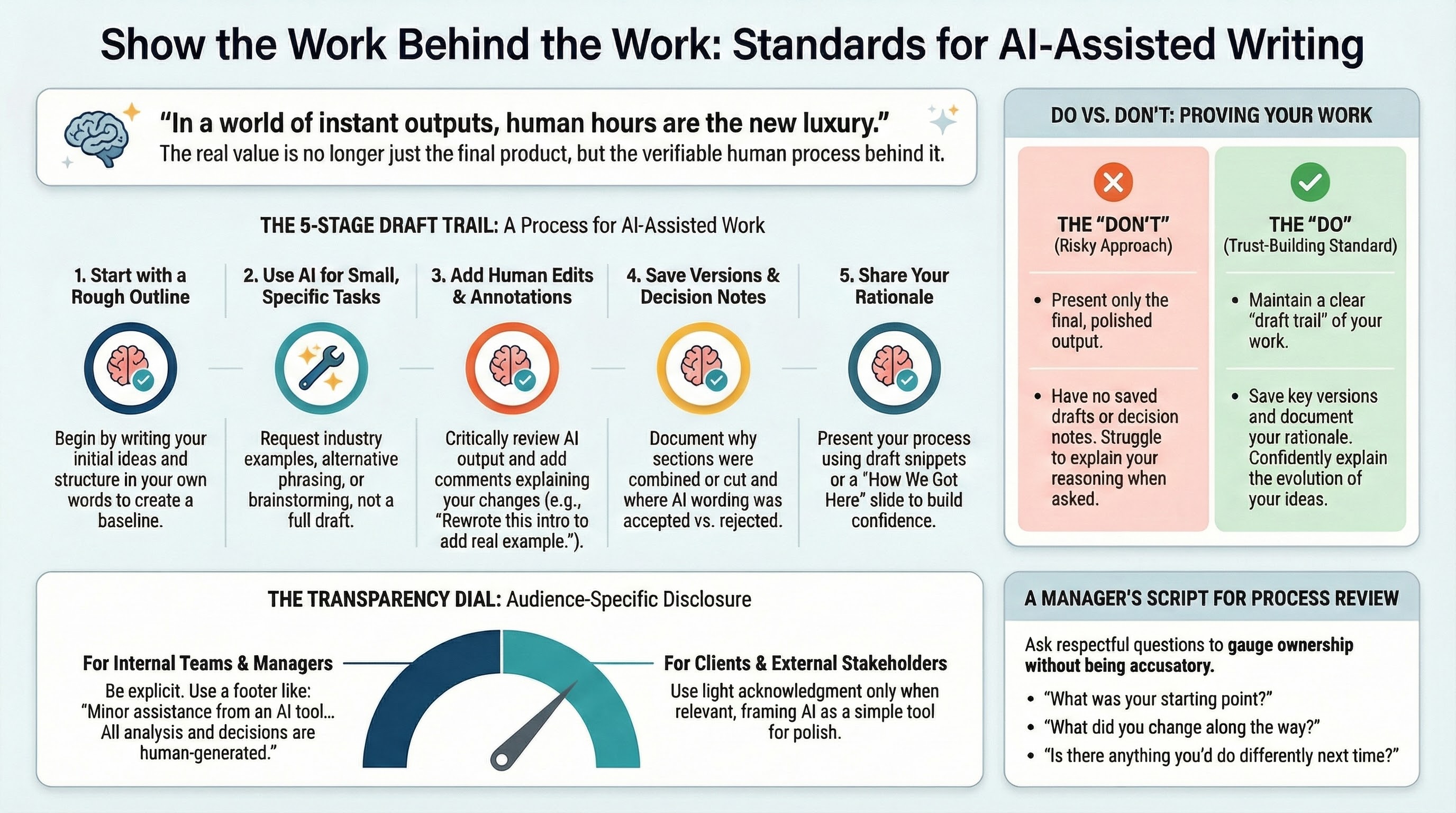
That is why “show your work standards” matter. Think of them as three habits that protect your credibility: you keep a visible draft trail, you communicate AI’s role in a responsible way, and you ask process-focused questions that surface real ownership. These habits are not extra busywork. They are how you prove you applied judgment, made choices on purpose, and did not simply accept the first output that looked good. When you show your work, you turn “trust me” into “here’s the evidence.”
Start with the draft trail, because it is the easiest to build and the fastest to pay off. The goal is not to save every tiny change, it is to preserve the turning points in your thinking. Begin each project with a rough outline in your own words, even if it is messy, then save it as Draft 1. As you add research, examples, and structure, save new versions at key moments like Draft 2, Draft 3, and Near Final. Along the way, capture the sources you used and write short “decision notes” like why you changed a section, what you removed, and what you kept. When someone asks how you got there, you can show the evolution instead of trying to recreate it from memory.
Next, treat AI like a tool that you document, not a ghostwriter that leaves no footprints. If you use AI to brainstorm options, improve clarity, or generate examples, keep a light record of what you asked for and what you changed afterward. The important part is your judgment. For example, if the AI produces a generic introduction and you rewrite it to match your team’s real experience, note that you replaced the generic language with a concrete example and explain why. This makes your work defensible because it shows you were steering the output, not just polishing it. Over time, this also helps you learn faster because you can see your own patterns of improvement and the moments where your thinking got sharper.
Then comes transparency, and this is where people often overthink it. The point is not to announce AI use loudly in every situation, and it is not to hide it either. The goal is to be clear, appropriate, and accountable based on the audience. Internally, it can be enough to include a simple note that you used an AI tool for minor editing or examples, while stating that the analysis and decisions are yours. Externally, you do not need to lead with AI, because clients care most about the logic and the outcome, but you also should not dodge the question if it comes up. The hard truth is that getting caught using AI without disclosure can damage trust far more than responsible honesty from the start.
Finally, learn how to evaluate authenticity without turning interactions into accusations. If you are a manager, reviewer, or teammate and something looks unusually perfect, do not open with “Did you use AI?” Instead, ask process questions that naturally reveal ownership: “What was your starting point,” “What did you change along the way,” “Which sources shaped this,” and “What would you improve next time.” These questions do two things at once. They help you confirm understanding, and they create a culture where people can talk openly about tools while still being accountable for the thinking. When someone can explain their choices clearly, the tool matters less because the ownership is obvious.
The payoff is straightforward: you stop selling polished output and start delivering defendable decisions. A clean document gets attention, but a clear process earns confidence. When you can show drafts, explain key pivots, and speak plainly about how tools supported your workflow, you protect your credibility and strengthen it at the same time. Take this into your next assignment by creating Draft 1 in your own words, saving versions at major milestones, writing short decision notes, and preparing a simple explanation of where AI helped and where you made the calls. If you do that consistently, you will not just deliver results, you will deliver trust.