
It is a strange feeling when someone sounds flawless, but something in you is not convinced. In the AI era, polish is cheap. A clean slide deck, a smooth paragraph, even a confident answer can be generated or heavily assisted, which means your real job is no longer to judge how impressive someone sounds. Your job is to figure out whether the person actually understands what they are saying, and whether they can still think when the script stops working.
In this lesson, you will follow Morgan, a hiring manager filling a strategic role, as she learns to spot the “artificially educated” pattern: output that looks sharp, but comes from shallow understanding. She is not trying to catch people in a trap. She is trying to make a fair decision by testing how candidates handle questions, disagreement, and surprise when prepared answers run out.
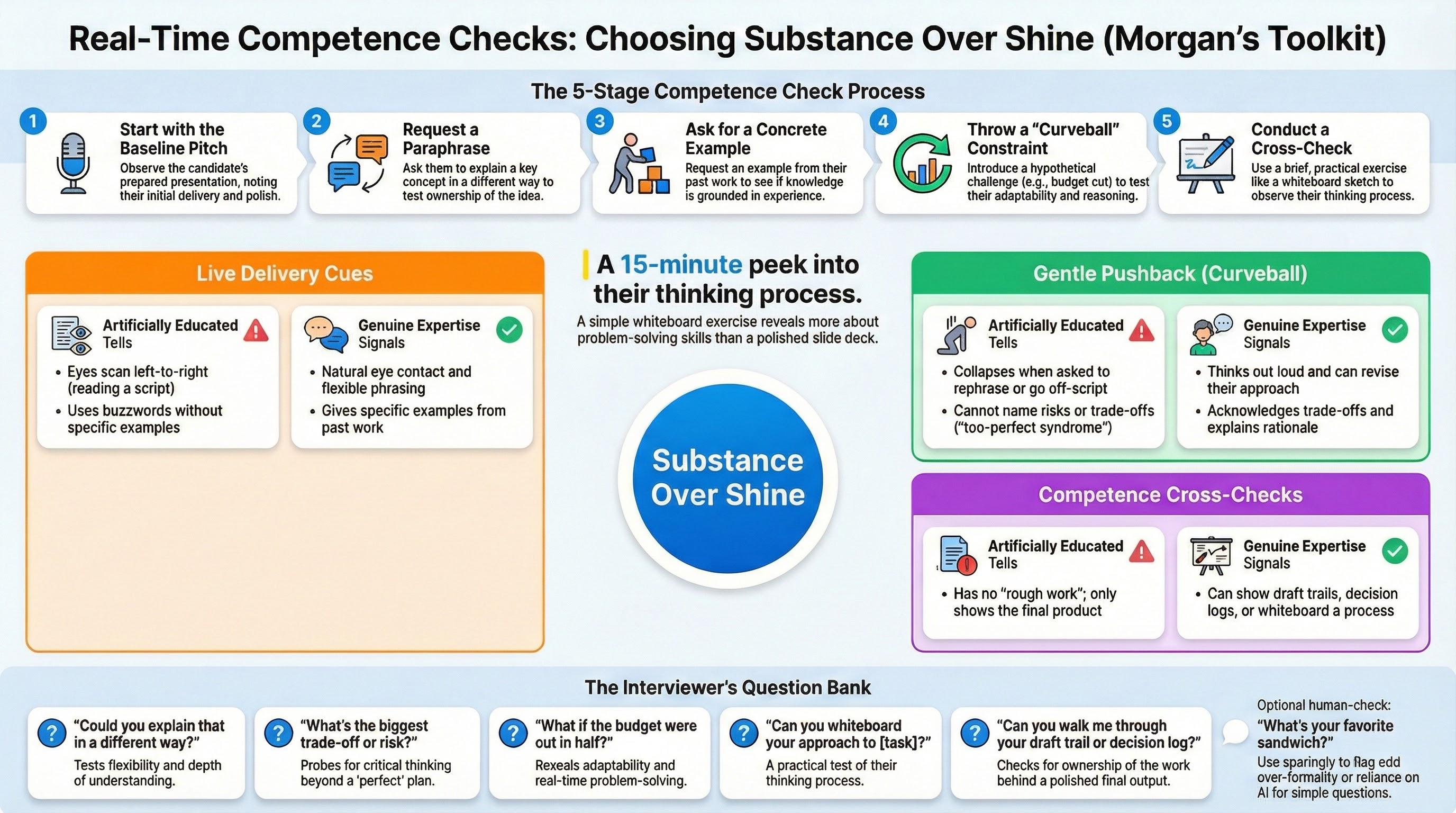
The first skill Morgan uses is noticing live delivery cues, meaning the small signs you can see and hear while someone is presenting. In her interview with Sam, the delivery is smooth, but the behavior is telling: limited eye contact, eyes scanning as if reading, and language that stays generic instead of grounded in real examples. When Morgan asks Sam to explain the same point in a different way, the clarity falls apart, which is the key moment. Someone who truly owns an idea can usually express it more than one way, because they understand it underneath the wording.
To use this in your own interviews or meetings, start by letting the person give their best prepared answer, then gently change the shape of the task. Ask for a quick example from their own work, ask them to rephrase the same idea simply, or ask them to summarize the biggest trade-off in one or two sentences. Watch for patterns like repeating the question to buy time, falling back into the same polished lines word-for-word, or getting jumbled the moment the order changes. One clue can be nerves, but several clues together usually mean the person is relying on memorized output instead of real understanding.
Next, Morgan uses gentle pushback, sometimes called a curveball question. This is where you test flexibility by changing a constraint: “What if the budget were cut in half?” or “What is the downside of this approach?” A strong candidate does not panic or pretend the plan is perfect. They reason in real time, adjust priorities, and name trade-offs without losing the logic of their original idea. A weaker candidate often reacts by doubling down on sunny claims, refusing to name risks, or acting like the question should not exist.
There is also a simple, underrated move Morgan learns: ask something unscripted and human to see if the person can respond naturally. The point is not the question itself, it is the way they handle an unexpected moment without “AI-shaped” phrasing or over-formality. If someone gives a bizarrely stiff answer to an easy, everyday prompt, it can signal they are leaning on a tool even when no tool is needed. Combined with pushback, this helps you see whether you are talking to a thinker or a performer.
Finally, Morgan adds competence cross-checks, which means asking the person to show their work, not just their final product. This can be a quick whiteboard outline, a rough plan sketched in real time, a walkthrough of how they reached a conclusion, or even a request for drafts, notes, or decision logs. These checks matter because the gap in the artificially educated pattern is usually the process: the person can present a finished answer, but cannot reproduce the thinking behind it. A real professional can usually explain what they tried first, what they changed, and why they made key choices, even if the work is messy. Also, do not confuse “less polished” with “less capable,” because someone can be nervous and still show real reasoning if you support them with one or two follow-up prompts.
By the end of Morgan’s process, she chooses substance over shine, because she has seen who can think under uncertainty and who collapses off-script. That is the real lesson: you are not selecting for perfect delivery, you are selecting for judgment, context, and adaptability. If you remember the three tools from this lesson, live delivery cues, gentle pushback, and competence cross-checks, you will be able to spot real understanding more reliably and make decisions with far more confidence.