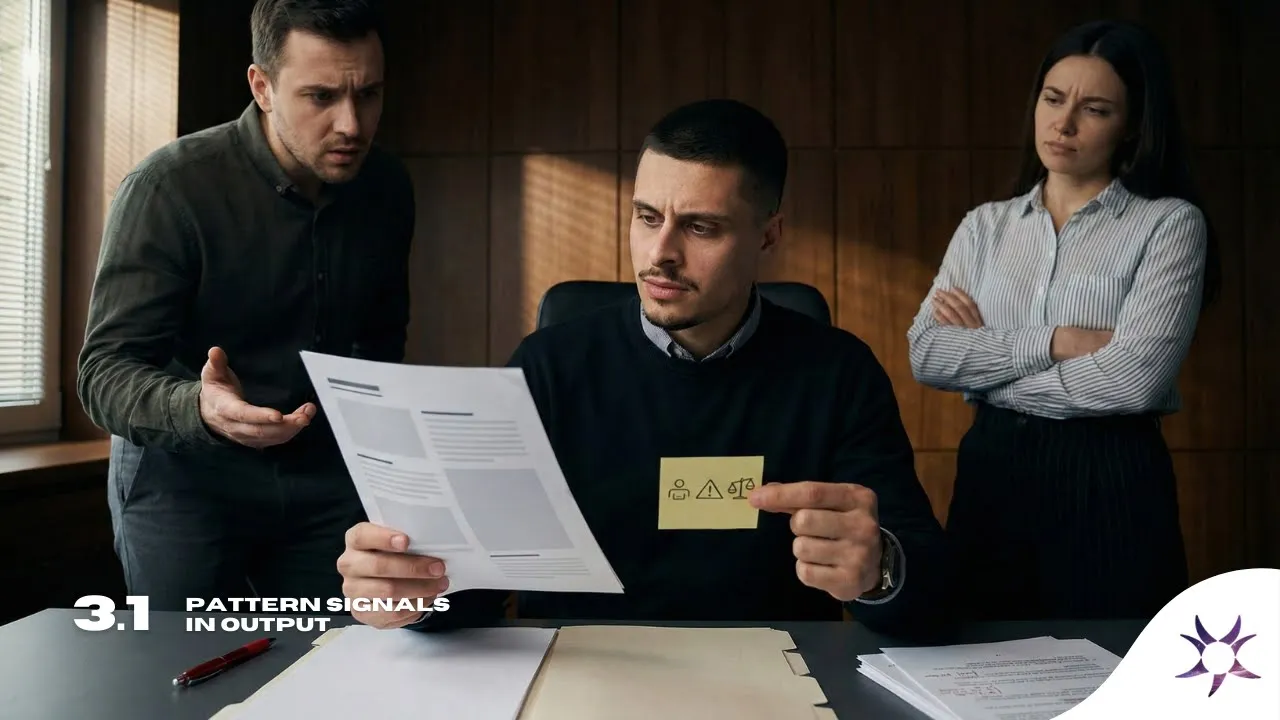

When you read something that looks perfect on the surface but feels strangely empty underneath, your gut is usually reacting to something real. In this lesson, you step into Alana’s shoes as she reviews a strategic report that is clean, polished, and well organized, yet somehow “blank” in voice and presence. She cannot immediately prove what caused that feeling, but she can name it, study it, and respond to it in a fair way.
The goal here is not to become an “AI detective.” The real skill is learning how to spot pattern signals that often show up when work lacks ownership, depth, or lived thinking, regardless of whether AI was involved. Alana reminds herself that smooth writing is not automatically suspicious, and that these signals are clues, not proof. That mindset matters because it keeps you focused on improving the work instead of attacking the person.
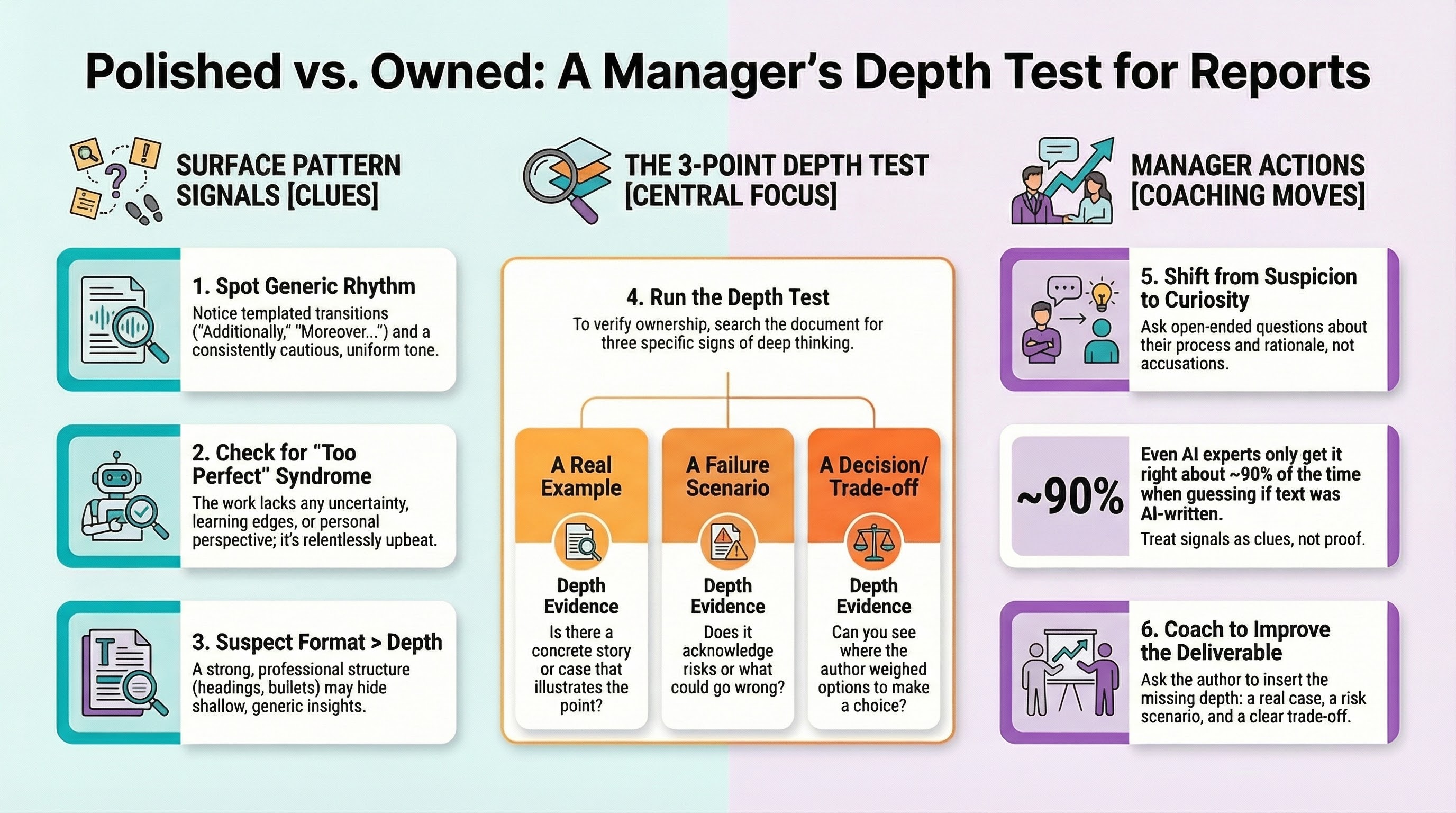
The first signal is what Alana calls generic rhythm clues. She notices the prose has an unusually predictable cadence, where sentences feel like they were built from the same template over and over. Transitions are overly tidy and repetitive, and the language stays safe, broad, and non-committal, like it is trying to avoid ever taking a real stance. Human writing usually has natural variation, with a mix of short and long sentences, occasional imperfect phrasing, and moments where the writer’s personality peeks through. When that variation disappears and everything becomes uniformly polished, it is a sign to look closer.
The second signal is too-perfect syndrome, which is a different kind of “perfect.” Alana is not just seeing correct grammar and clean formatting, she is seeing a complete lack of uncertainty, trade-offs, or learning edges. In real work, especially expert work, you often hear something like, “Here’s what we recommend, and here’s what could go wrong,” because genuine understanding includes awareness of risks and limitations. She also notices the absence of personal touch: no “I” or “we,” no specific experience, no lesson learned, and even the encouragement lines feel canned and generic. When the writing has zero roughness and zero personal stake, it can sound professional while still being hollow.
The third signal is the most important because it tests substance, not style: format vs depth. Alana sees a report that is structured like a textbook with familiar headings and a neat framework, but she asks a harder question: what is this actually saying? To make that concrete, she uses a simple depth test by searching for three things in the content itself: one real example that shows the recommendation in action, one realistic failure scenario that explains how things could break, and one clear decision or trade-off that shows the author chose a path for a reason. If those pieces are missing, the document may look impressive while still offering thin insight.
When Alana runs that depth test, the report fails in a revealing way. It speaks in generalities, names generic risks without imagining how they would show up in real life, and never explains why one approach was chosen over another. That is the hallmark of “informative but not actionable” writing, where the structure does the heavy lifting and the content does not carry its weight. The key takeaway is that frameworks and clean formatting are not the problem. The problem is when the writer hides behind them instead of contributing concrete details, hard-earned insight, and reasoning that only a real participant in the work could provide.
Now comes the part that separates a good evaluator from a harmful one: how to respond. Alana chooses to turn suspicion into curiosity, which means she does not accuse, she investigates through conversation. She separates “this sounds generic” from “you used AI,” and she keeps the focus on output quality rather than intent. In practice, that looks like asking the author to explain choices, walk through the reasoning behind a framework, describe a real example from the project, and talk through risks and alternatives. This approach tests understanding and also forces depth to appear, because no one can fake specific reasoning for long without actually having it.
By the end of this lesson, you should remember three things. First, pattern signals like generic rhythm and too-perfect polish are not proof, but they are valid prompts to slow down and look for depth. Second, the fastest way to test depth is to look for a real example, a realistic failure mode, and a clear decision or trade-off that shows ownership. Third, the most productive response is curiosity that protects trust while demanding substance, because the goal is better work with a visible human mind behind it. Carry that into your next review or your next draft, and you will start producing and recognizing work that is not just polished, but genuinely owned.