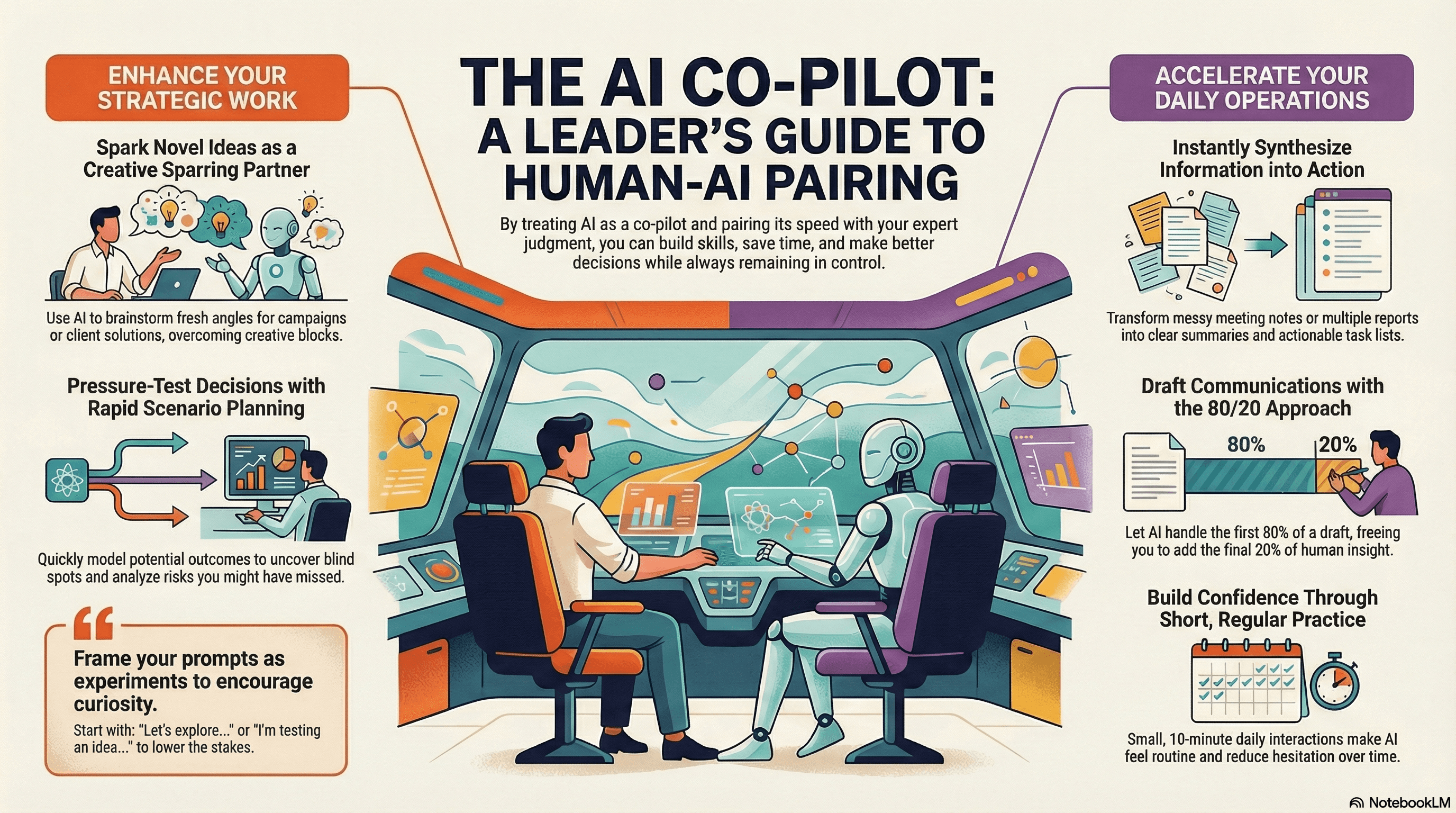

Sustainable AI integration does not come from massive, one-off initiatives. It comes from building small, low-risk habits into the workday. When executives treat AI as a daily practice—not a side project—they learn faster, protect their judgment, and gain time back week after week.
This course treats AI as a practical copilot for leaders, not a threat to their expertise. You will learn how to adopt a learner’s mindset so every interaction with AI is treated as an experiment, not a performance review. You will see how to pair your expertise with AI’s speed and pattern recognition, and how short, regular practice sessions can make AI feel as normal as email. The aim is simple: help you make better decisions in less time.
Across real executive use cases, this approach delivers consistent results. Leaders use AI as a creative sparring partner for brainstorming, a writing coach for high-stakes communication, and a sounding board to tighten delegation and priorities. In strategic planning, they use AI to pressure-test scenarios and expose blind spots that would otherwise go unchallenged. Work that once took hours is often reduced to minutes, while the quality of thinking, communication, and strategy improves.
Core Principles for Sustainable AI Adoption
The course is built on three principles that keep AI useful and manageable in an executive context.
The Experimenter’s Mindset
Executives who adopt AI successfully do not start by asking, “Is this perfect?” They start by asking, “What can I learn from this?” That shift lowers the stakes and makes room for curiosity instead of defensiveness.
Using learner-minded prompts such as “Let’s explore…”, “I’m testing this out…”, or “Give me three options to react to…” sets the tone. You are not locking in a decision; you are gathering raw material. This mindset also signals to your team that it is acceptable to try, adjust, and improve. When leaders model visible experimentation instead of quiet skepticism, employees are far less likely to hide their AI use or wait for permission.
Human–AI Pairing
High-performing executives do not hand over decisions to AI; they pair AI with their own judgment. The pattern is simple: let AI generate a draft or analysis, then refine and upgrade it with your expertise.
In practice, this looks like placing AI output next to your own version and merging the best elements of both. For many tasks—summaries, outlines, first drafts—AI can comfortably do 70–80% of the groundwork. You then supply the final 20–30%: context, nuance, ethical judgment, and strategic direction. AI handles the grunt work; you keep ownership of what matters most.
The Power of Habit
The biggest gains do not come from the single “wow” moment; they come from daily repetition. Short, consistent practice builds familiarity, reduces anxiety, and steadily improves the quality of what you get back.
Dedicating 10–15 minutes a day to AI-assisted tasks is enough to move the needle. Over time, you develop “prompt intuition”: a feel for what to ask, how to refine, and when to stop. The tool also starts to reflect your preferences as you re-use patterns and refine prompts. Like compound interest, the returns from these small interactions accumulate: minutes saved here, an hour saved there, and whole categories of work become lighter and faster.
Practical Use Cases Across Executive Functions
Throughout the course, you will see how these principles translate into real work. The focus is on tasks you already do—brainstorming, writing, planning, delegating—not on abstract demos.
Ideation and Brainstorming
At the front end of projects, AI is a fast brainstorming partner. A short session can surface angles, questions, and cost-saving ideas that would have taken days to assemble from scratch. Leaders use AI to generate options, then blend the strongest ideas with their own judgment and brand knowledge. The goal is not to accept AI’s first answer, but to widen the field of possibilities quickly.
Communication and Synthesis
Executives spend a large share of their time translating complexity into clear messages. AI sharply reduces that load.
HR leaders use AI to co-draft sensitive communications so the tone is clear, firm, and humane. Operations leaders feed in messy meeting notes and ask for a clean summary with decisions, owners, and deadlines. Division heads use AI to condense multiple long reports into a one-page brief, then layer on their strategic perspective. Across these examples, AI handles structure, clarity, and first drafts; the leader applies context and final approval.
Strategy and Decision Support
In strategy work, AI shines as a pressure-tester. It can model “what if” scenarios, list second- and third-order consequences, and stress-test optimistic plans.
Executives use AI to compare build-versus-buy options, explore market-entry paths, or outline risks in a proposed initiative. Because the system has no stake in office politics, it will raise questions and edge cases that an internal group might gloss over. This does not replace detailed financial or legal analysis, but it accelerates the thinking that comes before those steps and sharpens the questions you bring to experts.
Personal Productivity and Leadership Development
AI also fits into the quieter side of leadership: planning your week, clarifying your expectations, and reflecting on what is working.
A short daily planning ritual with AI—reviewing priorities, drafting a focused to-do list, or summarizing yesterday’s progress—can create more intentional days. Leaders also use AI to “test” a delegation message by asking, “If you were receiving this, what would you still find unclear?” That simple move exposes vague instructions, missing context, or unspoken assumptions before the message hits someone’s inbox.
Outcomes You Can Expect
Leaders who apply these practices report two types of benefits: hard time savings and softer, but equally important, upgrades in how they think and lead.
On the measurable side, tasks like writing summaries, preparing briefings, and cleaning up notes routinely shrink from hours to minutes. Over a month, those reclaimed pockets of time add up to multiple hours that can be redirected to higher-value work.
On the qualitative side, AI serves as a catalyst. It helps you see around corners faster, articulate ideas more sharply, and communicate with greater empathy and precision. Your confidence grows because you are no longer reacting to AI as an abstract threat; you are using it, shaping it, and seeing concrete results.
As leaders openly adopt a learner’s mindset and visibly practice with AI, they change the culture around them. Teams feel more permission to experiment and more supported in learning. That shift—toward curiosity, transparency, and continuous improvement—is the real long-term payoff of integrating AI into executive workflows.