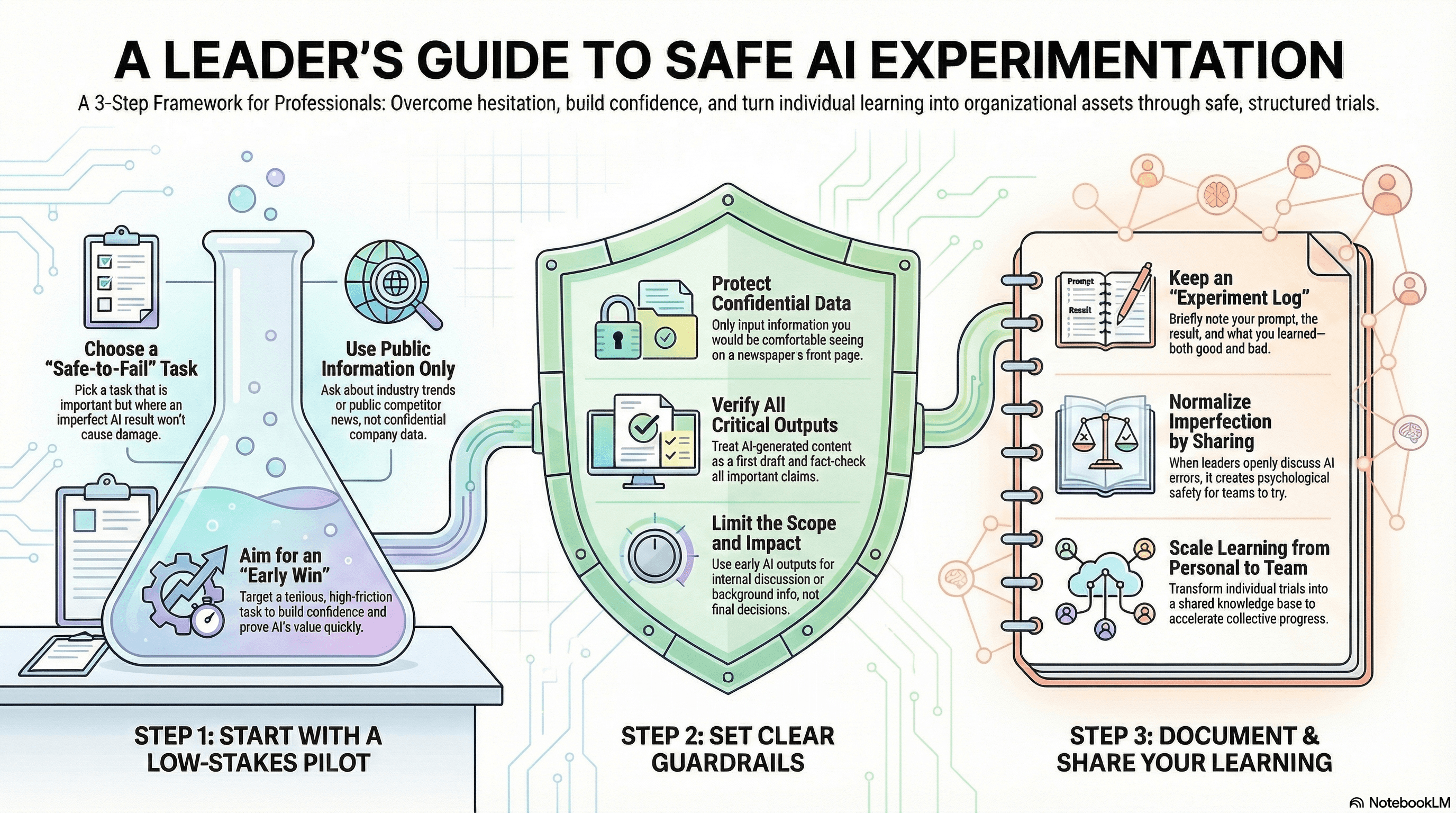

This lesson presents a practical framework for turning AI skepticism into confident, responsible adoption. The model uses a simple three-part cycle: start with a low-stakes pilot, add clear guardrails, and deliberately document and share what is learned.
Leaders begin by choosing a task that matters but is not mission-critical—work they can safely experiment on without risking clients, revenue, or reputation. Next, they define rules around data, quality checks, scope, and ethics so AI can be used boldly without losing control. Finally, they capture and socialize their experiments so that individual trials become shared playbooks.
The Principle of the Low-Stakes Pilot
The starting point for sustainable AI adoption is a low-stakes pilot. In our case example, an executive named Marcus uses ChatGPT to gather public information on industry trends and a key competitor. The task is familiar and useful, but if the AI fails, nothing important breaks.
Characteristics of an effective pilot
Reversible: If the output is weak, it can be ignored and the old method reused.
Based on public information: Prompts rely on non-sensitive, publicly available data.
A “high-friction” task: The work is tedious but non-critical, such as summarizing reports or scanning articles.
Marcus’s first attempt does not produce magic, but it does surface a regulatory angle he had overlooked. That small win gives him enough evidence to try a more ambitious task next. Early wins of this kind keep leaders engaged long enough to get better at using the tools.
Common pitfalls when choosing a pilot
Starting with a mission-critical deliverable: A board packet, public statement, or investor memo is a poor first test. Begin with internal drafts and prep work.
Being vague or overly broad: Prompts like “Tell me what we should do next year” invite shallow, generic output. Narrow the ask to a specific question, market, or competitor.
Expecting a miracle: Treating AI as an oracle guarantees disappointment. See the pilot as a way to learn how to work with the tool, not as a one-click strategy engine.
Establishing Essential Guardrails for Safe Experimentation
Once an initial pilot produces value, the next step is to formalize guardrails—simple rules that let you experiment without inviting chaos. Before asking ChatGPT to help with a competitor SWOT analysis, Marcus wrote down a few personal rules.
Core categories of AI guardrails
Data guardrails (privacy and confidentiality): Public AI tools should never receive information you would not share outside the company. Use anonymized, hypothetical, or public data for sensitive topics.
Quality guardrails (verification and judgment): AI output is a first draft, not a final answer. Surprising or critical claims should be checked against primary sources.
Scope guardrails (limiting impact): Early on, AI-generated content should stay inside the team as input for discussion, not as polished deliverables. Frame outputs as “ideas to react to,” not finished products.
Ethical guardrails (transparency and honesty): When AI meaningfully shapes work that affects others, do not hide that fact. Clear, simple disclosure builds trust and invites constructive questions.
Common pitfalls when setting guardrails
Ignoring confidentiality: Pasting unreleased product details, employee issues, or internal financials into a public AI tool creates real risk. Treat the system like a smart intern who is not under NDA.
Blindly trusting the output: Confident language from the AI is not proof of accuracy. Teams that skip verification end up building plans on bad information.
Having no usage boundaries: Without clear expectations, people may start using AI for decisions or communications that require human judgment. Leaders should say plainly where AI is welcome and where human control remains absolute.
Documenting and Socializing Learning
The final piece of the framework is turning individual experiments into shared, reusable knowledge. After his early successes, Marcus created a simple “AI Experiment Log” where he captured what he tried, which prompts he used, what worked, and what went sideways.
Why documenting the process matters
It normalizes imperfection: Logging both wins and misfires signals that mistakes are part of learning, not evidence of incompetence.
It captures actionable insight: Details that feel obvious in the moment—prompt tweaks, useful follow-up questions, better ways to narrow the task—are easily forgotten. Writing them down turns trial-and-error into a lightweight playbook.
It enables scaling: When experiment notes are shared, private tests become shared starting points. Over time, these logs can evolve into a simple internal guide to common use cases, good prompts, and recurring pitfalls.
Practical ways to document and share
Keep a simple journal: After each experiment, jot down the task, your prompt, the outcome, and one or two key lessons.
Track process metrics: Note not just whether the experiment “worked,” but how it changed your work—time saved, options surfaced, or clarity gained.
Share in low-pressure forums: Use a recurring agenda item or a dedicated channel for people to share what they are trying. Emphasize learning, not performance.
Common pitfalls in learning documentation
Only celebrating wins: If you only highlight the glossy successes, people will hide their messier attempts and the organization will learn more slowly.
Relying on memory: Without quick notes, everyone re-learns the same lessons from scratch.
Keeping everything siloed: When one person hoards their learning, the organization stays dependent on a few early adopters instead of building a broad base of confident users.
From Paralysis to Momentum
Marcus’s journey reflects a pattern many leaders will recognize. He does not become less experienced or cautious; he simply gives himself permission to experiment in a structured way. By starting with a low-stakes pilot, setting sensible guardrails, and documenting what he learns, he turns vague anxiety into informed, repeatable practice.
The payoff of this framework is momentum. Safe-to-fail experiments create a bridge between theory and action. Guardrails protect what matters most while giving people freedom to explore. Shared learning compounds over time, making every new experiment cheaper and more valuable than the last.
The deeper mindset shift is this: AI is not a threat to hard-won expertise; it is a force multiplier for it. The real danger is not trying and stumbling, but standing still while the landscape moves. Leaders who embrace this cycle—pilot, protect, and share—position themselves and their organizations to learn faster than the world changes, with AI as a co-pilot instead of a competitor.