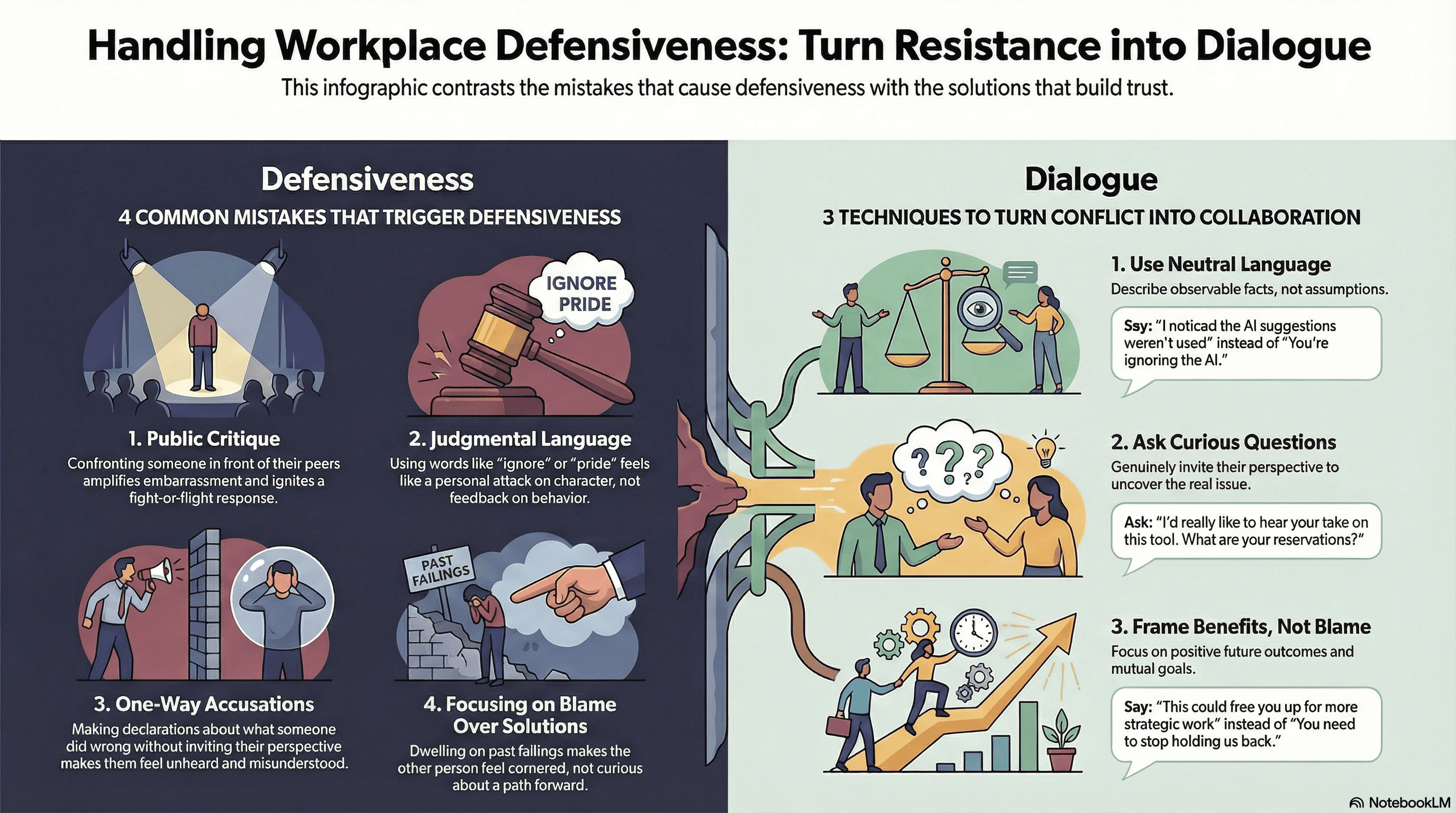

This briefing explains a communication strategy for handling resistance to change, especially resistance driven by pride or fear of becoming obsolete. “Naming the Pattern Without Shaming” gives leaders a way to confront unhelpful behavior while preserving dignity and status. At its core, the approach asks leaders to describe behavior in neutral terms, get genuinely curious about what is driving it, and frame change around shared benefits instead of blame.
Used consistently, these moves make prideful resistance workable rather than immovable.
Case Study: When Naming the Pattern Backfires
Alex, a VP at a manufacturing firm, wants managers to adopt a new AI scheduling tool. Sam, a veteran manager, keeps relying on manual methods and ignoring the tool’s recommendations.
In a weekly operations meeting, Alex calls Sam out in front of the team: “Sam, you keep ignoring the AI recommendations. We’ve given you a tool to improve forecasts, but it’s like you don’t want to use it.”
Sam stiffens. “I’m not ignoring it. Maybe I just trust my 20 years of experience more than a shiny new toy.”
Alex replies, “Experience is great, but we can’t cling to old ways out of pride.”
That last word—pride—lands as a direct hit on Sam’s identity. He snaps: “Out of pride? If you think I’m the problem, maybe I shouldn’t be in these meetings.”
The fallout:
Sam shuts down, avoids Alex, and disengages from the initiative.
The AI tool is sidelined. The rollout stalls not because the tech is weak, but because the conversation turned into public shaming.
Alex tried to confront a real pattern—prideful resistance to a new tool—but did it in a way that attacked status and self-respect. Once that line is crossed, learning stops and self-protection takes over.
What Went Wrong
A few specific choices turned a coaching moment into a blowup.
Alex confronted Sam in front of peers, which amplified threat and embarrassment. Instead of being invited into reflection, Sam was cornered. He also used loaded language: phrases like “ignoring the recommendations” and “clinging to old ways out of pride” implied laziness, stubbornness, and ego. Sam heard, “You’re the problem,” not, “We have a problem to solve.”
On top of that, Alex never asked for Sam’s perspective. He delivered a verdict without a single question, giving Sam no room to express doubts about the tool or pressures he was facing. And the exchange focused entirely on blame—what Sam hadn’t done—rather than exploring how Sam’s experience and the AI could work together.
The core question—how to use AI in a way that honors expertise—never even enters the conversation.
The Constructive Approach: Three Core Techniques
After the conflict, Alex’s mentor, Diane, helps him reset. She gives him a simple structure for re-engaging Sam: use neutral language, ask curious questions, and frame benefits, not blame.
Use Neutral Language
Neutral language describes events the way an unbiased camera would record them: no exaggeration, no mind-reading, no labels.
In a private meeting, Alex opens with: “I noticed that in the last two project plans, the AI recommendations weren’t included.”
He avoids trigger words like “ignoring” or “refusing” and uses “I” statements to anchor the concern in shared outcomes: “I’m worried we’re not getting the full benefit of this tool yet.”
That shift lowers the temperature. Sam may still feel cautious, but he is no longer defending his reputation in front of a crowd. The conversation can move.
Ask Curious Questions
Once the situation is named neutrally, Alex leans into curiosity instead of accusation.
“How do you feel about this new tool? I get the sense you have reservations, and I want to understand them.”
This signals respect. Sam is treated as a partner in solving the problem, not a culprit. As he talks, real issues surface: he doubts the AI can handle the nuance he’s built over 20 years and worries the tool will make his role look less valuable.
Alex reflects back what he heard: “It sounds like you’re concerned the tool might miss details your experience catches, and that could undercut the value you bring. Is that accurate?”
Being accurately understood softens Sam’s stance. The conflict shifts from “me versus you” to “us versus the problem.”
Frame Benefits, Not Blame
With the real fears on the table, Alex pivots to what could be gained by integrating the tool.
He connects the change to Sam’s values: “I don’t want to replace your judgment. I want the AI to handle the grunt work so you can spend more time on strategy and client relationships—where your experience really matters.”
Rather than replaying past failures, Alex describes a better future: faster forecasts, fewer late nights, more time solving complex issues. He proposes a low-risk pilot where Sam’s team uses the AI on a limited set of projects, with a review point built in.
He also reinforces Sam’s importance: “Your performance and judgment are strong. I’m asking how we can use this tool to amplify your strengths, not compete with them.”
The AI stops being a threat to Sam’s identity and starts becoming a way to extend his impact. Sam agrees to try the pilot.
Scaling the Approach: From One Conversation to Culture
Alex then applies the same pattern with his broader leadership team.
He opens with neutral, respectful language: “We have a lot of experience in this room. I also know that trying a new tool in the middle of busy operations can feel risky. I’ve felt that myself.”
He follows with curiosity: “What concerns or hopes do each of you have about using AI in your workflows?”
The room moves from guarded silence to an honest list of issues: data security, time to learn, fear of losing control. Instead of dismissing these concerns, Alex treats them as design inputs.
Finally, he frames collective benefits. He asks them to imagine a version of their work where repetitive reporting is automated, late-night emergencies are fewer, and they have more time for strategy and coaching. The tool becomes a lever for outcomes they already care about, not just another mandate.
By the end of the meeting, one leader volunteers their team for the next pilot, and others ask for training instead of quietly dragging their feet. The culture starts to shift from quiet resistance to cautious engagement.
Key Takeaway for Leaders
“Naming the Pattern Without Shaming” is not about softening the truth. It is about delivering the truth in a way that preserves dignity and invites ownership.
When you describe what you see in neutral, specific terms, ask curious questions that surface real fears and constraints, and frame change around concrete benefits and shared goals, you create the conditions for prideful resistance to soften into participation. People stop feeling like they are the problem and start seeing themselves as part of the solution. That shift is what makes real adoption possible.