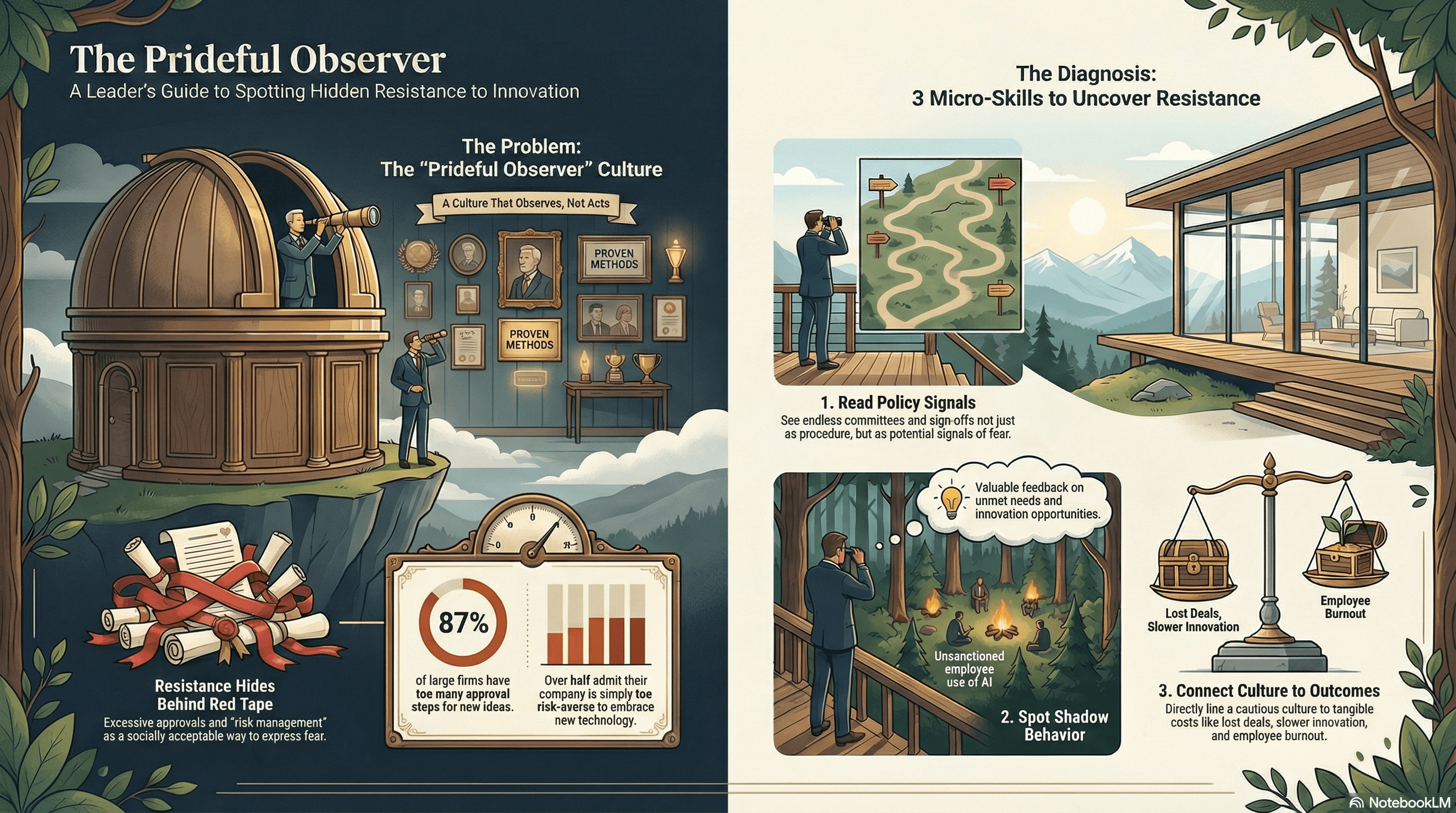

This briefing explains “prideful observer culture,” a pattern where organizations proudly watch new technology from a safe distance while clinging to what has always worked. It looks like rigorous caution, but is often driven by fear of the unknown, fear of failure, and fear of losing status or control. Pride in past success hardens into slow decisions, long approval chains, and an unspoken rule: better to critique than to try.
Innovation does not stop in these environments; it goes underground. People experiment in secret with tools like ChatGPT because formal channels feel too slow or too skeptical. The result is delayed projects, missed opportunities, tired teams still doing work the hard way, and ambitious talent drifting toward faster-moving organizations.
To help you shift this pattern, this briefing introduces three micro-skills:
• Read Policy Signals – See how rules and approvals reveal what the organization is really afraid of.
• Spot Shadow Behavior – Treat unofficial use of new tools as feedback about friction and unmet needs.
• Connect Culture to Outcomes – Link your stance on innovation to the business results you say you care about.
The real solution is not a clever AI tool. It is a leadership shift from pride and fear to curiosity and courage.
What Prideful Observer Culture Looks Like
A prideful observer culture prides itself on not being “fooled by fads.” Leaders point to years of success and insist that proven methods are safer than untested tools. In practice, it often means no one wants to feel like a beginner again or risk being wrong in public.
James, a manufacturing COO, delayed using AI for equipment monitoring by repeating, “We’ve done this for fifty years.” Later, he admitted he was worried about looking uninformed in front of his engineers and board. Pride in past performance had become a shield against feeling vulnerable. In environments like this, slowness is equated with wisdom, committees spread responsibility so no one has to sponsor a bold move, and people who raise fresh ideas are praised in public but quietly stalled.
Micro-Skill 1: Read Policy Signals
Policies and governance structures are not neutral. They tell a story about what leaders value—and what they fear.
Maria, a hospital CEO, tried to introduce an AI triage tool for emergency staff. On paper it matched every stated priority. In reality, the project was slowly suffocated by a long approval journey through department review, ethics, IT security, an innovation council, and the board. Maria sensed a shared subtext: fear of liability, fear of upsetting senior specialists, fear of disrupting routines. By the time the pilot was approved, urgency had vanished and the project fizzled.
Reading policy signals means noticing which ideas move quickly and which always get stuck in “just one more review,” where “risk” language is masking discomfort or ego, and which protections are truly about safety versus protecting pride. When you treat policies as emotional signals instead of just checklists, you can redesign them to manage genuine risk without letting fear quietly run the show.
Micro-Skill 2: Spot Shadow Behavior
In prideful observer cultures, innovation often shows up first as rule-breaking.
Devin, a VP at a financial firm, discovered his analysts secretly using ChatGPT to write summaries and generate code, despite a company-wide ban. Conversations with the team revealed that official tools were clunky, deadlines were brutal, and prior requests for better support had gone nowhere. “If we wait for permission, we’ll miss the deadline,” one analyst said.
Shadow behavior—unsanctioned tools and experiments—is a double signal. It is a risk signal, because sensitive data might be exposed and leaders lack visibility. It is also a creativity signal, because people are motivated enough to find better ways even without support. Instead of only cracking down, ask where people are quietly bypassing official processes, what frustration or aspiration is driving that behavior, and how you could create a safe, supported version of what they are already doing in the shadows.
Used well, shadow behavior becomes a map of where your systems are failing and where demand for innovation is highest.
Micro-Skill 3: Connect Culture to Outcomes
Jasmine, a tech services CEO, watched her firm lose a major AI-powered support contract. Her team had the capability. What they lacked was cultural readiness. Some leaders doubted whether they should be in AI at all. Others fixated on liability and worst-case scenarios. Meetings circled the same concerns until a smaller, bolder competitor stepped in, delivered quickly, and won the deal.
Connecting culture to outcomes means naming how this pattern hits the metrics you already track. How many deals, partnerships, or pilots have you delayed or declined because AI feels threatening? Where are people still doing manual work AI could safely assist with, and what is that costing you in time and burnout? What signal are you sending to ambitious employees when curiosity is met with silence or suspicion?
Once you see culture in your pipeline, timelines, and turnover, the need for change stops being theoretical.
From Diagnosis to Action
Step two is creating conditions where experimentation feels possible, safe, and worthwhile.
Practical moves include simplifying the path to pilots with a clear, lightweight process for low-risk AI experiments; creating sandboxes where the default is to try, measure, and learn rather than to block by habit; and recasting committees from gatekeepers into enablers whose role is to help teams launch responsible pilots, not bury them. Assume resistance is a rational response to how work is structured. Change incentives, workflows, and signals instead of blaming individuals.
Most of all, this shift requires visible leadership humility. Leaders must be willing to learn in public, share both wins and awkward attempts, and celebrate employees who discover better ways—even when those ways challenge long-held expertise.
Principles to Carry into the Course
Key principles:
• Policies are clues – Every approval step and review reflects not just what you value, but what you fear.
• Shadow AI is feedback – When people innovate in secret, they are telling you where your systems are too slow or too rigid.
• Culture drives numbers – Your stance on AI shows up in revenue, cost, speed, quality, and talent retention.
• Humility unlocks progress – The example you set—curious, open, willing to be a learner again—is your most powerful lever.
Prideful observer culture is not destiny. It is a set of habits. With deliberate attention, you can rewrite those habits, move your organization off the sidelines, and into the arena where innovation actually happens.