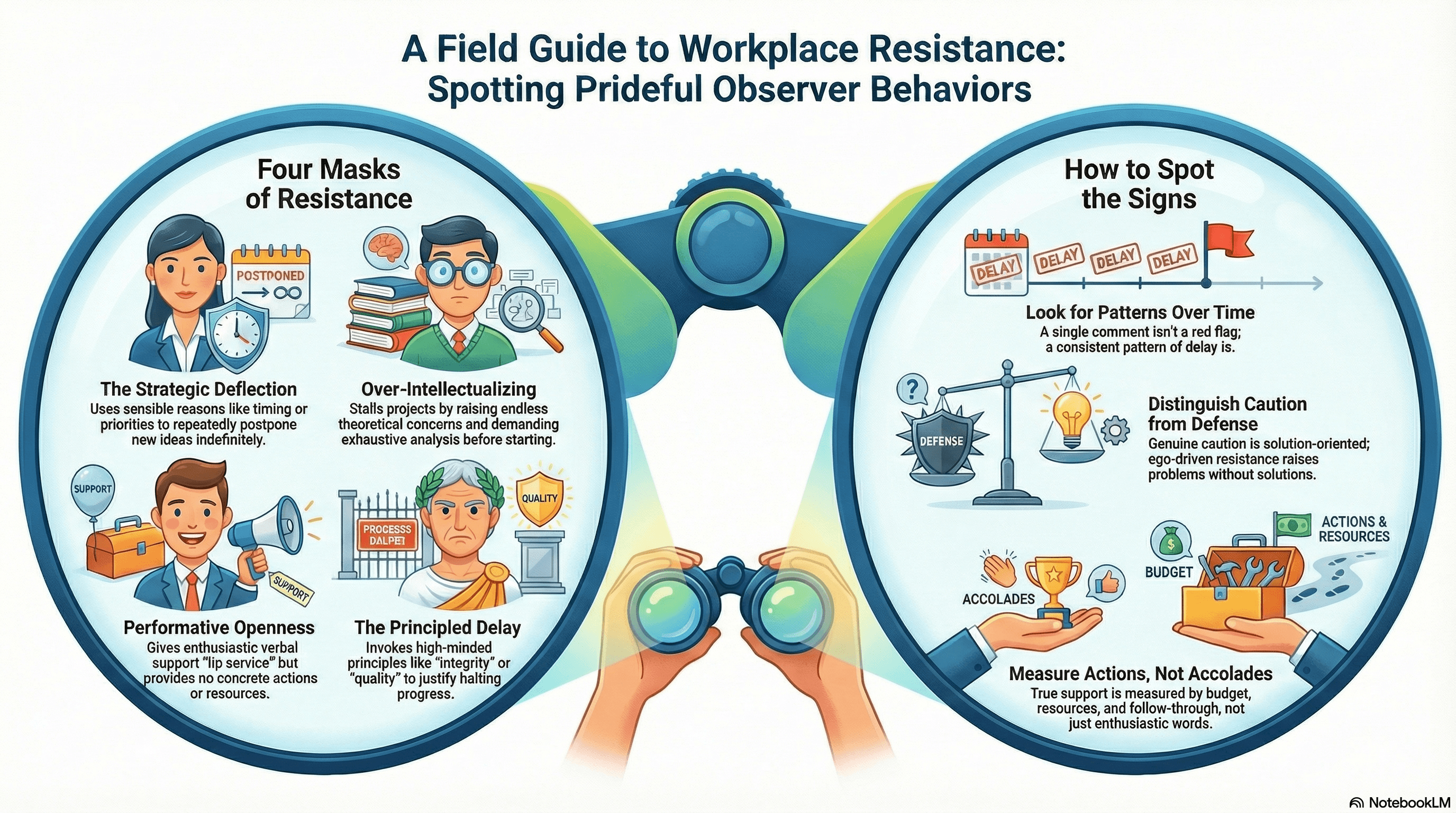

This lesson explores “Prideful Observer Behaviors” – quiet, ego-driven ways leaders and experts slow down AI adoption without ever saying “no.” Instead of open conflict, resistance shows up as polite questions, strategic delays, and principled concerns that sound reasonable but keep the organization in place. You will focus on four recurring patterns: Strategic Deflection, Over-Intellectualizing, Performative Openness, and Principled Delay.
These patterns drain momentum, discourage experimenters, and teach everyone that it is safer to stand back than to learn in motion. The goal is not to shame people who behave this way. Often they are high performers who feel threatened or overwhelmed. Your task as a leader is to recognize the pattern, see the fear underneath it, and respond in a way that invites movement instead of more debate.
What Prideful Resistance Looks Like
Prideful resistance is a human response to what AI represents: disruption, loss of control, and unfamiliar rules of winning. It is rooted in ego (“Where does my expertise fit now?”), fear (“What if I can’t keep up?”), and comfort (“I know how to succeed in the current system”). It rarely sounds negative. Instead, it is wrapped in professional language about priorities, risk, and quality, which makes it hard to challenge without sounding reckless. You will often see it in people whose influence rests on deep manual expertise or on being the final decision-maker: they talk positively about innovation while quietly blocking the specific changes that threaten their identity or routines.
Four Archetypes of Prideful Resistance
Strategic Deflection
Strategic Deflection is when someone publicly agrees that AI is important but keeps pushing real action into the future. The default move is “not now.” The language sounds responsible – “We need to stabilize the core first,” “Let’s revisit next year,” “Once the dust settles, we can pilot this” – and a Head of Operations might repeat these lines every quarter while nothing actually starts. The driver is a desire to protect familiar processes and avoid the messy learning curve of change while still appearing supportive, and the tell is a long trail of postponed initiatives, each justified by a different “urgent priority.”
Over-Intellectualizing and Analysis Paralysis
Over-Intellectualizing slows progress by flooding the work with complexity: edge cases, theoretical pitfalls, and exhaustive analysis requirements before any small test can begin. A senior analyst might insist, “Before we do anything, we need a comprehensive framework to test every scenario this model might face,” adding new layers of analysis each time the team moves toward a pilot. This pattern is common among experts whose identity rests on mastering complexity; a tool that simplifies their domain feels like a threat. Healthy caution helps design a test; Over-Intellectualizing keeps the team stuck in endless preparation.
Performative Openness and Lip Service
Performative Openness is loud verbal support for AI with no real follow-through. The person praises innovation in public and positions themselves as a champion, then quietly does nothing to move the work forward. A sales leader might say, “This is fantastic, I’m a huge supporter of AI,” yet never volunteers a team, shares data, or adjusts targets. The motive is image management – wanting the reputation of being future-focused without taking on the risk or discomfort of actual change – and the gap between positive statements and concrete commitments is the clearest sign.
Principled Delay
Principled Delay leans on important values – integrity, fairness, safety, customer trust – to justify halting or indefinitely postponing AI initiatives. A risk leader might argue, “We should delay deployment until we thoroughly vet the model for bias and errors. Our values emphasize excellence and integrity.” Sometimes that stance is exactly right; it becomes Principled Delay when “thoroughly vet” is never defined, each proposed safeguard is “not enough,” and there is no clear timeline to move forward. Sincere caution is specific and solution-oriented; Principled Delay stays vague and resists time-bound criteria.
Turning Resistance into Momentum
Recognizing these archetypes is only useful if you change how you respond. Calling someone “defensive” or “afraid of AI” almost always hardens their stance. A better approach is to respect the concern they name, look for patterns, and steer the conversation toward small, contained actions.
With Strategic Deflection, do not accept “later” at face value; ask, “What would need to be true for us to run a low-risk pilot this quarter?” then shrink the scope, remove obvious blockers, and agree on a real start date. With Over-Intellectualizing, acknowledge the expertise and convert abstract worries into a testable experiment: “Let’s run the AI in parallel with the current process for a short period and evaluate it using your criteria,” shifting the focus from theory to evidence. With Performative Openness, translate praise into commitments: “Could your team be our first pilot, and when could you start?” If they pull back, the gap between words and actions becomes visible and can be explored directly. With Principled Delay, validate the value being invoked (“You’re right that integrity matters”) and immediately move to structure: “What specific tests or guardrails would make you comfortable starting a limited pilot, and by when could we have them in place?”
Key Insights for Leaders
• Resistance wears a professional mask. Ego-driven avoidance rarely shows up as open hostility. It arrives as sensible concerns about timing, risk, or values.
• Patterns matter more than moments. Anyone can ask for a delay or raise a tough question once; prideful resistance reveals itself through repeated deflection, endless analysis, or a chronic gap between words and actions.
• Action is the real test of support. Enthusiastic statements and clever questions mean little without corresponding moves: pilots launched, time allocated, people reassigned, metrics updated.
• Empathy unlocks movement. These behaviors are usually driven by fear of losing relevance, control, or status. When you address those fears directly – by creating learning time, sharing credit, or defining clear guardrails – you are more likely to turn a Prideful Observer into a curious participant.
As you work through this course, use these archetypes as a lens rather than a weapon. Notice where they show up in your organization and, more importantly, where they show up in you. The leaders who will benefit most from AI are not the ones who never feel threatened. They are the ones who can name their own resistance, choose learning over pride, and help others do the same.