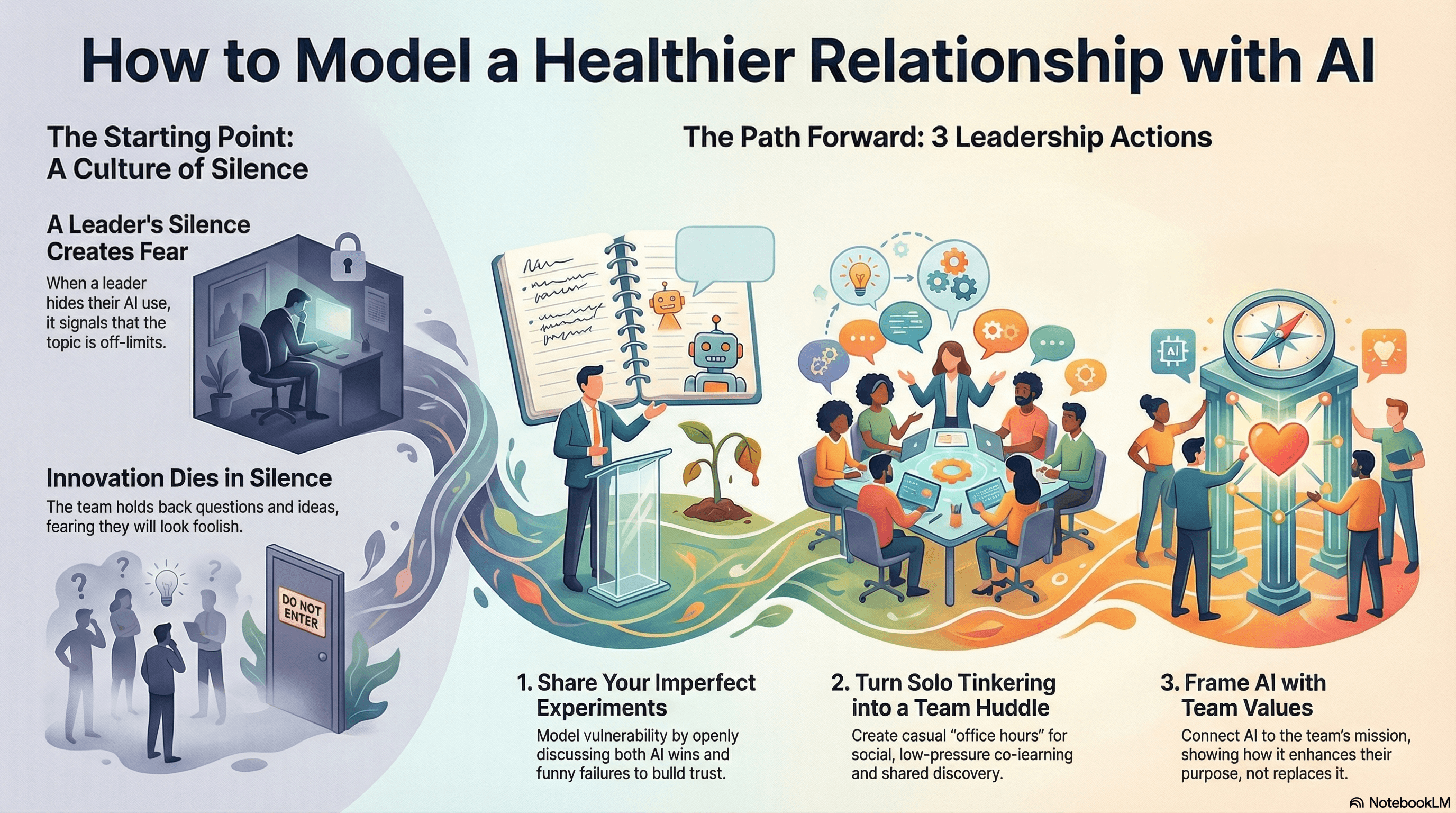

This lesson outlines how leaders can model a healthy relationship with artificial intelligence so it becomes part of everyday work rather than a distant initiative. The core reality is simple: people copy what leaders do. If leaders treat AI as something to quietly figure out on the side, teams learn to wait, watch, and protect themselves. When leaders use AI openly, talk honestly about it, and connect it to the team’s purpose, AI turns from a threat into shared opportunity.
Three leadership behaviors reliably shift teams out of passive observation. First, leaders who are transparent about their own AI experiments—especially the awkward, imperfect ones—create psychological safety. Second, leaders who move from solo tinkering to shared experimentation turn AI from a private project into a social, energizing activity. Knowledge spreads quickly, and even skeptics find a low-risk way to participate. Third, leaders who tie AI use to the team’s values and mission help people see technology as a tool to protect what they care about.
These behaviors move teams from anxiety to active, collaborative exploration.
Leading with Transparency and Vulnerability
The first decision is whether leaders stay silent about their AI learning or bring it into the open. Silence can feel safer, but it quietly freezes the culture.
When a leader experiments with AI in private and never mentions it, people assume AI is either irrelevant or risky to talk about. Curiosity goes underground. Early adopters keep their experiments quiet because they see no permission from above. The unspoken rule becomes: “We don’t talk about this here.”
The alternative is a leader who narrates the learning journey while it is still messy. Instead of hiding early attempts, they say, “I tried using ChatGPT to summarize last week’s client meeting. It saved me some time, but it also misunderstood a few points. Here’s what I changed.” Sharing both the win and the flaw normalizes imperfection, demystifies the tool, and signals that experimentation is expected.
Leaders do not need advanced technical skills. They need visible humility. The more they narrate their process—what they tried, what went wrong, what they adjusted—the safer it becomes for everyone else to take a first step.
Moving from Solo Efforts to Collaborative Co-Learning
Individual experimentation is a useful starting point, but a leader who figures things out alone gains efficiency while everyone else remains on the sidelines, unsure where to begin.
The real shift happens when leaders turn AI from a solo practice into a shared one. One practical move is to host informal AI huddles or office hours: short, low-pressure sessions where a small group brings real tasks—drafting an email, summarizing a report, analyzing a list—and everyone experiments together.
In one team, a single 45-minute huddle did more than weeks of scattered solo efforts. Someone discovered a way to make an AI scheduling assistant recognize time zones and immediately taught the rest. A skeptic who came just to watch it “mess up” ended up suggesting a better prompt and left amused and slightly proud that his wording unlocked better results.
Co-learning changes the emotional tone around AI. Instead of feeling like a silent performance test—“Can you keep up with this new tool?”—it becomes a group puzzle. People swap prompts, laugh at strange outputs, and trade small wins. The leader’s role is not to have all the answers, but to convene the space, protect the low-stakes atmosphere, and keep the focus on real work that matters to the team.
When teams start asking to repeat these sessions—turning them into a weekly coffee chat or a standing show-and-tell—you know the culture is shifting. AI is no longer something people quietly worry about; it has become something they learn together.
Grounding AI in Values and Purpose
Even with transparency and co-learning in place, adoption can stall if people feel that AI threatens what they value most. Long-tenured employees or highly skilled specialists may worry that AI will cheapen their work, lower quality, or be used as an excuse for cost-cutting. If leaders ignore these fears, resistance hardens.
The path forward is to put values at the center of the conversation. This starts with genuine listening. When a team member says, “I’m worried this will turn our service into something generic,” the leader resists the urge to argue. Instead, they acknowledge the concern and connect it to shared standards: “I hear you. Our reputation for high-touch service matters to me too.”
From there, the leader frames AI as a way to protect and extend those values, not replace them. For example: “If we let AI handle some routine drafting, we can spend more time on the thoughtful parts of the client conversation. The goal isn’t to sound robotic; it’s to free you up to be even more human where it counts.”
This framing only works if leaders are willing to draw clear lines. They must be explicit that certain decisions will remain human, that some uses of AI are off-limits if they undermine quality or ethics, and that they will challenge any push to treat AI purely as a shortcut. When people see that leadership is serious about protecting what matters, they become more willing to experiment with how AI can serve those priorities.
The Payoff: A Culture of Shared Learning
When leaders model vulnerability, convene co-learning, and keep values front and center, the culture starts to shift.
Conversations about AI move from whispered side comments to open, energetic discussions. Instead of prideful observers waiting on the sidelines, you see team members offering to share a prompt that worked or asking a colleague how they approached a tricky task. Failures do not disappear, but their meaning changes. A strange or incorrect AI output becomes learning fuel for the next iteration, not proof that someone should never have tried.
Over time, knowledge stops being trapped with a few early adopters. New discoveries and better practices spread quickly because people have regular spaces to talk about them. AI becomes less of a looming test of competence and more of a shared toolkit that everyone is gradually mastering together.
Most importantly, the team’s relationship with change itself begins to shift. Instead of viewing every new tool as a threat, people gain confidence that they can learn, adapt, and still honor their standards. A leader who is openly learning gives others permission to learn. A leader who stays curious helps others stay creative. And a leader who refuses to trade away core values shows everyone that technology can be used with integrity, not at its expense.
Modeling a healthy relationship with AI is less about being the most advanced user in the room and more about going first, out loud, and inviting everyone else to turn uncertainty into shared progress.