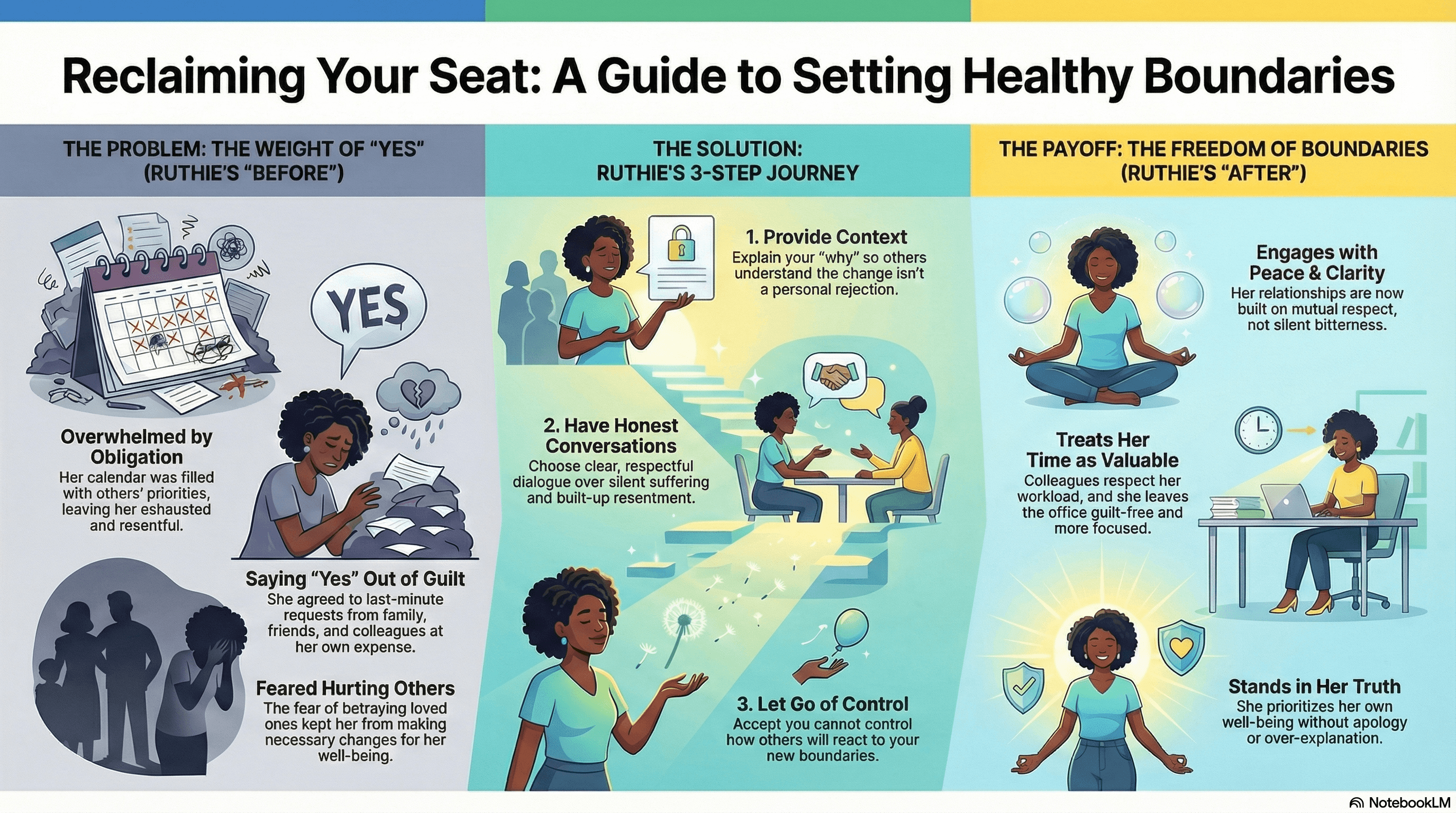

Clarity shows up in how you relate, how you communicate, and how you protect what matters without turning growth into conflict. Repositioning is not about cutting everyone off. It is about creating truthful access to you that matches who you are becoming. Repositioning starts when you admit that the current arrangement is not sustainable. Ruthie realizes she has been living as the dependable one in every room, the fixer at work, the emotional support in her friendships, and the automatic yes in her family. None of those roles are inherently bad, but when they become defaults, they quietly remove her from her own life. Repositioning means deciding what is still aligned, what needs to change, and what capacity you actually have. It is a move from unconscious loyalty to conscious integrity, where your relationships are still honored but no longer run by guilt.
The first key is that context matters because people cannot adjust to what they do not understand. Ruthie learns that sudden distance without explanation often feels like rejection, even when your intention is self-protection. Context does not mean you owe a full breakdown of your healing journey or a long defense of your choices. It means you give a clear why in language that helps the other person locate the change. For example, Ruthie tells her mother, “I love helping you, and I need to plan support instead of doing everything last minute because I am working on my health and balance.” That sentence offers respect, connection, and a new boundary without accusation. Context helps you reposition without burning bridges because it replaces guessing with clarity.
The second key is honest conversations, because clear communication reduces confusion and resentment. Ruthie stops hoping people will notice she is overwhelmed and starts naming what she needs while she still has respect in her voice. At work, she addresses a colleague who regularly hands her last-minute tasks by saying, “I can help when it is planned, but I cannot take on surprise work after hours anymore. If it comes in late, it will move to the next day.” Notice what makes this effective: it is direct, it focuses on behavior, it states a boundary, and it explains the new standard. Honest conversations also keep you from performing agreement while building silent anger. If you feel resentment growing, it is usually a signal that a truth is waiting to be spoken.
Repositioning with understanding also requires you to prepare for emotional discomfort. Ruthie has moments where she wonders if she is being selfish, ungrateful, or difficult, especially when her new choices disrupt old expectations. This is where many people quit and revert, not because the boundary was wrong, but because the discomfort feels unfamiliar. Ruthie learns to pause and separate guilt from truth. She asks herself, “Is this guilt coming from love, or from my old role being challenged?” She also learns to regulate her delivery, because calm is not weakness. Calm is credibility. When you speak from clarity instead of frustration, your boundary lands as a decision, not a threat.
The third key is letting go of control, because you cannot manage how others respond to your growth. Ruthie discovers that even when you communicate well, some people will still react with disappointment, defensiveness, or distance. A friend might say, “You changed,” as if growth is an insult. A family member might go quiet to punish you back into compliance. A coworker might test your boundary to see if you mean it. Letting go of control means you stop taking responsibility for reactions that are not yours to carry. Ruthie practices staying grounded by repeating a simple truth: “I am responsible for being clear and respectful. I am not responsible for making this comfortable for everyone.” This is how you protect your peace without becoming hardened.
In real life, repositioning often looks like small, consistent adjustments rather than one dramatic exit. It can look like changing how often you answer calls, setting time limits on emotional labor, declining events that drain you, or redefining your role on a team so you are not the default catch-all. Ruthie creates a new rhythm: she schedules family help instead of reacting to every request, she sets work boundaries that protect her evenings, and she chooses friendships that include mutual care. For you, the practice is simple and honest: identify one relationship where the current access does not match your values, decide what needs to change, write a one sentence context statement, and then have the conversation while you are calm. Repositioning is not just what you say once. It is what you consistently uphold.
Repositioning with understanding is the skill of making room for who you are becoming without creating unnecessary harm. When you provide context, you allow people to see you clearly while still honoring your limits. When you have honest conversations, you reduce confusion and keep resentment from building in silence. When you let go of control, you stop carrying responsibility for reactions and stay grounded in your truth. Ruthie Rose’s journey shows that growth does not require disappearance, and boundaries do not require hostility. It requires clarity, respect, and the courage to keep your seat at the table aligned with your life.