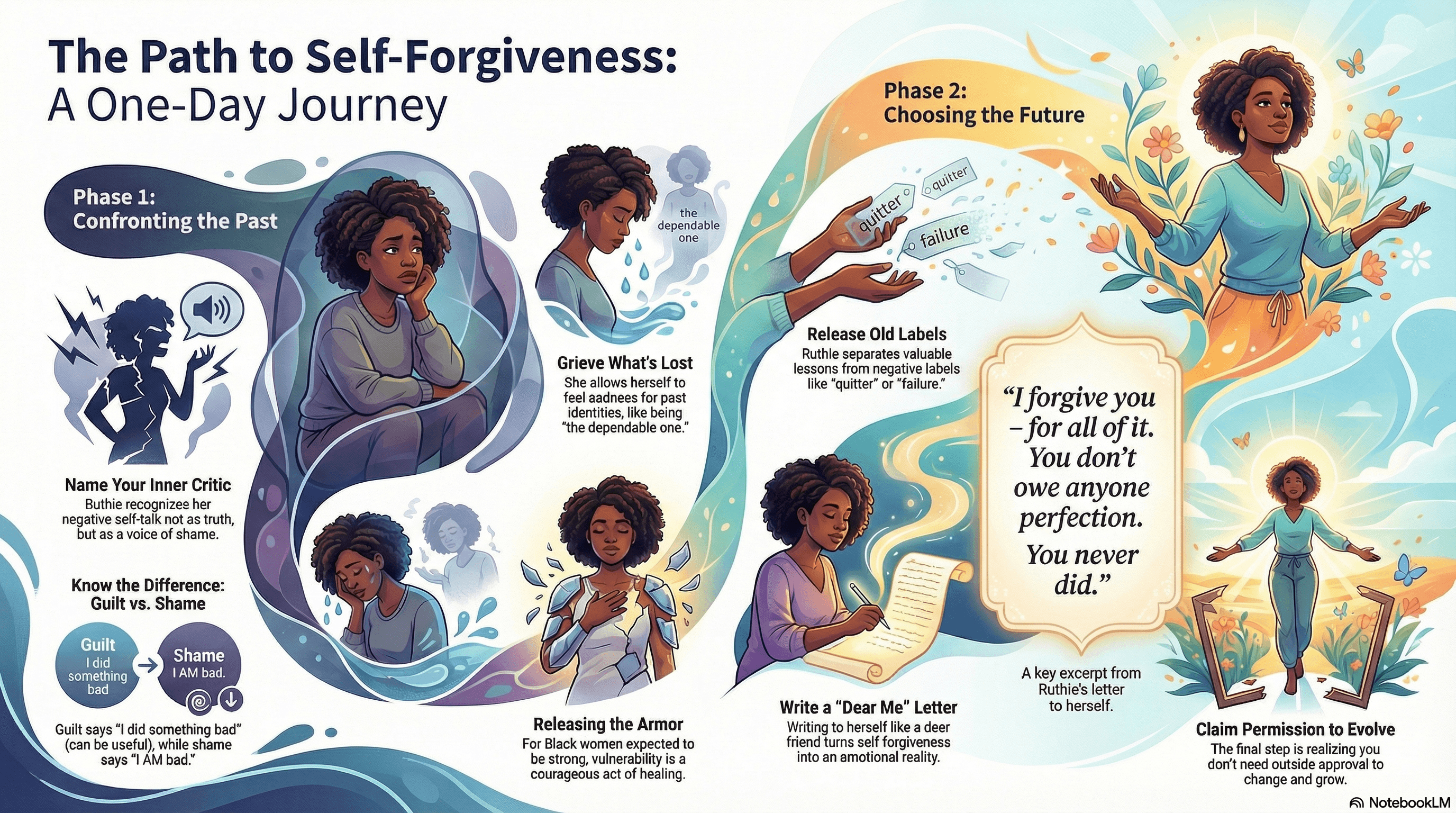

In the earlier lessons, we saw Ruthie Rose learn to name her values, track what drains or nourishes her, and set boundaries that protect her peace. This lesson turns the focus inward, because growth is not only about changing relationships and routines, it is also about changing the way you relate to yourself. The purpose here is simple and demanding: create space for self-forgiveness, release the weight of the past, and give yourself permission to move forward without dragging old shame into your next season. Ruthie is not trying to erase her history or pretend she never struggled. She is learning how to carry her story with clarity instead of punishment, so the person she is becoming has room to breathe.
Self-forgiveness is the foundation of sustainable growth because you cannot build a new life while constantly sentencing yourself for the old one. Many people confuse self-forgiveness with letting yourself off the hook, but it is the opposite. It is accountability without self-hatred. Start by separating guilt from shame. Guilt says, I did something that was not aligned, and it can guide repair. Shame says, I am bad, and it keeps you stuck. Ruthie notices that when she thinks about choices she regrets, her mind tries to label her as irresponsible, selfish, or too much. In this lesson, she practices naming what she carried, like people-pleasing, perfectionism, or survival habits that once protected her. Then she releases the shame attached to those habits by reminding herself that coping is not the same as character, and growth does not require punishment.
Ruthie’s turning point begins in an ordinary moment. She is washing dishes after a long day when a memory surfaces, a conversation she avoided, a boundary she did not hold, a time she stayed too long in something that was draining her. The old script shows up fast: You should have known better. Look at you. She pauses, because pausing is power. She places a hand on her chest and asks a different question: What was I trying to protect when I made that choice. This is how self-forgiveness starts, by getting curious instead of cruel. For you, this can look like a quick internal check-in: What did I need then. What do I know now. What would compassion say to me in this exact moment. Ruthie learns that the inner critic is loud, but it is not wise, and she can choose a steadier voice.
Self-forgiveness also requires truth, not just tenderness. Ruthie does not pretend her choices had no impact. If she recognizes that she hurt someone, she considers whether repair is possible, and she takes responsibility where it is appropriate. If she recognizes that she hurt herself, she acknowledges it directly, without minimizing it. The difference now is that she is no longer using regret as a weapon. She is using it as information. She looks back through the lens of her non-negotiable values and notices where she abandoned herself, overextended, or stayed silent to keep access. Then she makes a clear commitment: I will not keep paying for that lesson forever. Growth means you learn, you adjust, and you move forward. Staying in self-punishment is not integrity, it is stagnation.
Releasing the past does not mean forgetting. It means letting the past inform you without defining you. Ruthie realizes she has been carrying labels that were never meant to be permanent. She has called herself the one who always messes up, the one who cannot stick with anything, the one who has to prove she is worthy. This lesson helps her separate lessons from labels. A lesson sounds like, I need clearer boundaries with my time. A label sounds like, I am selfish for needing space. A lesson sounds like, I chose comfort over honesty. A label sounds like, I am a coward. Ruthie practices rewriting her internal language so that her history becomes a teacher, not a prison. You can do the same by taking one painful memory and asking, What did this teach me, and what story am I still telling about who I am because of it.
A common trap is using the past as an identity because it feels familiar, even when it hurts. Ruthie notices that some of her old narratives kept her connected to people who benefited from her staying small. If she believed she was always at fault, she would keep overexplaining, overgiving, and overfunctioning to earn peace. Another trap is confusing nostalgia with safety. You can miss who you were, and still outgrow what you tolerated. Another trap is thinking you must feel fully healed before you move forward. Ruthie learns that release is often a series of small decisions, not a dramatic moment. She starts practicing micro-releases: closing a mental argument, deleting an old apology text she was about to send out of guilt, or choosing rest without needing to justify it. Each small release returns energy back to her present life.
Permission to become is the final shift, because many people wait for approval they are never going to get. Ruthie has spent years trying to be understood before she is allowed to change, but this lesson teaches her that permission is an inside job. She gives herself permission to evolve, to choose alignment, and to trust what she has learned about herself. That permission shows up in practical ways. She stops auditioning for acceptance. She communicates calmly instead of defensively. She holds her boundaries without turning them into a debate. When guilt rises, she treats it as a signal that she is breaking an old pattern, not proof that she is wrong. For your practice, try a simple sentence you can return to: I am allowed to grow, even if it disappoints someone, even if it feels unfamiliar, even if I am still learning.
To bring everything together, Ruthie writes a Dear Me letter, not as a performance, but as a private act of closure and courage. In it, she names what she carried, she forgives herself for what she did to survive, she releases the labels that kept her anchored to an old version of herself, and she gives herself permission to become someone new. The lesson for you is clear: self-forgiveness is how you stop leaking energy into regret, releasing the past is how you keep the lesson without keeping the shame, and permission to become is how you move forward with self-trust. If you apply this lesson, your growth will feel less like a fight and more like a return to yourself, where your seat at the table is no longer something you earn through suffering, but something you claim through alignment and peace.