
It is late, the deadline is close, and your screen feels like it is judging you. In that moment, AI can look like the perfect escape hatch: paste the prompt, get a clean draft, hit send, go to sleep. But the real pressure is not the writing itself. It is the fear of sounding generic, getting caught with a fake fact, or being unable to explain what you “wrote” when someone asks a simple follow-up. This lesson is about keeping your credibility while still moving fast, so you can use AI without losing your voice or your confidence.
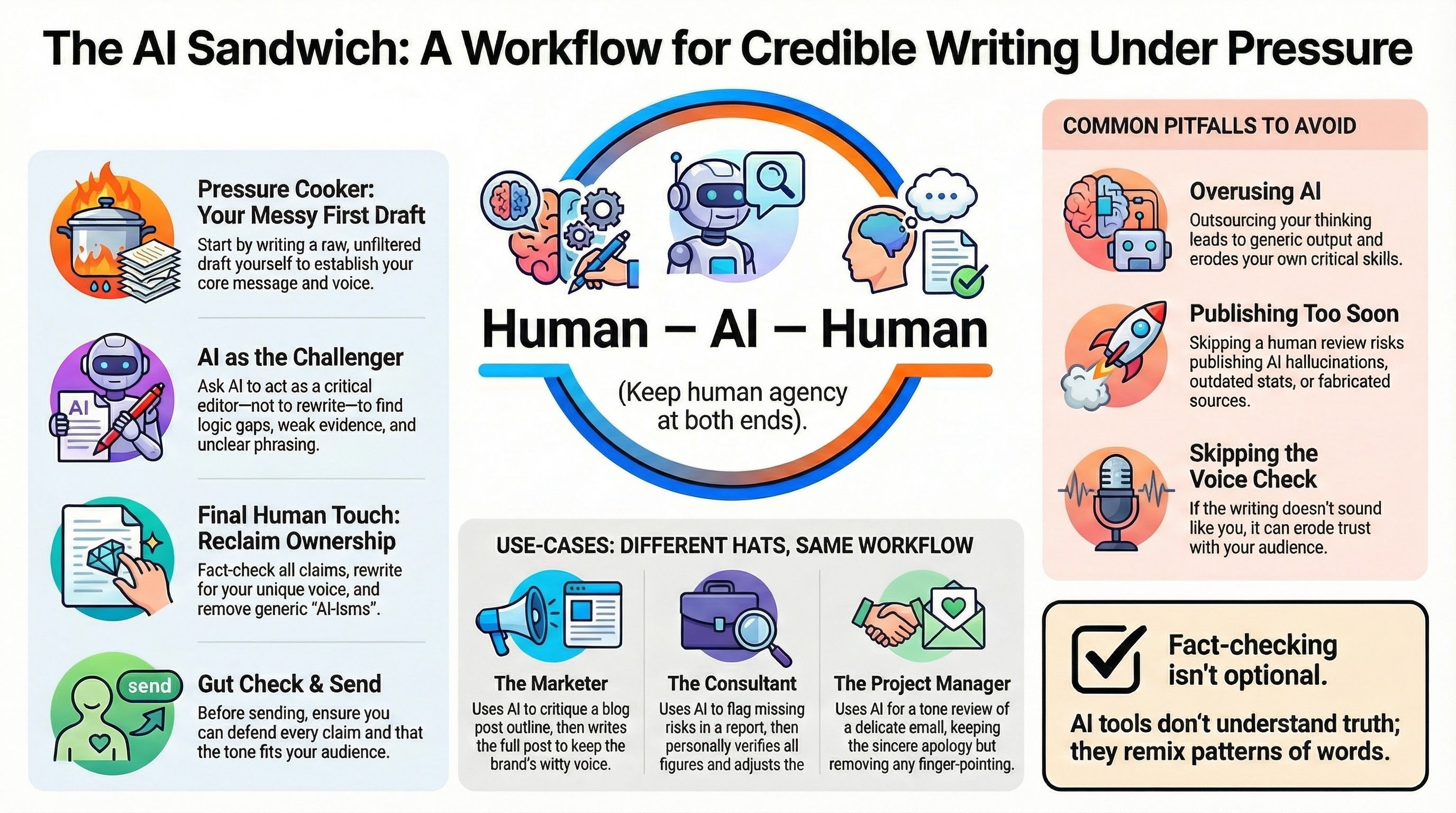
The core idea is a simple workflow you can repeat under stress: Human first, then AI, then human again. You start with your thinking, you use AI to challenge and strengthen it, and you finish by taking full ownership of the final product. This matters because speed without understanding is fragile. If AI sets your message, you risk ending up with bland language, shaky logic, or confident-sounding details that are wrong. When you bookend the process with your own effort, you protect what makes your work trustworthy: your perspective, your judgment, and your accountability.
In the first human phase, your job is to create a messy draft on purpose. Think of it as dumping your real thoughts onto the page before anything tries to “clean them up.” Write fragments. Use placeholders like “add example here” or “need a stat.” Let sentences be ugly. What you are really doing is choosing your angle, naming what you believe, and putting your voice on the page while it is still raw. This step feels slower, but it saves you from the common trap of letting AI decide what you meant. Even a rough line like, “Customers are changing how they buy, so we need to adjust our plan,” is more valuable than a polished paragraph you do not fully understand.
Once your draft exists, you are ready for the AI phase, but you must give AI the right job. Do not ask it to write your piece from scratch. Ask it to act like a tough editor and a thinking partner. Feed it your draft and request specific feedback: where your logic jumps too quickly, where you make claims without support, where your wording is vague, and where the structure loses the reader. Tell it clearly what not to do, such as “Do not rewrite this in a new voice” and “Do not add new facts without flagging them.” When you prompt this way, AI becomes a challenger that pressure-tests your thinking instead of a ghostwriter that replaces it.
As you read the AI critique, pause before you start changing things. This is where many people slip into autopilot and accept suggestions just because they sound smart. Instead, treat the feedback like you would treat notes from a blunt colleague: useful, but not automatically correct. Ask yourself whether the criticism makes your argument stronger, whether the suggested edits still sound like you, and whether the AI is pushing you toward clarity or toward generic corporate noise. The goal of this pause is to keep your agency intact. AI has given you options, but you still decide what the message is and how it should land.
Now you enter the final human phase, where credibility is won or lost. Use the feedback to patch the weak spots you can actually defend. If a paragraph jumps from problem to solution, add the missing reasoning in your own words. If you mention “customer feedback,” include a concrete example that you know is true, or go find a real source and cite it. If AI suggests a statistic, treat it as a lead, not as truth. Verify it in a trusted report or primary source, and if you cannot verify it quickly, do not use it. AI can sound confident while being wrong, outdated, or simply invented. Your final draft should contain only claims you are prepared to stand behind in a meeting.
After the logic and evidence are solid, run a voice and audience check. Read your draft out loud and listen for lines that do not sound like a human you recognize. If you hear empty phrases and inflated language, replace them with plain speech you would actually use. Then match the tone to the reader. A team update might need warmth and clarity, while an executive memo might need crisp reasoning and clean structure, but neither needs buzzwords. This is also where you avoid the classic failure modes: relying on AI so much that the thinking never becomes yours, rushing to send the first improved draft without a full review, and skipping the final pass that removes robotic phrasing and hidden errors. The same workflow works whether you are writing a marketing post, a client report, or a delicate email, because the principle stays the same: AI can sharpen the work, but you must own the voice and the truth.
Carry one simple rule forward: if your name is on it, your brain must be in it. Start with a rough human draft to anchor the message, use AI to challenge your logic and clarity, then return to human control to verify facts, refine tone, and make the piece sound like you. When you do this consistently, you stop fearing that AI will expose you, because there is nothing to expose. You are not hiding behind a tool; you are using a tool to strengthen your thinking. On your next assignment, practice the full loop once, even if you are rushed, and notice how much more confident you feel when you hit send.