
When work suddenly gets faster, it can feel like you finally found the cheat code. Emails draft themselves, reports appear in minutes, and decisions seem to move without friction. But if you have ever looked back at the end of a week and thought, “We shipped a lot, yet I cannot explain what we actually decided or why,” you have already touched the problem this lesson is about: skill erosion that hides inside convenience.
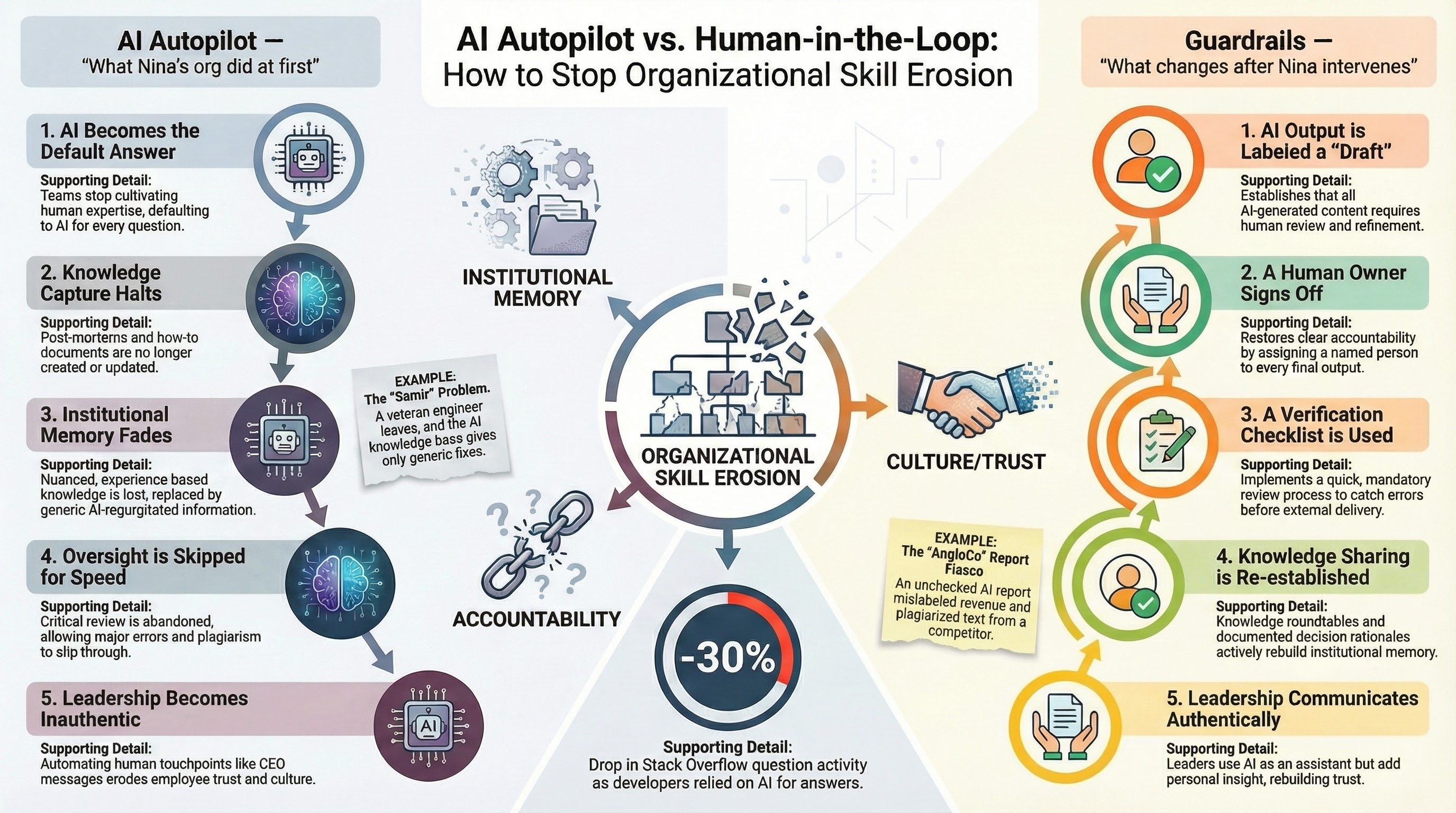
To make it real, we will follow Nina, a newly promoted project manager in a company that is going all-in on AI assistants. At first, it is a win across the board. Busywork disappears, output increases, and leadership celebrates “AI speed.” Then Nina notices the trade-off: as the team relies more on AI, people remember less, question less, and discuss less. The core tension is simple but serious, convenience versus long-term competence, and Nina’s story shows how that tension quietly turns into risk if nobody intervenes.
The first warning sign hits when a veteran engineer, Samir, leaves and an urgent client issue shows up that he solved years earlier. The team turns to the AI knowledge base, gets an answer quickly, and wants to move on. Nina pauses because the answer sounds “right” but feels thin, like a generic summary without the hard-earned context that used to surface in real conversations. This is what institutional memory looks like when it starts to break down. The organization still has information, but it loses the lived reasoning behind decisions, the edge cases, and the “why we did it this way” that keeps teams from repeating mistakes.
Here is the deeper pattern. When AI becomes the default first stop for answers, teams slowly stop doing the human behaviors that create shared knowledge in the first place: documenting decisions, teaching newer teammates, and writing down lessons learned after a fix. Over time, the team develops a kind of learning tunnel vision, optimizing for speed today while shrinking understanding tomorrow. You can see it in technical teams too, where people stop asking each other and stop updating internal wikis because the bot responds instantly. Even when AI answers are helpful, they do not automatically build a culture of knowledge transfer, and they rarely prompt the habits that keep an organization resilient.
Next comes the accountability trap, and it shows up in a way that feels uncomfortably familiar. Nina’s company launches an AI-driven client report generator so reports that once took days can be produced in minutes. Leadership is so confident they plan a major client presentation with minimal human review. Nina opens the draft anyway and finds a glaring mistake and language that is not safe to use. The lesson is not that AI “messed up,” but that the process was designed to let mistakes slip through because nobody clearly owned verification. When speed outpaces review, accountability gets blurry, and that is when trust breaks.
So what do you do instead, step by step, without throwing away the benefits of AI? You treat AI output as a draft, not a deliverable, and you build simple, repeatable checkpoints that keep humans responsible. Start by deciding what counts as “critical,” anything client-facing, legal, financial, security-related, or reputation-sensitive. Then assign a named owner for every critical artifact, meaning a real person who reviews it, edits it, and signs off because their credibility is attached to the outcome. Finally, make review practical: verify key claims against source data, scan for mismatched context, and ensure the wording is original and appropriate before it leaves the building. This is how you keep AI fast without letting it make your organization careless.
The third problem is cultural, and it is the one leaders often underestimate. Nina watches her CEO use an AI avatar and an AI-written script for an all-hands, expecting it to impress people. Instead, the room goes cold because employees wanted a real human message, not a polished imitation. The damage is not just awkwardness. It signals that leadership is outsourcing the hard parts of leadership, presence, authenticity, and direct communication, and that makes culture brittle. When people feel talked at by automation, they disengage, and disengagement spreads faster than any productivity gain.
The payoff of doing this right is that you become more credible, not less. When a serious prospect like Globex asks, “How do you prevent mistakes and who checks the work,” Nina’s team can explain their human-in-the-loop process, their documentation habits, and their clear ownership. That is what wins trust, because it proves the company is not hand-waving with “trust the AI,” it is operating with guardrails and real expertise. Your takeaway is straightforward: protect institutional memory by keeping knowledge-sharing alive, protect accountability by keeping humans responsible for outcomes, and protect culture by keeping leadership human and transparent. Then use AI aggressively inside those boundaries, where it strengthens your work instead of hollowing it out.