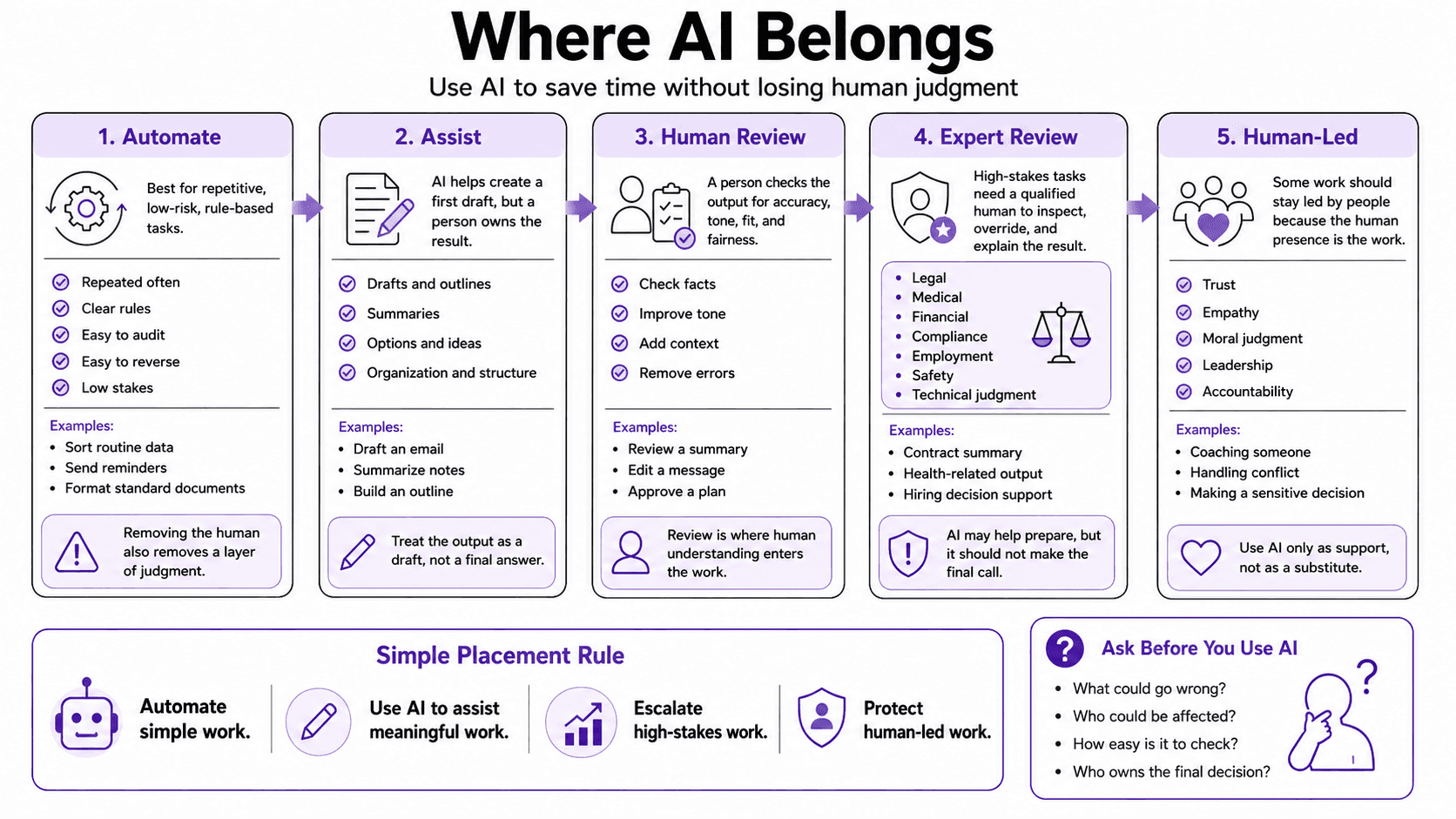
AI becomes most useful when people learn how to place it wisely within their work. Instead of asking, “Can AI do this?” a better question is, “Where does AI belong in this process?” Not every task needs the same level of AI involvement. Some tasks are simple enough for automation. Some tasks are better suited for AI support with human review. Some tasks require expert review before moving forward. Other work should remain human-led because it depends on trust, care, judgment, or accountability. The goal is not to use AI everywhere. The goal is to use AI carefully so it saves time without weakening responsibility.
Automation means the tool handles a task with little or no human involvement at the moment the work is being done. This can be helpful when the task happens often, follows clear rules, produces predictable results, and can be checked afterward. Examples include sorting basic information, sending routine reminders, formatting standard documents, flagging missing fields, or organizing files in a repeated way. These tasks are often good candidates for automation because the risk is low, the pattern is clear, and mistakes can usually be found and fixed without causing major harm.
Automation still requires caution because simple tasks can create a false sense of safety. When a person is removed from the process, a layer of judgment is removed as well. That matters when the task involves people, money, privacy, safety, fairness, or important decisions. A tool may follow a pattern, but it does not understand the full human situation. Before automating a task, the user should ask whether the task is low-risk, whether the results can be seen clearly, whether a mistake can be undone, and whether a wrong result could cause confusion, harm, or loss of trust. If any of those answers raise concern, the task should not be fully automated.
For most people, the strongest everyday use of AI is assistance with review. In this lane, AI helps create a starting point, but a person still owns the result. AI can draft an email, summarize notes, organize ideas, compare options, create an outline, prepare talking points, or turn messy information into a clearer structure. The human then checks the work, improves the tone, confirms the facts, adds context, removes anything incorrect, and decides whether the output is ready to use. This keeps AI useful without treating it as the final authority.
A helpful way to think about AI is this: the first answer is material, not a decision. It may be useful, but it still needs inspection. A summary may leave out an important detail. A draft may sound polished but miss the right tone. A recommendation may seem reasonable but overlook something important about the people involved. A list of ideas may be creative but not practical. Review is not a small final step. Review is where human understanding enters the work. The person checks for accuracy, fit, fairness, purpose, and usefulness.
Some work requires a higher level of care. If a task involves legal, medical, financial, compliance, employment, safety, or technical judgment, AI should not be treated as the decision-maker. It may help prepare information, organize documents, draft a first version, or highlight possible issues, but a qualified person must inspect the result before it is used. A contract summary needs legal review. A health-related suggestion needs medical judgment. A hiring or workplace decision needs human review for fairness and context. A financial recommendation needs someone who understands the risk and can explain the final choice.
Some work should remain led by people from the beginning because the human presence is not extra. It is the work itself. This includes listening to someone in distress, handling conflict, making moral decisions, building trust, coaching a team member, caring for a community, leading through uncertainty, or taking responsibility for a difficult call. AI may help someone prepare, reflect, or organize their thoughts, but it should not replace the human role. The more a task depends on empathy, trust, lived context, values, or accountability, the more carefully AI should be kept in a supporting position.
The practical rule is to automate simple work, use AI to assist meaningful work, review anything that could affect people, and bring in experts when the stakes are high. A good AI decision begins by naming the task clearly, then asking what could go wrong, who might be affected, how easy the output is to check, and who should be responsible for the final result. Used this way, AI does not replace judgment. It helps people focus their judgment where it matters most. The real skill is not only knowing how to use the tool. The real skill is knowing where the tool belongs.