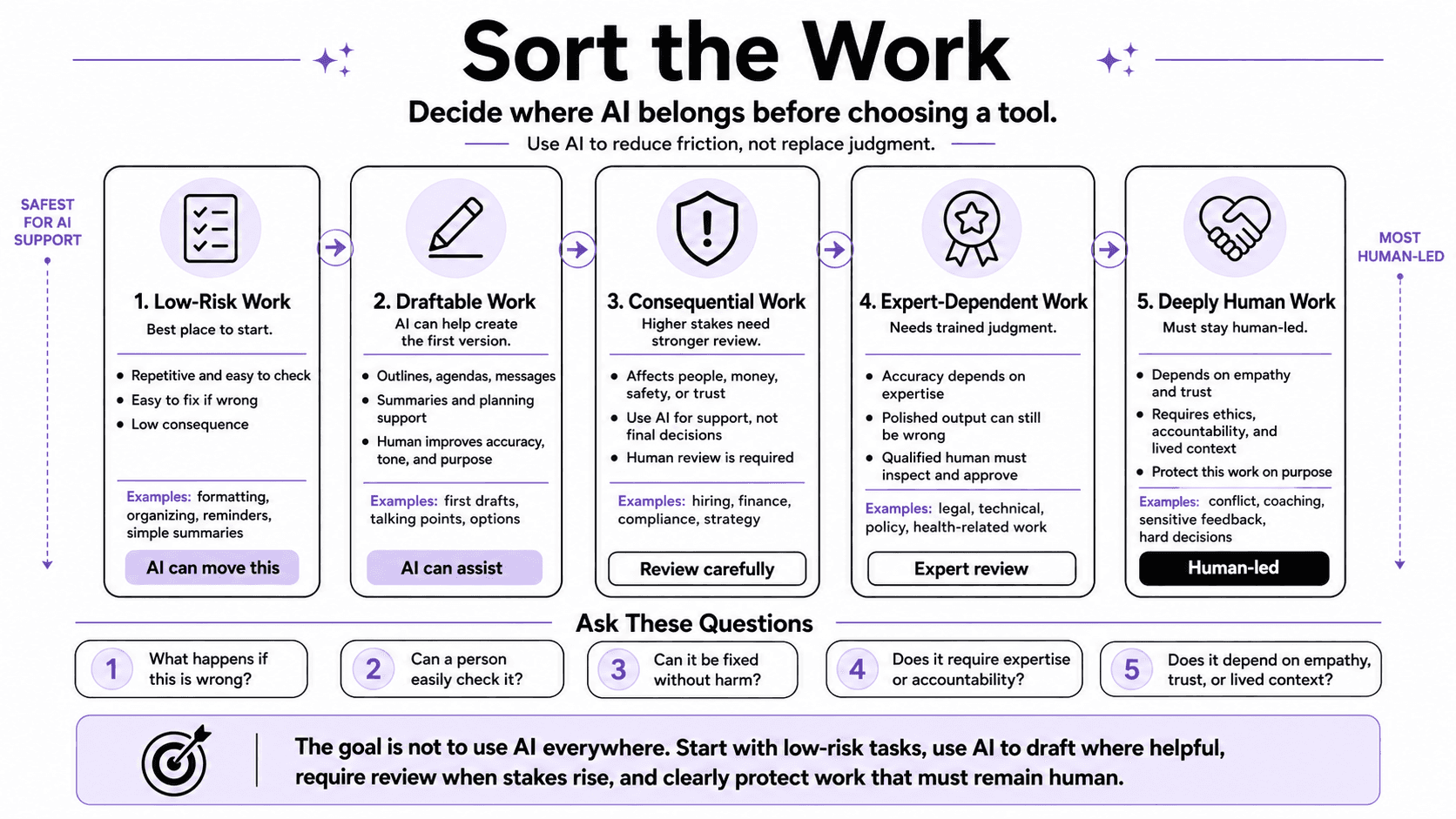
A smart AI decision starts before the tool is chosen. The first step is to understand the work itself. A job is rarely one single thing. It is made up of smaller tasks such as writing, planning, scheduling, deciding, reviewing, listening, organizing, serving, and solving problems. Each task carries a different level of risk, skill, and human responsibility. Some tasks are simple and repeatable. Some only need a first draft. Some require expert knowledge. Others depend on care, trust, ethics, and human judgment. When people sort the work first, they stop asking, “Can AI do this job?” and begin asking the better question, “Which parts of this work could AI support, and which parts must stay human?”
The safest place to begin is with work that is low risk, repetitive, easy to check, and easy to fix. These tasks usually do not affect someone’s health, job, money, dignity, safety, or future. They may include formatting a document, organizing notes, creating a simple checklist, sorting information into categories, drafting routine reminders, cleaning up a basic spreadsheet, or summarizing a non-sensitive meeting. This type of work helps people build confidence with AI without creating unnecessary exposure. If the AI makes a mistake, a person can usually notice it, correct it, and move forward without serious harm.
Repetition is often a useful signal. Repeated tasks quietly drain time, energy, and attention. A five-minute task may not seem important until it happens every day, across several people, for months. Routine follow-up emails, recurring agendas, weekly summaries, status updates, standard reports, and basic information requests can slowly pull focus away from deeper work. AI can help by creating a starting point, organizing the material, or handling the first pass. The goal is not to remove effort from meaningful work. The goal is to stop spending human focus on work that does not require much human judgment.
Some work should not be handed over to AI, but it can be started with AI. Draftable work includes outlines, agendas, emails, announcements, summaries, reports, planning notes, talking points, options, and first versions of instructional or communication materials. In these cases, AI can help people get something on the page quickly. The human still reviews the result for truth, tone, purpose, voice, and fit. This is one of the strongest uses of AI because the person remains active in the process. AI provides momentum, but the person shapes the final meaning.
Some tasks carry more weight because the outcome affects people, money, law, safety, trust, or important decisions. These tasks should be handled with greater care. Hiring decisions, legal claims, medical guidance, financial approvals, discipline, compliance, safety instructions, and major strategy choices all require stronger review. AI may still be useful for gathering background, organizing notes, comparing options, drafting questions, or preparing a summary. However, the final decision must be made by people who understand the context and can be held responsible for the result. When the stakes rise, the level of review must rise too.
Some work depends on trained judgment. A person may only be able to tell whether an AI-generated answer is useful if they already understand the field. This matters because AI can sound confident even when its response is incomplete, outdated, or wrong. A budget analysis, technical recommendation, policy interpretation, grant strategy, health-related summary, legal explanation, or compliance decision may look polished while still requiring expert review. If a participant cannot tell whether the output is accurate, fair, complete, or safe, then the task is not a good candidate for independent AI use. It needs a qualified human reviewer.
Some work must be clearly protected because it depends on empathy, trust, relationship, ethics, accountability, lived context, or moral judgment. This includes giving sensitive feedback, resolving conflict, comforting someone, making final people decisions, communicating bad news, building trust with a client or community member, coaching a team, deciding what is fair, and taking responsibility for a difficult call. AI may help someone prepare their thoughts or organize background information, but it cannot replace the human presence required in the moment. Naming this work matters because unnamed human work can be quietly pushed aside in the name of speed.
A practical work map gives each task a clear place. Some tasks can move with AI because they are low risk and easy to check. Some tasks can be assisted because a first draft would help, but a human still needs to improve it. Some tasks require review because errors would matter. Some tasks require expert review because only a qualified person can judge the output. Some tasks should remain human-led because the work depends on care, trust, ethics, or accountability. The goal is not to use AI everywhere. The goal is to use AI where it reduces friction, protect the places where people matter most, and create more room for meaningful human work.