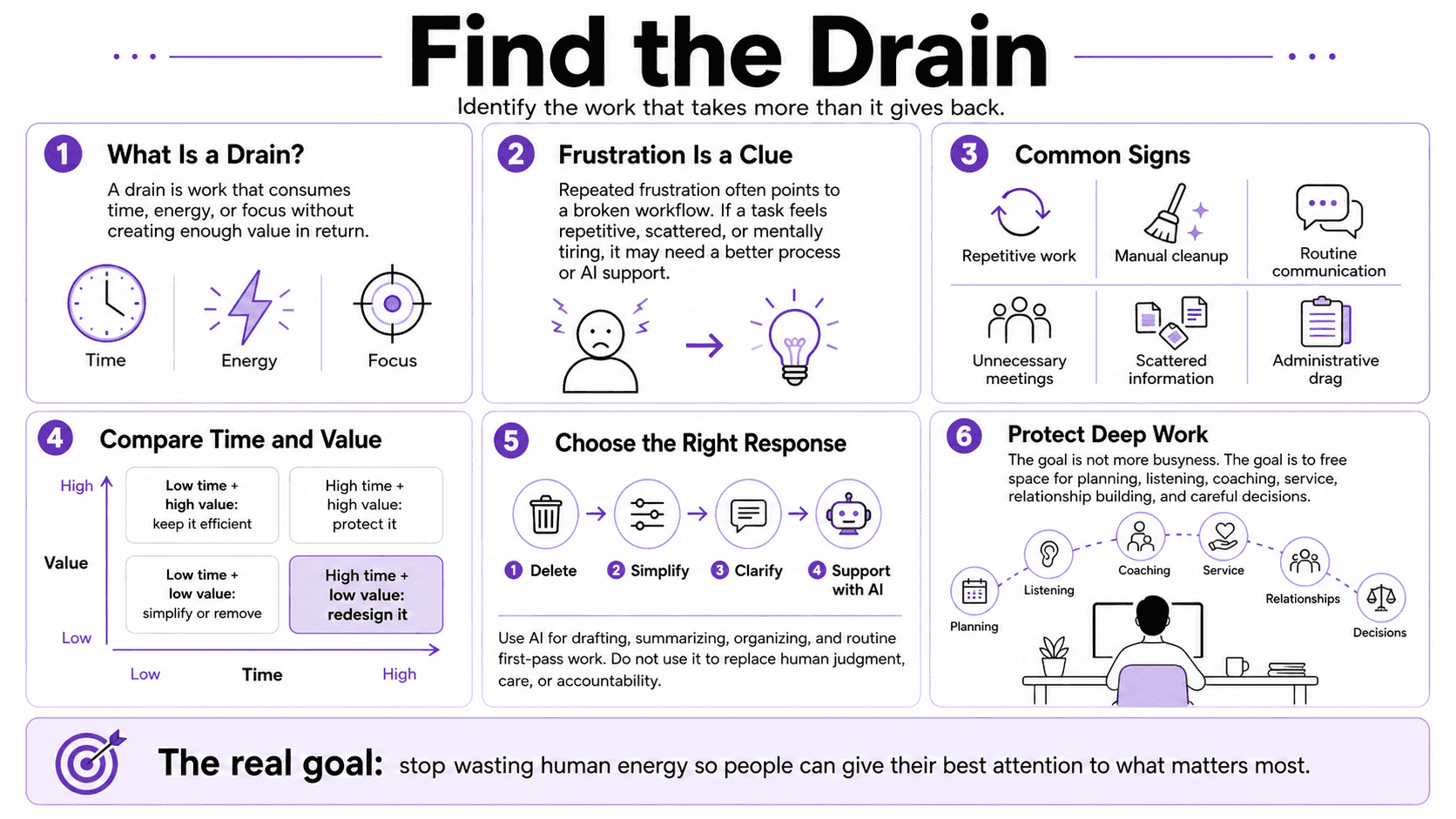
Work does not usually become heavy all at once. It becomes heavy through small repeated tasks that quietly take over the day. This lesson is about learning to notice those hidden drains before they become normal. A report that should take twenty minutes may start taking two hours because the information is scattered. A follow-up message may turn into a long chain of reminders. A meeting may happen every week even though no real decision is made. At first, these things can seem like a normal part of work. Over time, they become a drain. A drain is any task that takes time, energy, or focus without creating enough value in return.
Frustration should not be ignored. When people feel tired by a task, confused by a process, or annoyed by the same repeated problem, that feeling is giving useful information. It may show that the work is too manual, too scattered, too unclear, or too dependent on memory. The goal is not to avoid every hard task. Some hard work matters deeply. The goal is to notice when human energy is being wasted on work that could be simplified, clarified, supported, or removed.
Drain often hides inside ordinary work. It can look like copying the same information into different systems, cleaning up messy files, sorting routine emails, sending repeated reminders, building the same report again and again, or sitting in meetings that do not move anything forward. It can also show up when people have to chase information because no one knows where the latest version lives. These tasks may seem small by themselves, but when they repeat across days, weeks, and teams, they quietly take capacity away from more meaningful work.
A task should not be judged only by how long it takes. Some tasks take time because they deserve time. Listening to a client, coaching a team member, planning a difficult decision, solving a sensitive problem, or building trust may take hours, but that time creates real value. The better question is whether the time matches the value. If a task takes a lot of time and creates real care, insight, trust, or direction, it may need to be protected. If a task takes a lot of time and creates little value, it may need a better process.
To find the drain, a person can slow down and ask simple questions. What task keeps repeating? How often does it happen? How long does it take? Who has to be involved? What value does it create? What would break if it stopped? What part feels most frustrating? These questions turn a vague feeling into something visible. Instead of saying, “I am too busy,” the person can say, “Every Friday, three people spend two hours gathering updates that already exist in five different places.” That is a problem that can be improved.
AI can help with some drains, but it should not be the first answer to every problem. Sometimes the real fix is a clearer owner, a simpler form, one shared folder, fewer approval steps, a better template, or a meeting that becomes a written update. AI is useful when it helps draft, summarize, sort, organize, prepare, or clean up routine work that a person can still review. It is less useful when the task requires trust, care, sensitive judgment, or final responsibility. The tool should support the work, not hide a broken process.
Reducing drain should not create a faster treadmill. If a team saves two hours and immediately fills those two hours with more meetings, more messages, and more low-value tasks, nothing has really improved. The better purpose is to make room for focused work. Focused work includes planning, listening, coaching, serving people, building relationships, solving problems, and making careful decisions. These kinds of work need attention. They cannot always be rushed between interruptions. Saving time only matters if that time is used for something better.
The real shift is from asking, “How can we do more?” to asking, “What deserves our best energy?” A person who understands the drain starts to see work differently. They notice repeated tasks, scattered information, routine messages, unclear meetings, and manual cleanup as signals. They compare time with value. They protect the work that needs human judgment. They use AI carefully where it can reduce friction, but they do not hand over responsibility. In the end, finding the drain is not about becoming busier or faster. It is about freeing human attention for the work that actually matters.