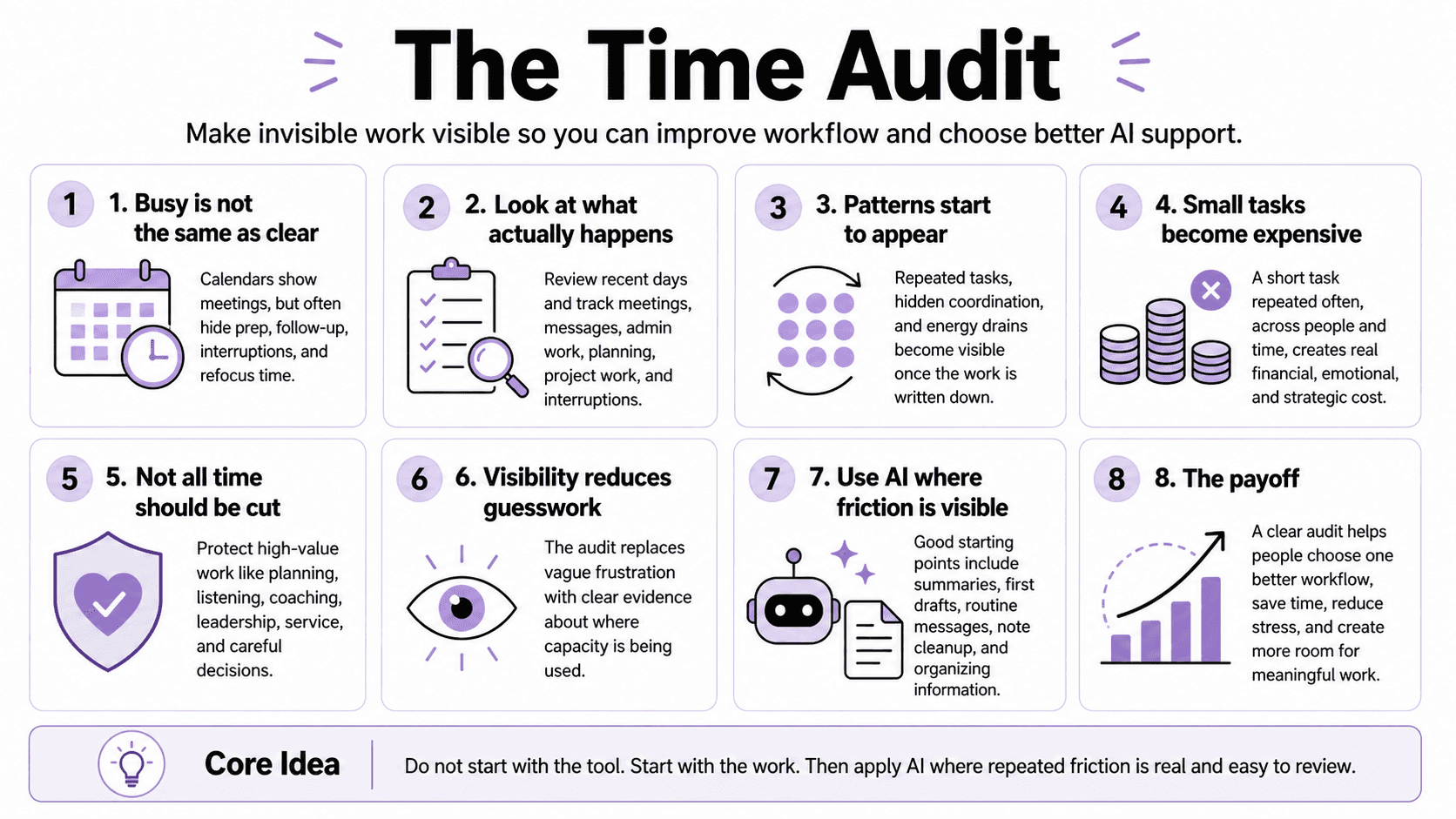
A person can move through an entire workday feeling busy and still end the day unsure where the time actually went. Their calendar may show meetings, but it often leaves out the time spent preparing, answering messages, searching for information, solving small problems, and trying to regain focus after interruptions. Memory can also be misleading. People tend to remember the biggest tasks, the stressful moments, or the work they intended to complete, but they often overlook the small repeated actions that quietly filled the day. A time audit helps make these invisible parts of work visible. It is not about blame or criticism. It is about seeing the real shape of the workday so better choices can be made.
A time audit begins by looking back at recent workdays with honesty. The person reviews their calendar, notes, messages, meetings, and recurring responsibilities. They ask what they actually did, not what they hoped to do. They notice the time spent in meetings, email, chat, planning, preparation, follow-up, administration, project work, and interruptions. This review does not have to be perfect to be useful. Even looking closely at two or three days can reveal important patterns. The goal is to move from a vague feeling of being overloaded to a clearer picture of what is consuming time and attention.
Once the work is written down, repeated activities become easier to recognize. A short daily update may appear again and again. A weekly meeting may include hidden preparation and follow-up. A simple client message may turn into several rounds of communication. A person may realize that their best thinking time is constantly being broken into small pieces. They may also notice that some tasks feel normal only because they have been repeated for so long. The audit turns scattered moments into a visible pattern that can be studied and improved.
Time carries cost. A task that takes 10 minutes may not seem important by itself, but if it happens every day across several people, it becomes much larger. A one-hour meeting with ten people is not just one hour of work. It is ten hours of team time, plus preparation, follow-up, and the mental cost of stopping other work. These costs are not only financial. They are emotional, strategic, and human. Repeated low-value work can drain energy, delay important goals, and push meaningful work to the edge of the day.
A time audit also helps people understand that not all time should be treated the same. Some time should be protected, not reduced. A long conversation with a staff member may matter because it builds trust. A planning session may matter because it leads to better decisions. Time spent listening, coaching, serving, thinking, and leading can carry deep value. The point is not to cut everything that takes time. The point is to ask whether the time matches the value. Some high-time work deserves protection. Some repeated work deserves redesign. Some low-risk tasks may be ready for support.
Without a time audit, people often guess where the problem is. They may say, “We have too many meetings,” or “Email is the issue,” or “We need AI to save time.” Sometimes they are right, but sometimes they are reacting to the loudest frustration instead of the clearest pattern. Visibility changes the conversation. Instead of saying, “We are overwhelmed,” a person can say, “Three hours each week go to preparing the same update,” or “Every meeting creates another hour of follow-up,” or “I spend my focused work time answering routine questions.” Clear problems lead to better decisions.
AI should not be added simply because it is available. It should be applied where the work shows clear friction. If recurring meeting notes take too much time, AI may help create a first summary and identify possible next steps. If routine messages slow people down, AI may help draft responses that a person reviews. If scattered notes make planning difficult, AI may help organize them into a clearer structure. If reports repeat each week, AI may help turn bullet points into a first draft. The human still checks the work, protects judgment, and decides what is accurate, appropriate, and useful.
The real value of the audit is that it gives people a better starting point. Before the audit, they may feel busy, tired, and unsure where AI could help. After the audit, they can see what repeats, what drains energy, what carries real value, and what may be ready for support. This makes AI use more practical and more responsible. Instead of chasing tools or trying to change everything at once, people can choose one clear workflow to improve. The goal is not simply to save minutes. The goal is to create more room for meaningful work, clearer decisions, better service, and stronger human attention.