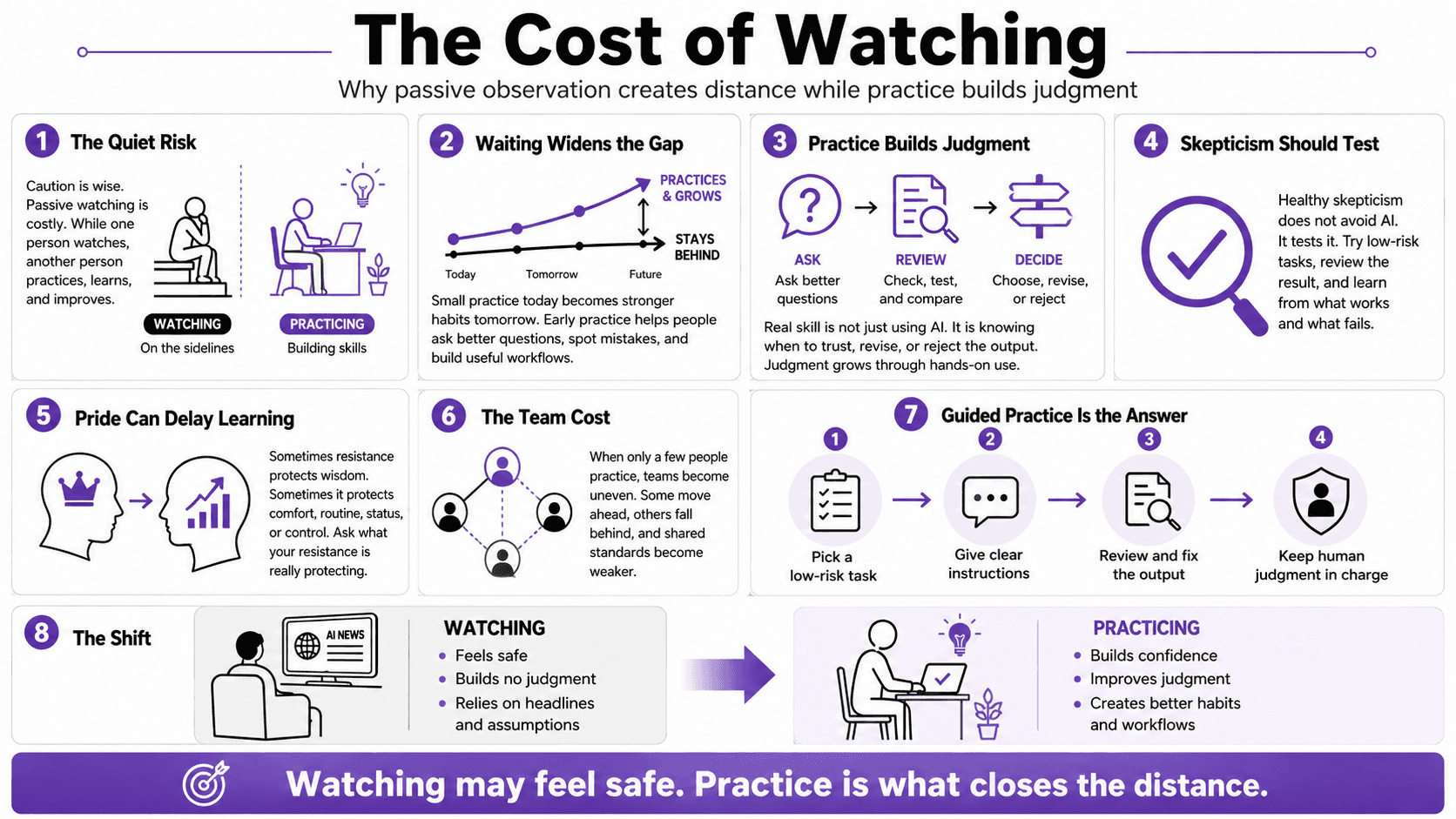
Learning to use AI responsibly begins with a balanced mindset. The goal is not to rush into every new tool without thinking, but it is also not wise to stand back and only watch while others build skill. Caution is necessary when people use AI. People should protect private information, check important claims, and avoid using AI for work that requires legal, medical, financial, or deeply personal judgment. The real danger is passive watching. Watching feels safe because it does not require risk, effort, or change. But while one person watches, another person practices. The person practicing begins to learn what AI can help with, where it fails, how to ask better questions, and how to review the answer before using it.
Waiting too long creates distance. At first, the gap may look small. One person uses AI to clean up notes. Another uses it to outline a meeting. Another uses it to prepare questions before a difficult conversation. These small uses may not seem dramatic, but they build habits. Over time, the person who practices becomes faster, clearer, and more confident. The person who waits may still be reacting to headlines, rumors, or secondhand opinions. By the time AI feels normal, the early learner may already have months or years of useful experience.
The most important skill is not simply knowing which buttons to press. The real skill is judgment. A person who practices learns how to tell when an AI answer is useful, incomplete, too generic, biased, outdated, or wrong. They learn when to accept help, when to revise the result, and when to reject it completely. This kind of judgment does not come from watching other people use AI. It comes from trying AI on real but low-risk tasks, comparing the output to human understanding, and improving the work step by step.
Skepticism can be wise. People should not trust AI just because it sounds confident. A polished answer can still be wrong. A clear paragraph can still leave out important context. A useful draft can still need human care before anyone sees it. But skepticism becomes weak when it only avoids the tool. The better form of skepticism tests. It asks AI to summarize a simple document, draft a routine message, organize scattered notes, or create a checklist. Then it reviews the result carefully. This turns doubt into learning instead of letting doubt become an excuse to stand still.
Some resistance comes from honest concern, but some resistance comes from pride. It can be uncomfortable for capable people to feel like beginners again. A leader, teacher, manager, or experienced worker may not want to admit that a new tool could change part of their work. So they may stand outside the change and critique it. They may say it is overhyped, unserious, dangerous, or not relevant. Sometimes that critique protects real standards. Other times, it protects comfort, routine, status, or control. The key question is simple: is the resistance protecting wisdom, or is it protecting the fear of having to learn?
The cost of watching does not stay with one person. It spreads across a team. When only a few people build AI skill, the workplace becomes uneven. Some people move faster and develop better workflows. Others depend on them or fall behind. Some use AI safely and openly. Others may use it quietly without guidance, which can create privacy risks, poor quality, or confusion about what is allowed. A team that avoids the conversation does not avoid AI. It only avoids shared standards. That makes practice, guidance, and honest discussion even more important.
The answer is not reckless use. The answer is guided practice. People should begin with low-risk work that is easy to review, such as outlines, meeting notes, routine drafts, planning lists, brainstorming, or organizing ideas. They should avoid sensitive personal information, confidential material, and decisions that affect someone’s rights, health, money, job, or safety. A good practice habit is simple: choose a small task, give clear instructions, review the result, fix what is wrong, and decide what still needs human judgment. This keeps AI in the role of assistant, not authority.
The goal is not to become impressed by AI. The goal is to become capable with it. The person who moves from watching to doing does not blindly trust the tool. They learn how to use it with care. They ask better questions. They spot weak answers faster. They build repeatable workflows. They protect the human parts of the work, such as care, context, ethics, relationships, and final responsibility. Watching may feel safe in the moment, but practice is what closes the distance. The people who start with small, responsible steps build confidence without losing judgment.