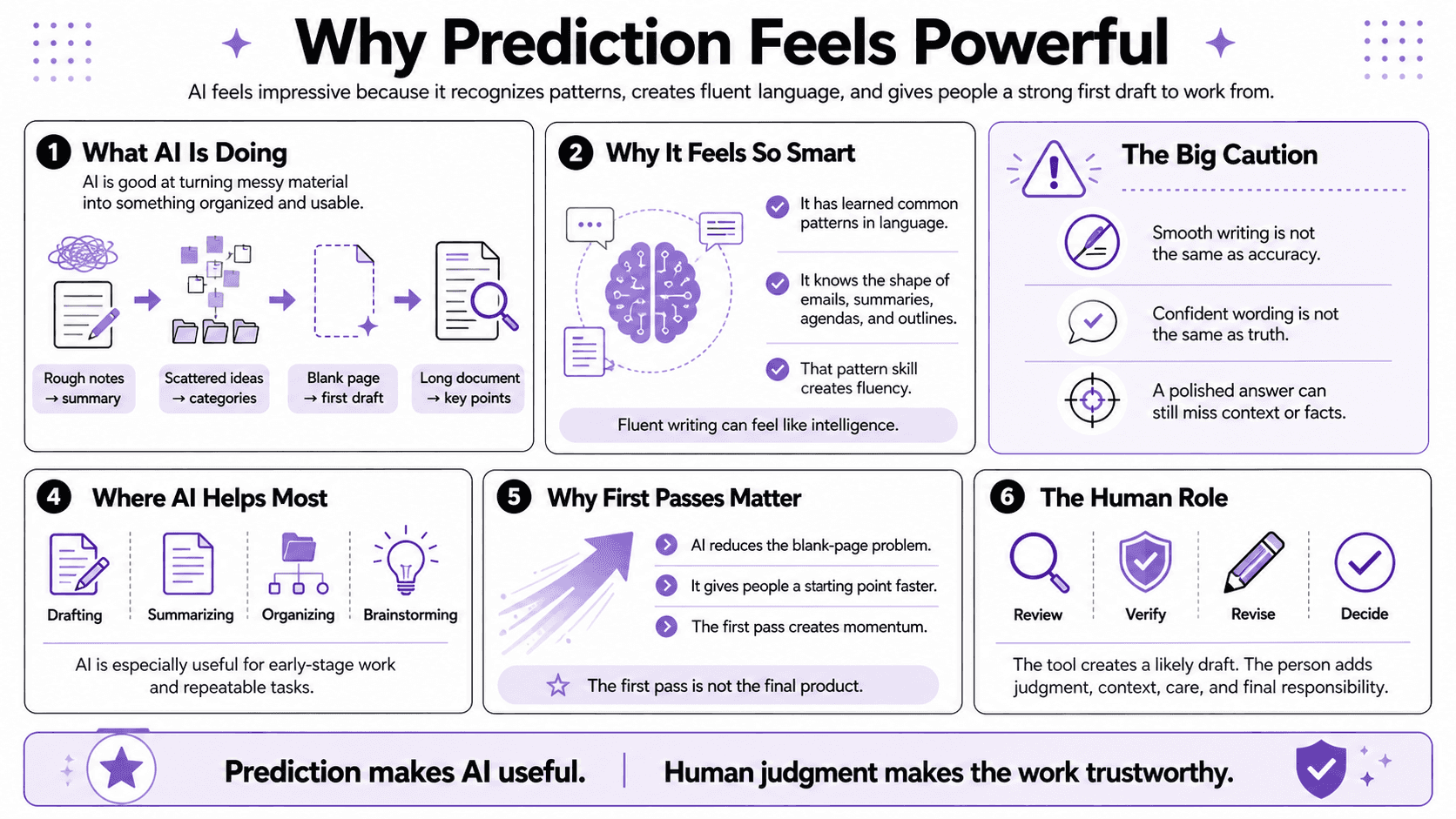
Think about a person who sits down after a long meeting with a page full of rough notes. The notes are messy and uneven. Some lines are decisions, some are questions, some are reminders, and some are half-finished thoughts. Before AI, that person might stare at the page and wonder where to begin. Now they can paste those notes into an AI tool and ask for a summary, a list of action items, and a follow-up email. Within seconds, the messy notes begin to take shape. The tool creates clean sentences, organizes the ideas, identifies possible next steps, and drafts a message that may sound ready to send. That moment can feel powerful because the tool does more than answer a question. It helps turn disorder into something organized and usable.
AI can do this because it has learned patterns in language. It has been trained on many examples of emails, summaries, memos, agendas, outlines, explanations, and plans. When someone asks it to create one of those things, it predicts what would likely fit the request. It looks at the words, the context, and the instruction, then builds a response that follows familiar language patterns. It is not thinking like a human being with memories, values, emotions, and lived experience. It is producing a likely piece of writing based on patterns it has learned.
One reason AI feels impressive is that its writing can be very fluent. When writing flows smoothly, people often assume it is thoughtful, complete, and true. AI can create that smoothness quickly because it recognizes common forms of communication. It knows how a professional email often begins. It knows how a meeting agenda is usually arranged. It knows how a short explanation often moves from an idea to an example and then to a conclusion. That fluency is useful, but it can also be misleading. A clear sentence can still be wrong. A confident answer can still leave out important information. A polished paragraph can still be based on a weak guess.
This is one of the most important lessons to remember: sounding right is not the same as being right. AI can make an answer feel complete before the answer has been checked. It can provide dates, names, reasons, and recommendations in a calm and confident voice, even when some of those details are wrong, incomplete, or unsupported. That does not make the tool useless. It means the person using it must stay alert. The output should be treated as a draft, not a final decision. The human still needs to ask, “Is this accurate? Is this fair? Is this complete? Does this fit the real situation?”
AI is especially useful when it helps shape material that already exists. It can turn rough notes into an outline. It can turn a long document into a short summary. It can organize scattered ideas into clear categories. It can take an early thought and offer several possible directions. It can also take a blunt message and make it clearer, warmer, or more professional. This matters in everyday work because many people are not starting from nothing. They are surrounded by notes, emails, drafts, transcripts, plans, and half-formed ideas. AI can help move that material from messy to usable.
The first version of anything is often the hardest to create. A blank page can slow people down because they have to decide where to start, what structure to use, and what words should come first. AI lowers that barrier by giving the person something to react to. Even when the first version is not good enough, it changes the task from creating to improving. That is a meaningful shift. It is often easier to cut, revise, reorder, and sharpen a draft than it is to build one from nothing. AI can help people get moving, but that movement still needs human direction.
The person using AI should not disappear from the work. Instead, they should become a stronger reviewer. After AI creates a first version, the human brings the missing pieces: judgment, purpose, context, voice, care, and responsibility. In the meeting notes example, the manager still needs to check whether the right people were assigned to the right tasks. They need to confirm that the deadlines are real. They need to remove anything that was not actually decided. They need to adjust the tone so the message fits the team. AI can help shape the material, but the human still decides what the final version should become.
The real power of AI is that it can make language move quickly. It can take fragments and create structure. It can take confusion and offer order. It can take a blank page and provide a starting point. That power is real, especially for drafting, summarizing, organizing, brainstorming, and preparing. But the limit is just as real. Prediction is not truth. Fluency is not wisdom. A first version is not a final product. The best use of AI is not to let it think for people, but to let it help people think, review, revise, and act with more clarity.