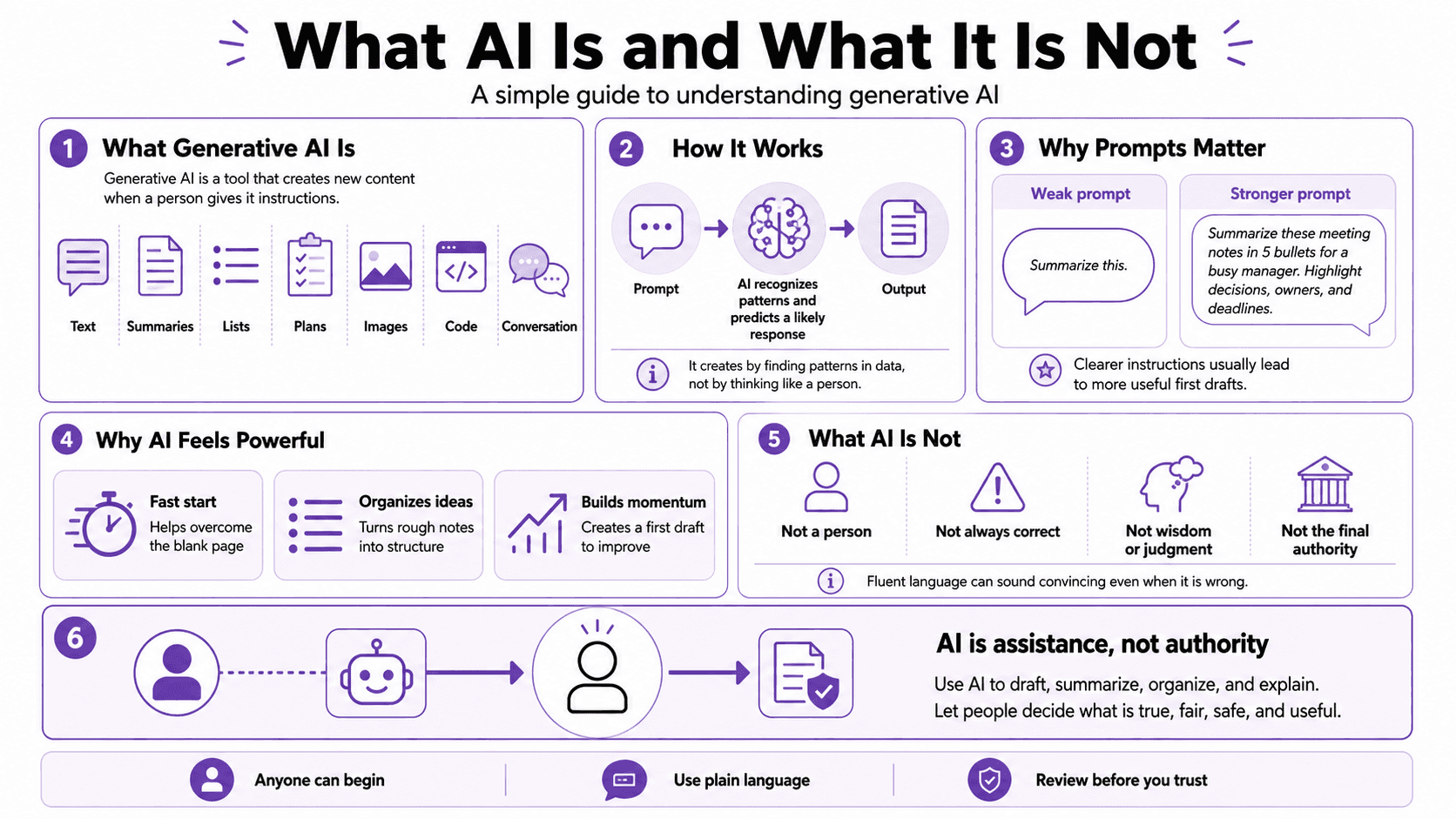
Generative AI is one of the simplest forms of advanced technology for many people to begin using because it responds to ordinary language. At its core, generative AI is a tool that creates new material when a person gives it instructions. It can write a draft, summarize notes, make a checklist, create an outline, explain an idea, suggest a plan, help with code, generate an image, or hold a conversation. The simplest way to understand it is this: a person gives the tool a request, and the tool produces an output. That output may be helpful, but it is still only a starting point. The person using the tool remains responsible for deciding whether the result is accurate, appropriate, and worth using.
AI can help with many everyday tasks because much of work involves shaping information. A leader may have messy meeting notes that need to become a follow-up email. A teacher may need a lesson outline. A nonprofit worker may need a donor update. A student may need help understanding a difficult idea. A business owner may need a first draft of a policy, a caption, or a plan. In each case, AI can quickly turn rough material into something more organized. It gives the user something to react to, improve, shorten, expand, or correct.
AI does not create because it thinks like a person. It creates by recognizing patterns. It has been trained on large amounts of language, structure, examples, and common forms of communication. When someone gives it a request, it predicts what kind of response would likely fit. That is why it can sound smooth, polished, and confident. It has seen many examples of emails, summaries, lists, explanations, and plans. However, sounding smooth is not the same as being right. AI can produce a clean answer that still includes mistakes, missing context, or unsupported claims.
A prompt is the instruction a person gives to AI. A weak prompt leaves the tool guessing. For example, “summarize this” may produce something useful, but it does not explain who the summary is for, how long it should be, what matters most, or what should be left out. A stronger prompt gives clearer direction: “Summarize these meeting notes in five bullets for a busy manager. Highlight decisions, owners, and deadlines. Use plain English.” That kind of instruction gives the tool a clearer target. The better the direction, context, and limits, the more useful the first response is likely to be.
One reason AI feels different from older technology is that people can use ordinary language to work with it. They do not need to be programmers. They do not need to understand every technical detail before trying a simple task. A community leader, worker, student, educator, owner, or manager can begin by asking for help with something familiar. They can ask AI to draft, summarize, organize, explain, compare, brainstorm, or prepare. The first skill is not coding. The first skill is learning how to describe the task clearly and then review the result carefully.
AI feels powerful because it can quickly move a person from a blank page to a first draft. It can take scattered thoughts and give them structure. It can turn a long document into a short summary. It can suggest options when someone feels stuck. It can help people begin when the hardest part is getting started. This speed can be useful because it reduces friction and gives people momentum. However, speed can also create overconfidence. A fast answer is not always a good answer. The value comes when the human uses the speed wisely, checks the work, and improves it with real judgment.
AI is not a person, a truth machine, or a final authority. It does not have lived experience. It does not carry moral responsibility. It does not know the full history of a workplace, family, community, classroom, client, or mission unless that context is given and appropriate to use. It can be outdated. It can miss important details. It can reflect unfair patterns. It can sound certain when it should be uncertain. For that reason, people should be especially careful with facts, numbers, dates, policies, health, law, finance, safety, and decisions that affect real people.
The healthiest way to use AI is to treat it as assistance, not authority. Let it help prepare, organize, draft, explain, and suggest. Let it reduce the blank page problem and make routine work easier to start. But do not hand over judgment. The human still decides what is true, fair, useful, safe, and aligned with the purpose of the work. AI can multiply meaningful effort when people stay thoughtful. It should make people more capable, not less responsible.