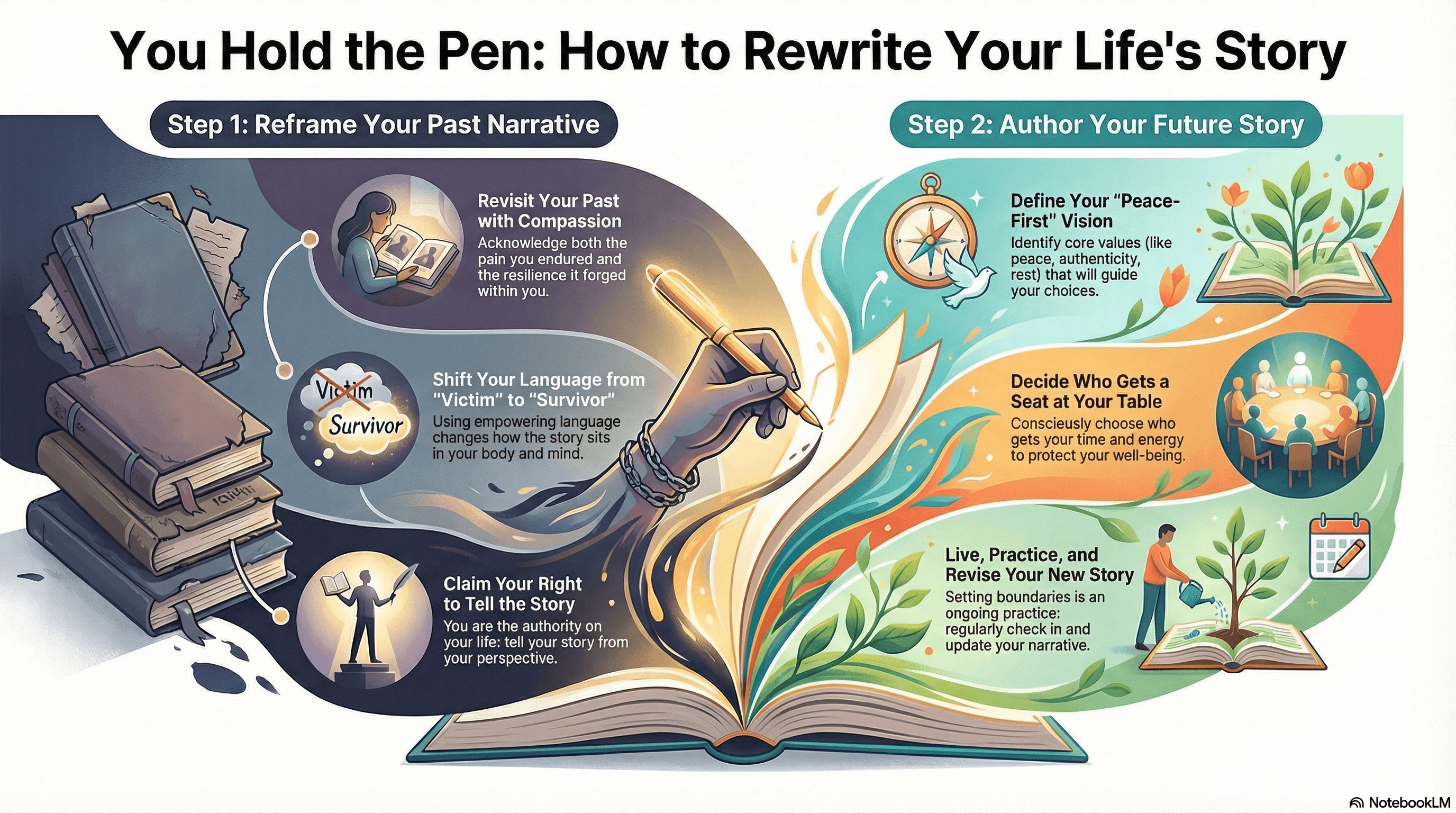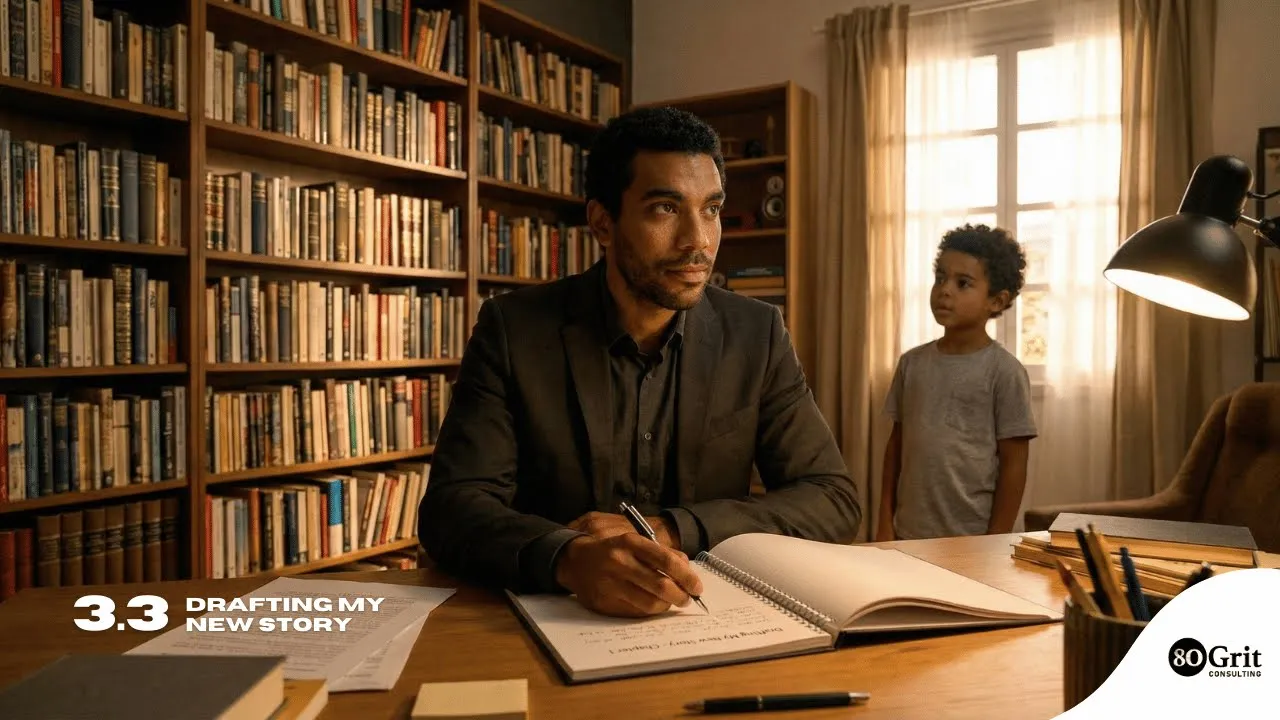

Welcome to Lesson 3.3: Drafting My New Story. This is where everything you have been uncovering stops being just insight and starts becoming authorship. Your past built skills, grit, and drive, but it does not get to hold the pen anymore. In this lesson you will create a living New Story document that honors where you came from and names who you choose to be now. Think of it like a compass you can reread when life gets loud and your old instincts try to take over.
Your New Story document is not magic, and it is not a performance. It will not erase your history or guarantee you never struggle again. What it will do is give you clear language for your identity, your values, your boundaries, and your vision, so you stop drifting back into survival mode on autopilot. When you write it down, you create something you can return to when you feel triggered, exhausted, or tempted to chase approval. The point is not to write a perfect story, the point is to write an honest one that keeps you anchored.
The first section is a compassionate narrative of your past. This means you tell the truth about what hurt, what shaped you, and what you carried, without glamorizing it and without hiding it. You are not writing to punish yourself or prove how tough you are. You are writing to see the full picture: the pain and the strength in the same frame. A helpful approach is to write as if you are describing someone you care about, with clarity and respect, because that person is you.
As you write your past, name the strengths your younger self developed, even if the circumstances were unfair. Maybe you learned to read a room fast, stay focused under pressure, protect others, work hard, or keep going when you felt alone. Those skills are real, and they helped you survive. The goal is to thank the version of you who did what was necessary, while also being honest about the cost. Survival habits can become identity if you never update the story, so this narrative is where you separate who you are from what you had to do.
The second section is your peace first future. This is not a fantasy life where nothing goes wrong. It is a clear description of what peace looks like in your real world: how you move through conflict, how you love, how you parent, how you lead, and how you rest. You are defining what you want your nervous system to feel like more often, calm, grounded, present, and what you will no longer accept, chaos, disrespect, constant pressure, emotional games. Peace is not passive, it is protected, chosen, and practiced.
A powerful way to write this is through the table metaphor. Imagine your life as a full table with room, warmth, and community, but only for what is healthy. Who gets a seat close to you, and what do they bring, honesty, consistency, accountability, respect, reciprocity, encouragement. Who needs to be repositioned, not from hatred, but from clarity, because access is earned through behavior, not history. This is where you write boundaries as commitments, not threats, and you remind yourself that your peace comes before other people’s comfort.
The third section is making your new story a practice. A document that sits untouched is just paper, but a document you return to becomes a tool. Decide how often you will revisit it, weekly, monthly, or at key moments like birthdays and major transitions. Add a simple ritual, reread it before hard conversations, review it after you get triggered, update it when you learn something new about yourself. If it feels safe, choose one trusted person you can share parts of it with, not for validation, but for accountability and support.
Conclusion: Drafting your New Story is the moment you stop letting the past narrate your present. You honor what your past built, but you refuse to let it hold the pen. You write a compassionate past narrative that tells the truth without self hate, you envision a peace first future with values and boundaries that protect your life, and you create rhythms that keep the story alive through real world tests. The outcome is ownership: you are the navigator, the voice, and the one illustrating what comes next.