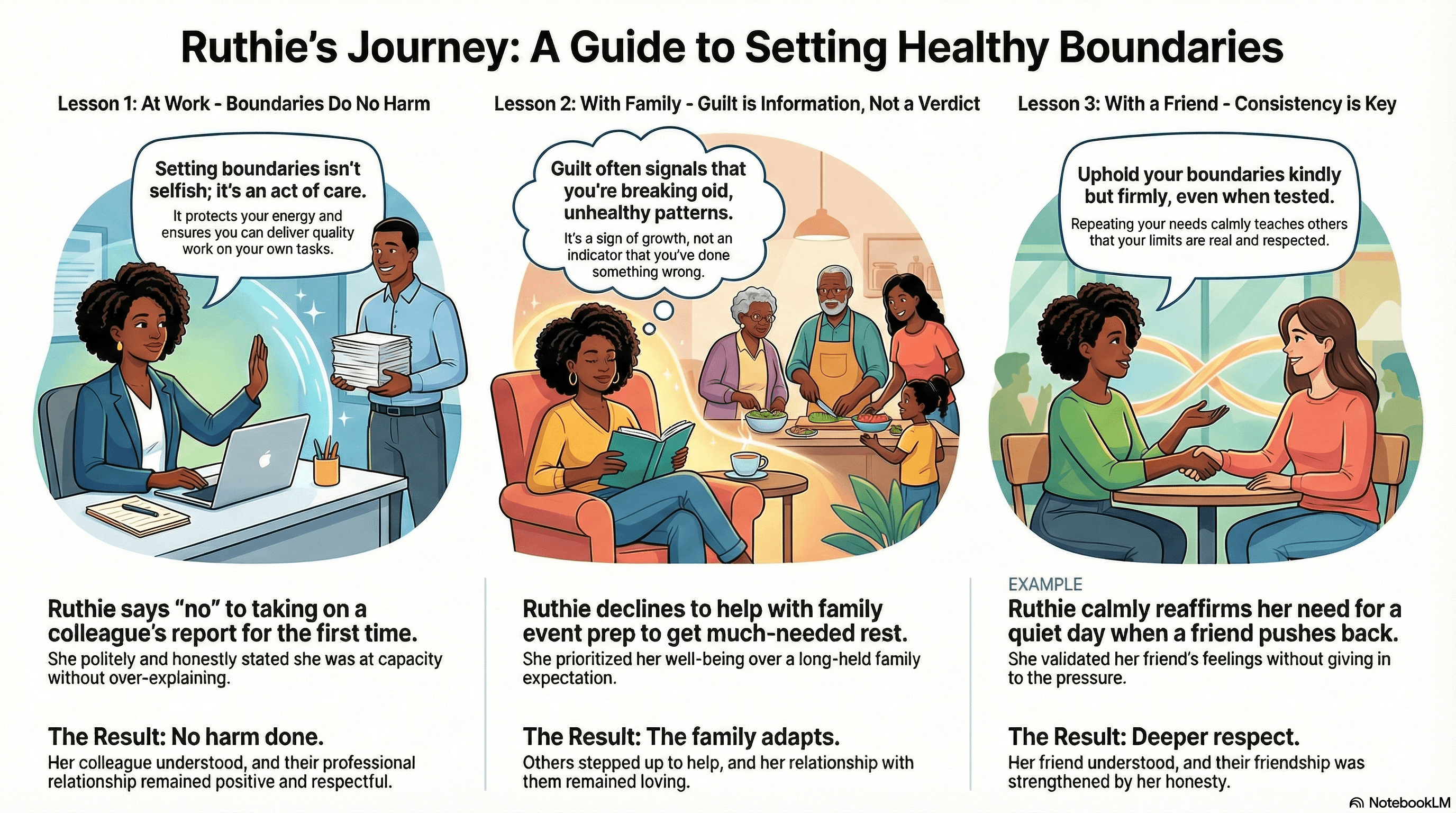

In this part of State of Essence, you are learning how to protect what you have clarified without turning your growth into a lonely path. This lesson is not about cutting people off or becoming cold. It is about setting clear, grounded boundaries so you can stay connected without emotional fallout. Ruthie Rose is in the middle of redefining self nourishment and clarity, and is learning that peace is not something you stumble into. Peace is something you practice, especially when the people around you are used to the old version of you.
Honoring your past means you tell the truth about what shaped you without letting it keep shaping your future. Ruthie respects the roles she played: the dependable teammate, the responsible daughter, the always available friend. Those roles helped her survive and succeed. But they also trained people to expect unlimited access to her time, energy, and emotional labor. Boundaries become the bridge between who she has been and who she is becoming. They allow her to keep love in the room while removing the pressure to abandon herself.
Ruthie’s first small moment happens at work. A colleague sends a late request, framed like an emergency, and Ruthie feels that familiar urge to rescue. This is where the Do No Harm takeaway starts to matter. Ruthie realizes that saying yes when she is depleted creates harm in two directions. It harms her because she becomes exhausted and resentful. It harms the relationship because she silently teaches people that her limits are not real. So she responds with care, not punishment: she names her capacity, respects the other person’s need, and declines the extra load. She is not trying to win or prove a point. She is protecting her ability to show up well.
Do No Harm is a mindset shift. A boundary is not a weapon, and it is not a lecture. It is a limit that keeps both people from paying the price of overreach later. A simple script Ruthie practices is, “I cannot take that on, but I can support in this smaller way,” or “I am at capacity, so I will not be able to help this time.” The common misstep here is overexplaining, apologizing excessively, or offering a long justification that invites negotiation. When you explain too much, you accidentally communicate that your boundary needs approval. A caring boundary is brief, calm, and direct. It treats the other person like an adult who can handle disappointment.
Her second small moment happens with family. Ruthie’s mother asks her to come early, help set up, and take on responsibilities that everyone assumes belong to her. Ruthie says no, and guilt shows up fast. This is where Understand the Why Behind the Guilt becomes a tool instead of a trap. Ruthie notices the guilt is not evidence that she is wrong. It is evidence that she is stepping out of an old agreement. The guilt is attached to an outdated role: the one who holds everything together. Her growth disrupts a familiar pattern, and her nervous system interprets that disruption as danger. Ruthie pauses and asks herself, “What is this guilt trying to protect, my values or my old identity?”
To work with guilt, Ruthie practices separating feelings from instructions. She lets guilt exist without letting it decide. She reminds herself that discomfort can be part of alignment, not a sign of failure. Another misstep she avoids is trying to buy her way out of guilt by shrinking back into the role. That relief is temporary, and it costs her long term stability. Instead, Ruthie chooses clarity: she honors her family by staying respectful, and she honors herself by staying honest. Over time, this teaches her that love does not require self abandonment, and that healthy relationships can survive her boundaries.
Her third small moment happens with friendship, where consistency becomes the whole lesson. A close friend pushes back, not because she is cruel, but because she is used to Ruthie always being available. Ruthie learns that boundaries only work when they are reinforced through behavior. If she says she needs rest but keeps showing up anyway, people learn her words are flexible. Ruthie stays kind and steady: “I care about you, and I am not available today. Let’s choose a time that works for both of us.” The misstep here is giving in after pressure, then feeling angry later. Consistency protects your peace because it removes the cycle of negotiation, resentment, and repair.
In conclusion, honoring your past means you do not shame who you used to be, but you also do not keep paying for it. Do No Harm teaches you to set boundaries as care, not punishment. Understanding the why behind guilt teaches you to treat guilt as information, not an order to return to old roles. Consistent reminders teach you that alignment is built through repeated choices, not one powerful conversation. Like Ruthie Rose, you are learning to stay connected without leaking yourself, and to reposition your seat with respect for others and loyalty to your becoming.