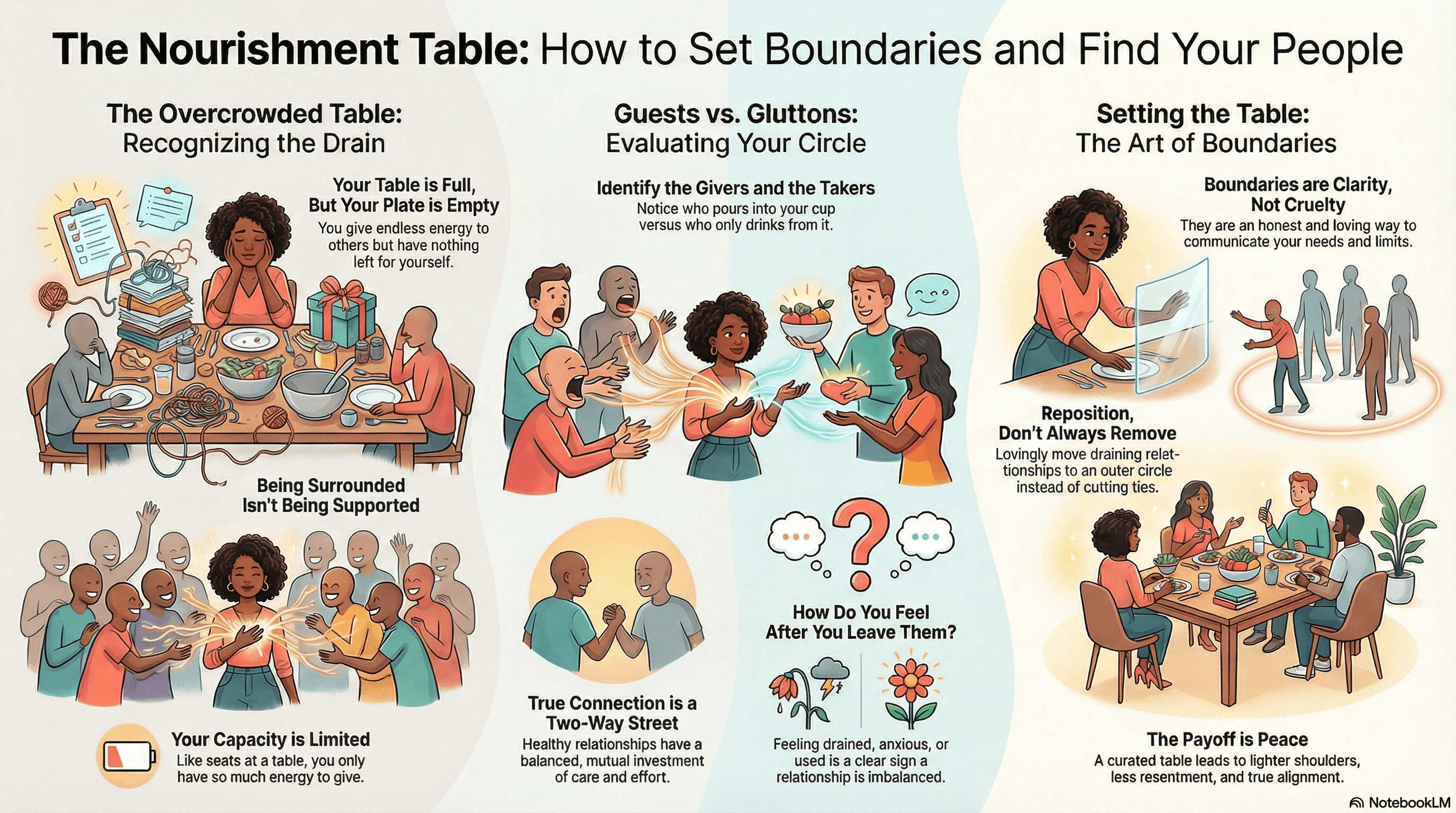

The Nourishment Table, where Ruthie Rose learns how to assess who has meaningful access to her life by separating connection, proximity, and nourishment. Ruthie is doing well on paper, yet she feels internally depleted because too many people, expectations, and obligations have had unrestricted access to her time and emotional energy. The table metaphor gives her language for what she has been sensing for a while: not everyone who is present in your life is actually contributing to your well being, and not everyone who feels close is safe or supportive.
Ruthie begins by imagining her life as a table where seats represent access. A seat is not just a friendship label or a family title; it is permission to influence you, to lean on you, to get your attention, and to receive your care. The first truth she has to accept is that there are limited seats. Capacity is real, and every yes costs something. When Ruthie tries to seat everyone, she ends up standing in the kitchen exhausted, serving everyone else while neglecting herself. Limited seats is not a harsh concept; it is a realistic one that protects your energy and makes room for relationships that are actually sustainable.
With that in mind, Ruthie takes inventory of who is sitting where. She notices that some people have front-row access because of history, guilt, or routine, not because of trust or nourishment. She also notices that she has been handing out seats as if access is owed, rather than earned through consistency, respect, and care. This is where the lesson shifts from obligation to intention. Ruthie learns to ask better questions: Does this person treat my life like something sacred, or like something they can consume whenever they want? Do I feel more like myself after time with them, or do I feel pressured to perform, fix, or shrink?
Once Ruthie recognizes the limited seats, she moves to the second takeaway: give and take over come and take. Nourishing relationships do not require perfect balance every day, but they do require mutual investment over time. Ruthie pays attention to patterns, not single moments. She notices who checks on her without needing something first, who celebrates her wins, who respects her no, and who shows up when she is not useful. She also identifies the people who only reach out when they need rescue, reassurance, or a listening ear, then disappear when the moment passes. That is come and take energy, and it quietly trains her to believe that her value is tied to what she provides.
A major breakthrough for Ruthie is learning that proximity is not the same as nourishment. Some people are close because they are coworkers, relatives, neighbors, or friends-of-friends, and they are simply around often. Proximity can create familiarity, and familiarity can be mistaken for intimacy. Ruthie realizes she has been calling some relationships “connection” when they are really just convenience, habit, or shared history. The table metaphor helps her place people accurately: some belong in her life, but not at her inner table. They can remain in the wider room of her world without having access to the parts of her that require trust.
Now Ruthie steps into the third takeaway: healthy boundaries. She reframes boundaries as the rules of the table, not weapons used to punish people. A boundary is a clear instruction for how someone can engage with you without draining your core. Ruthie practices repositioning by changing how she responds, what she agrees to, what she shares, and when she is available. She stops answering every call immediately, she declines last-minute requests that cost her peace, and she limits conversations that consistently spiral into emotional labor with no reciprocity. She learns that boundaries are not disrespect; they are self-respect put into practice.
As Ruthie sets boundaries, she faces the emotional fallout that often comes with growth. Some people push back, guilt-trip, or act confused because they benefited from her lack of limits. Ruthie learns that discomfort is not proof she is doing something wrong; it is often proof she is doing something different. She also learns a crucial skill: she does not need to overexplain to be valid. She can be calm, direct, and consistent, letting her actions reinforce the new standard. Over time, the right people adjust, the draining dynamics weaken, and Ruthie’s life begins to feel more like her own.
In conclusion, The Nourishment Table teaches Ruthie that her life has limited seats, and that access should be intentional rather than automatic. She learns to prioritize give-and-take relationships over come-and-take dynamics, and she uses healthy boundaries to protect who she is becoming without turning every shift into conflict. The goal is not isolation or exclusion; it is alignment, clarity, and self-nourishment that makes connection sustainable. As you leave this lesson, consider what your table currently looks like, who truly nourishes you, and what repositioning would allow you to live with more peace and integrity.