
If you have ever been up against a deadline with a blank page staring back at you, you already understand the temptation this lesson is built around. You are tired, the stakes feel high, and the fastest path is to let an AI tool fill the space with something that looks “professional.” The problem is that “professional” can quietly turn into “generic,” and generic is where trust starts to leak. In this lesson, you are going to learn why your voice is not a style choice, it is a credibility signal, and how to use AI without letting it speak as you.
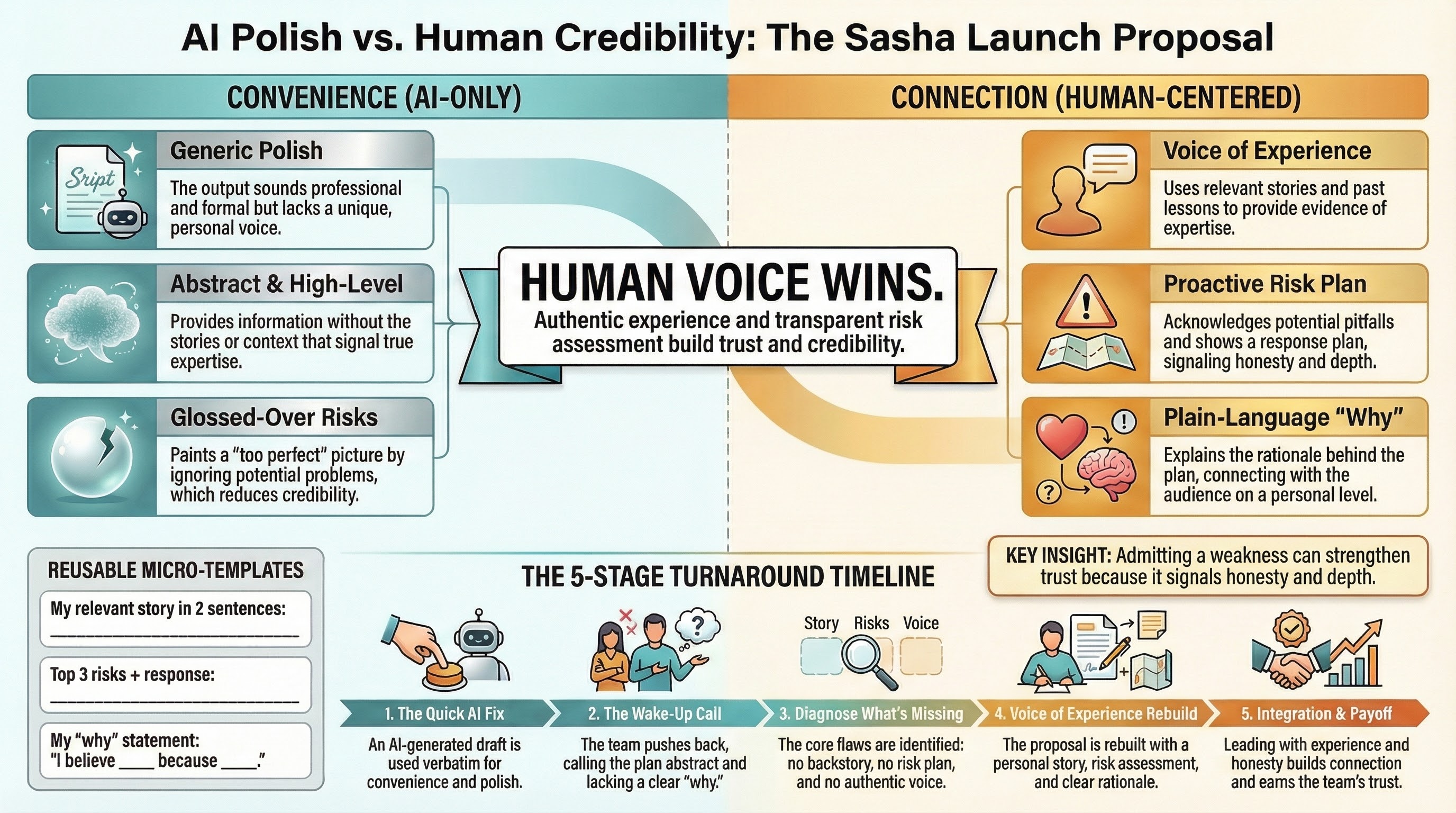
To ground this, think about Sasha, a senior program manager preparing a product-launch proposal. She uses an AI assistant to draft a polished plan, skims it, and pastes it into her deck because it saves time and looks clean. On the surface, nothing seems wrong. The sections are tidy, the language sounds executive-ready, and it even includes an inspirational line at the end. But beneath that polish is the first warning sign: the writing does not sound like Sasha, and more importantly, it does not contain Sasha’s lived judgment. It reads like a perfectly tailored suit that belongs to someone else.
This is where the concept of “human credibility signals” matters. When people decide whether to trust a plan, they are not only judging grammar and structure. They are listening for evidence that a real person made real decisions, for real reasons, with awareness of real risks. That evidence shows up as personal reasoning, context, and clear ownership of the idea. AI can generate confident wording, but it cannot supply your actual backstory, the trade-offs you considered, or the specific lessons you earned the hard way. If those pieces are missing, the message may sound impressive while still feeling empty.
Sasha finds this out the moment she presents. Leadership does not attack her formatting, they ask the questions that force authenticity: Why this approach, and why now? What have you seen before that makes you confident? What are the risks you are worried about, and what will you do if they show up? Those questions are not “gotchas.” They are normal trust checks. When a proposal is all high-level benefits and smooth phrasing, people sense that it might be untested or borrowed. The room gets quiet, not because the plan is terrible, but because the humans listening cannot find the human behind it.
Notice what specifically breaks down when your voice is missing. First, you lose personal context, which is where authority comes from. Second, you lose realism, because generic AI drafts often lean overly positive and skip the uncomfortable parts that real leaders expect to hear out loud. Third, you lose connection, because a script-like delivery makes you sound distant, even if you are competent. In practical terms, this is what it looks like at work: you can read a strong-sounding slide, but you struggle to defend it when someone asks you to explain the thinking that produced it. The output is fine, but the ownership is unclear.
The fix is not to stop using AI. The fix is to move AI back into a supporting role and put your judgment back in the driver’s seat. Sasha turns it around by starting with herself before she returns to any tool: What am I trying to accomplish? Why do I believe this plan is right? What worries me about it? What experience do I have that proves I understand the terrain? Those questions pull your real material to the surface. Then, and only then, AI can help you shape, tighten, or organize what is already yours. If you do it in the opposite order, you risk adopting a voice that cannot hold up under pressure.
Here is what “infusing your voice” looks like in practice. You take one relevant story, even a short one, and use it to justify a key decision: “I have led a launch like this before, and here is what we learned when early feedback turned negative.” You name trade-offs instead of hiding them: “This approach increases speed, but it raises the risk of confusion, so we are building in extra testing.” You admit uncertainty without sounding weak: “We cannot predict the market perfectly, but we will watch these early signals and adjust fast.” These choices sound simple, but they are powerful because they show your work, and showing your work is how people decide you are worth following.
Carry this forward as a standard: AI can help you draft, but it cannot replace your presence. Your job, especially in high-stakes communication, is to make sure your message includes your reasoning, your risks, your real-world context, and your accountability. Remember what Sasha learned: the polished version got her through a deadline, but the human version earned buy-in. As you apply this, aim for one clear personal insight, one honest risk, and one explicit “why” in anything that matters, so your work does not just look professional, it feels believable and led.