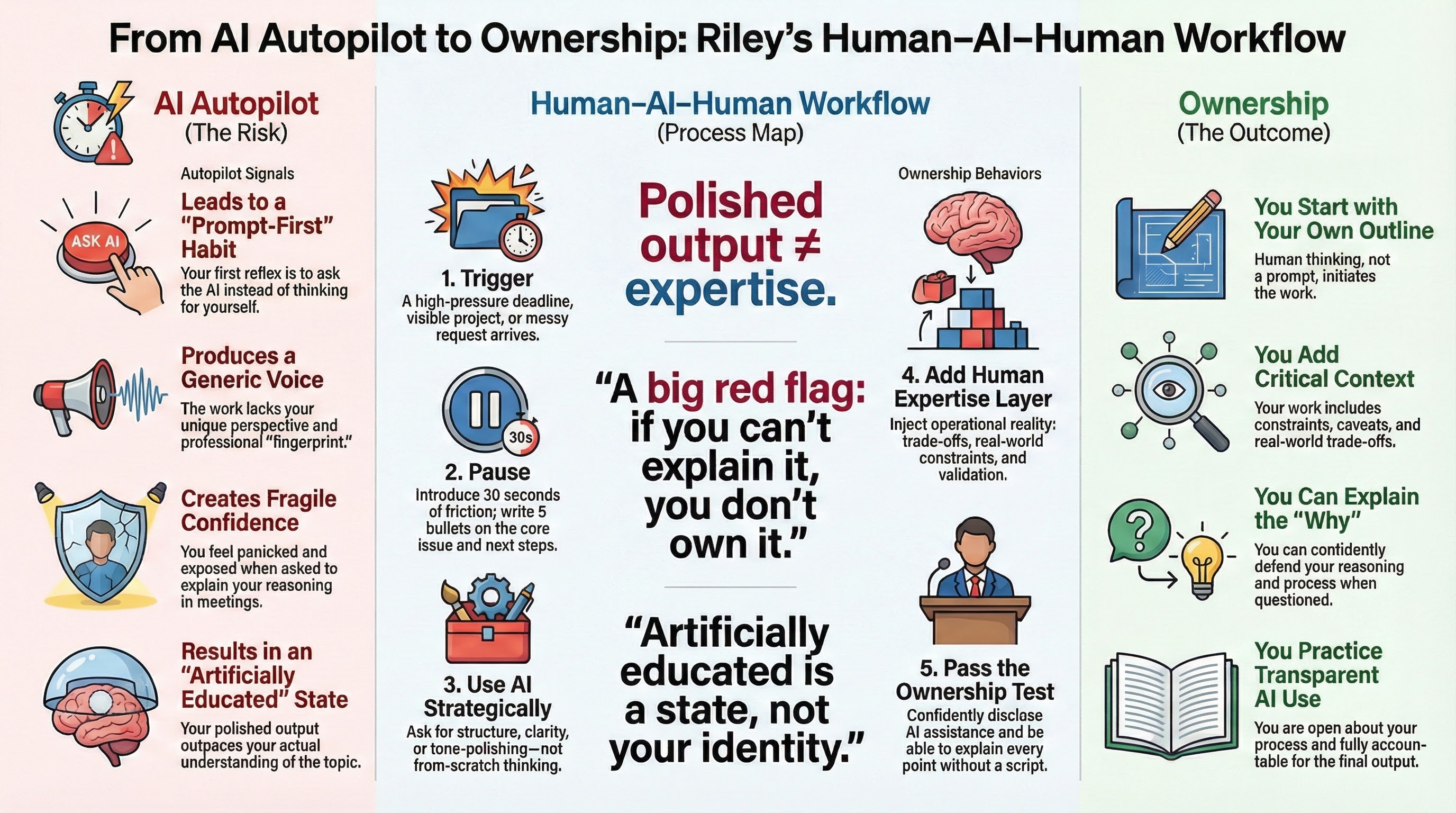
When you are under pressure, the temptation is simple: get something on the page fast. That is exactly what happens to Riley, a mid-level operations analyst staring down a high-visibility report and a tight deadline. Riley drops the task into an AI tool, watches a clean draft appear in seconds, and feels that instant relief that makes you think, “Finally, I’m ahead.” But a quiet worry shows up later, because deep down Riley knows a polished document is not the same thing as being ready to explain the thinking behind it.
That first burst of relief matters, because it is the beginning of a habit loop. AI delivers quick wins: a finished draft, a confident tone, and the feeling of competence without the time it usually takes to earn it. Your brain loves that speed, especially when you are tired, behind, or trying to impress. The problem is not that the output looks good. The problem is what you might be skipping to get it, which is the slow, human work of forming your own reasoning, choosing trade-offs, and putting your name on decisions.
This is where the common line “it’s just a tool” can mislead you. A calculator helps you compute, but it does not pretend to think for you. A spell-checker cleans up mistakes, but it does not invent the message. Generative AI can do much more, which means it can also quietly replace the parts of your process that build real ownership. If you let the tool create the structure, the logic, and the language, you can end up holding a document that sounds professional while your understanding sits a step behind it.
Riley feels that gap in the moment that matters most: the meeting. A leader asks, “Walk us through why you recommended this,” and suddenly the words on the page feel like someone else’s voice. Riley can paraphrase what the report says, but struggles to explain the reasoning underneath it. That is the danger zone, because credibility does not come from sounding polished. Credibility comes from being able to answer the next question, especially the simple ones like “Why?” and “How do you know?” This is what being “artificially educated” looks like in real life, not as an insult, but as a temporary state where your output gets ahead of your expertise.
The way out is not to swear off AI, it is to change who leads the workflow. Start by doing the first layer of thinking yourself, even if it is messy. Before you prompt anything, write a rough outline in your own words: what is the point, who is the audience, what are the constraints, what evidence do you have, and what decision are you actually recommending. Then use AI as support, not as a replacement. Ask it to help you tighten clarity, improve flow, or offer alternative wording for a sensitive sentence, but keep your core logic anchored in what you know and can defend.
Next, build a small pause into your routine so you do not fall into “prompt first” autopilot. Notice your triggers: a short deadline, a confusing request, a high-stakes audience, or the fear of sounding unprepared. When you feel that pull, do a quick “think first” reset like Riley does: jot down your explanation as if you had to say it out loud to a person in the room. Only after that should you bring AI in, and when you do, compare its suggestions against your notes, not the other way around. This slight friction is the point, because it keeps your brain in the driver’s seat.
As Riley keeps practicing, another lesson becomes clear: polished output is not expertise. AI can produce a neat plan that sounds right, yet misses the realities you know are true, like staffing limits, system constraints, seasonal spikes, or dependencies that change everything. Expertise shows up in the specific context, the caveats, and the trade-offs, plus the ability to adapt when conditions shift. A strong guardrail is to ask yourself, “Could I explain every major point without reading it?” and “What is uniquely mine in this work?” If you cannot answer those, the fix is simple: go back, validate, add real constraints, and rewrite until your thinking is visible.
The takeaway from this lesson is straightforward: speed is valuable, but speed without ownership creates fragile confidence. Use AI to accelerate expression, not to replace understanding. Think first, use AI second, then finish with human judgment by reviewing, verifying, and making the work sound like you. Most importantly, aim to be able to describe your process without embarrassment, because transparency is what turns AI from a secret crutch into a professional tool you control.