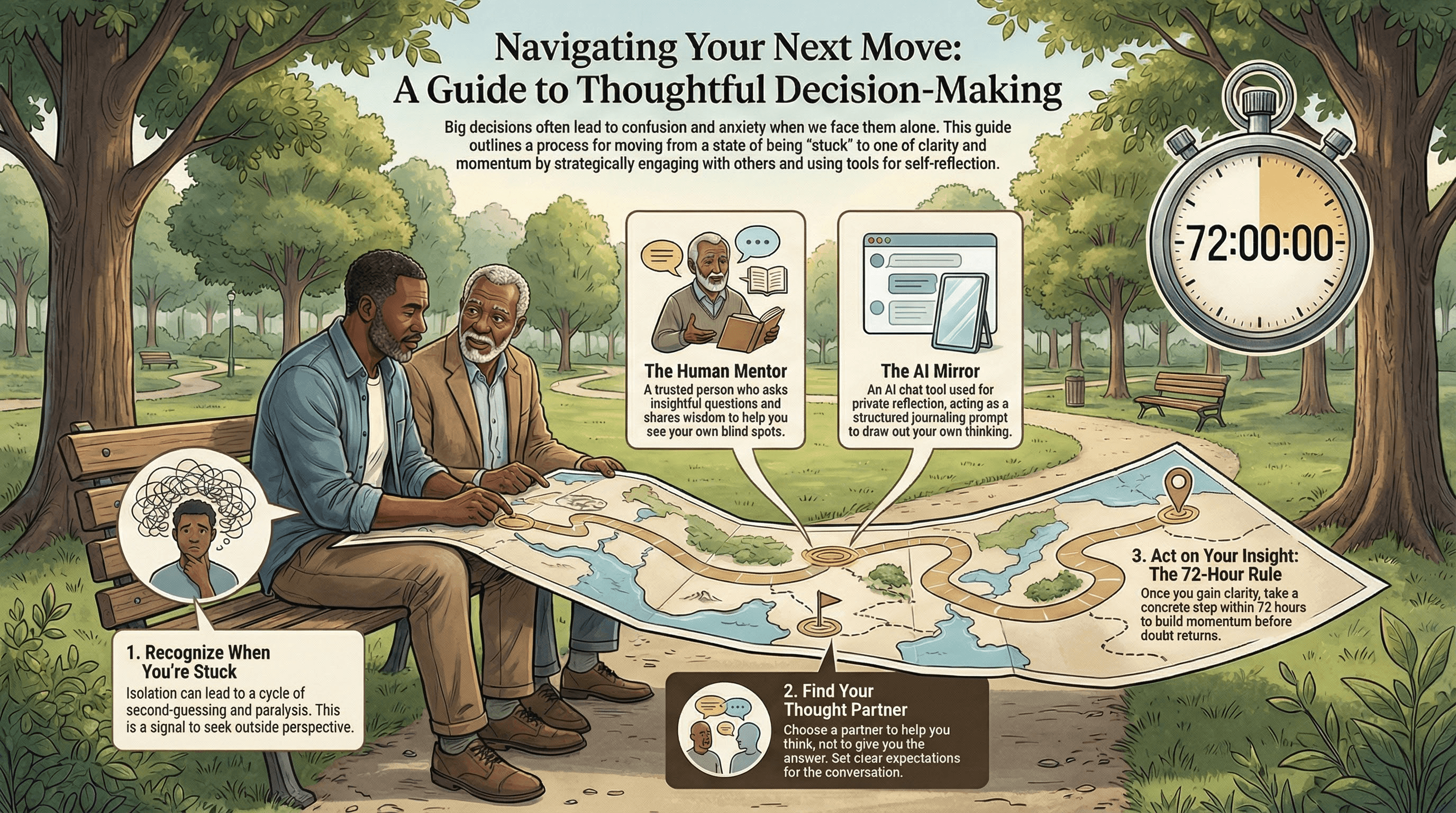

If you have ever stared at your life and thought, “I should be able to figure this out,” this lesson is for you. Maybe it is a career choice, a relationship decision, a leadership moment, or simply the feeling that you are stuck in your own head. You replay the same thoughts, you talk yourself into and out of options, and you end up tired with nothing decided. That is not because you are incapable. It is because your mind was never designed to be your only mirror. Thought partnership is the practice of using safe, honest conversations to help you see what you cannot see alone, so you can move forward with clearer judgment and less regret.
The first shift is understanding what thought partnership actually is. It is not asking someone to make a decision for you, and it is not looking for quick comfort or instant answers. Thought partnership is using conversation to uncover what you already know, challenge what you are assuming, and surface the next wise step. When you are alone, your fears and blind spots can get loud because there is no outside perspective to balance them. When you have the right partner, you get clarity faster because you are not trapped in the same loop. You still own the decision, but you do not have to carry the thinking by yourself.
Next, you have to choose the right partners, because not everybody is safe and not everybody is useful for every situation. A strong thought partner is usually close to the goals you want, or at least understands the kind of life you are building. They tell you the truth with care, not with ego, and they are willing to ask hard questions instead of just nodding along. Think of a mentor who has lived through the pressure you are facing, or a peer who is disciplined, honest, and steady. A person can love you and still not be the right person for this role if they only encourage you or only criticize you. The point is to find someone who can hold both, support and truth, so you can grow.
Once you have a potential partner, the quality of the conversation depends on you setting expectations. Many people reach out in a vague way, then leave the conversation frustrated because they got advice when they needed accountability, or they got comfort when they needed feedback. You can prevent that by being clear at the start. You might say, “I do not need you to solve this, but I need you to help me think,” or “I need you to challenge my assumptions,” or “I need encouragement and one practical next step.” You can also set a simple boundary like, “I am not looking to vent today, I want to leave with a decision.” When you name what you need, you respect their time and you give the partnership a purpose.
Now let’s talk about what to do inside the conversation so it actually helps. Start by explaining the situation in plain terms, then name what feels unclear. After that, invite questions. A good thought partner will often ask things like, “What do you want that you are afraid to admit?” or “What are you assuming is true without evidence?” or “What would you advise a friend in your situation?” These questions work because they shift you from spinning to seeing. For example, if you are deciding whether to take a new role, you might realize you are not afraid of the job, you are afraid of how it will look to others. That is a different problem, and it leads to a smarter next step. The conversation becomes valuable when it helps you separate facts from fears and desires from noise.
AI can also be part of thought partnership, but only if you use it as a mirror, not as a replacement for your judgment. The best way to use AI is to treat it like a guided journal that asks you questions and helps organize your thinking. You can prompt it to ask one question at a time, summarize what you have said, or help you list possible angles you have not considered. The key is boundaries. Do not hand over your identity, decisions, or mental health to a chatbot, and do not share sensitive details you would not want stored somewhere. If you use AI well, you are still the one deciding. The tool just helps you hear yourself more clearly and notice patterns you might miss.
The last step is the one most people skip, converting insight into action. A great conversation can feel powerful and still change nothing if you do not leave with a next step. So you will use a simple process: capture the key insight, name the decision it points to, and choose one action you can complete in the next 24 to 72 hours. If the insight is “I keep delaying because I fear disappointing people,” the decision might be “I am going to choose based on my values, not approval,” and the next action might be “Schedule a call with my mentor to practice the conversation,” or “Send the email,” or “Block one hour to draft the plan.” Momentum comes from follow-through, not from how emotional or inspiring the conversation felt.
As you close this lesson, remember what thought partnership is really doing for you. It helps you stop trying to be your own only advisor, your own only critic, and your own only encourager. You choose the right partners by looking for truth with care, you set expectations so the conversation has purpose, and you use questions to uncover what you already know and challenge what is holding you back. You can use AI as a safe reflection tool with clear boundaries, and you prove the value of every conversation by taking one real action within the next few days. If you carry one thing forward, let it be this: clarity is not just something you feel, it is something you use, and thought partnership works when it changes what you do next.