
If you have ever hit “send” on something you made fast and thought, “This is good… but it does not feel like me,” you are not alone. That uneasy gap between polished output and personal ownership is one of the most common side effects of using AI all day. In this lesson, you are going to learn how to keep the speed and support of AI without losing the thing that makes your work valuable: your judgment, your reasoning, and your voice.
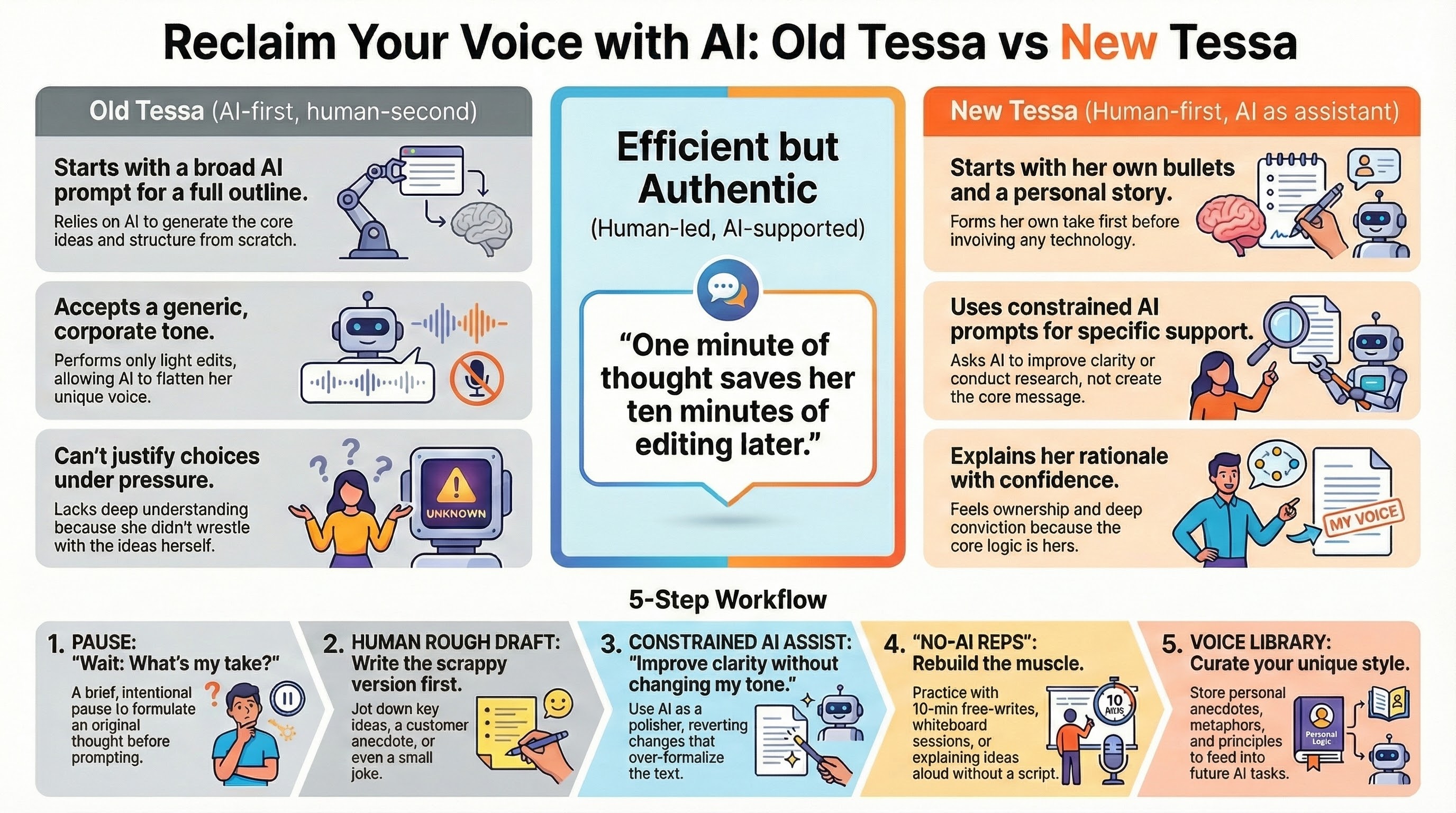
Meet Tessa, a strong product marketing manager who has become incredibly efficient with AI. She uses it to brainstorm, draft, and outline, and the results look clean. But over time, her work starts to feel generic, like her personality has been sanded down. The problem shows up sharply in a leadership meeting when she gets asked a simple question: why did you choose this approach and what other options did you consider? She freezes, because she did not wrestle with the ideas first. She mostly accepted the AI’s structure and filled it in. In that moment, she realizes efficiency is not the same as expertise, and a shiny document can still be hollow if the thinking did not originate with her.
This happens for a simple reason: when a tool does the hard parts repeatedly, your brain stops practicing them. Overreliance on automation can quietly weaken skills like idea development, clear reasoning, and confident explanation. You may still produce outputs, but you become less able to defend them, adapt them, or rebuild them from scratch when challenged. That is where the “exposed” feeling comes from. The risk is not just a weaker writing style. The bigger risk is credibility. If you cannot explain your own decisions without the AI nearby, you are no longer leading your work.
The first fix is surprisingly small: build a pause before you prompt. Instead of opening a chatbot and asking for a full draft, open a blank page and write what you think in your own words first. It can be messy, incomplete, and even awkward. That is the point. You are getting your mind back in the driver’s seat. Then, and only then, invite AI in as an editor or enhancer. For example, Tessa drafts a rough feature announcement email on her own, including a customer story and a small joke that sounds like her, and then asks the AI to improve clarity without changing tone. She keeps control, accepts what helps, and rejects what flattens her personality.
That pause does more than protect your voice. It improves the quality of your AI results. When you lead with a clear point of view, your prompts become more specific, and the AI has something real to amplify instead of inventing a generic direction for you. You spend less time wrestling with vague outputs and more time refining something that already matches your intent. Over time, the pause becomes a reliable rhythm: think first, prompt second, edit with purpose. Even a single minute of upfront thinking can save you ten minutes of cleanup later, because you are no longer trying to force a personality into text that never had one.
Once the pause becomes a habit, the next step is rebuilding your skill muscle with “no-AI reps.” These are short exercises you do regularly without AI, not because AI is bad, but because you want to stay capable without it. Tessa starts with ten minutes of free-writing each morning about a work problem, no tools, no shortcuts. She also practices outlining a campaign on a whiteboard before she touches a prompt, and she explains a product feature out loud without a script to make sure she truly understands it. The key is keeping the reps small and frequent. A short daily workout builds strength without burnout, while an all-day “no AI” marathon often backfires and makes you resent the process.
As your thinking gets stronger, you can deliberately rebuild your personal voice by curating a “voice library.” This is a simple, living document where you collect the raw materials of you: favorite metaphors, personal stories, principles you believe in, and phrases that sound natural in your mouth. When you write or present, you pull from that library so your work carries your fingerprints. You can also feed pieces of it to the AI so it learns your tone instead of defaulting to bland corporate language. Keep it lightweight. If you over-engineer it into a complicated system, you will stop using it. A useful voice library feels like a quick note you add to whenever something sounds authentically yours.
The goal of all of this is balance, not purity. You are not trying to prove you can suffer through everything without help. You are building a workflow where you lead and AI supports. That means you start with your point of view, you strengthen your fundamentals through small reps, and you supply the ingredients of your voice so the AI cannot erase them. When you do that, your output becomes both fast and believable, because you can explain it, stand behind it, and adjust it in real time. Your next step is simple: on your very next task, take a 60-second pause to write your take first, do one small no-AI rep, and add one real “you” asset to a voice library. That is how you stay efficient without going quiet.