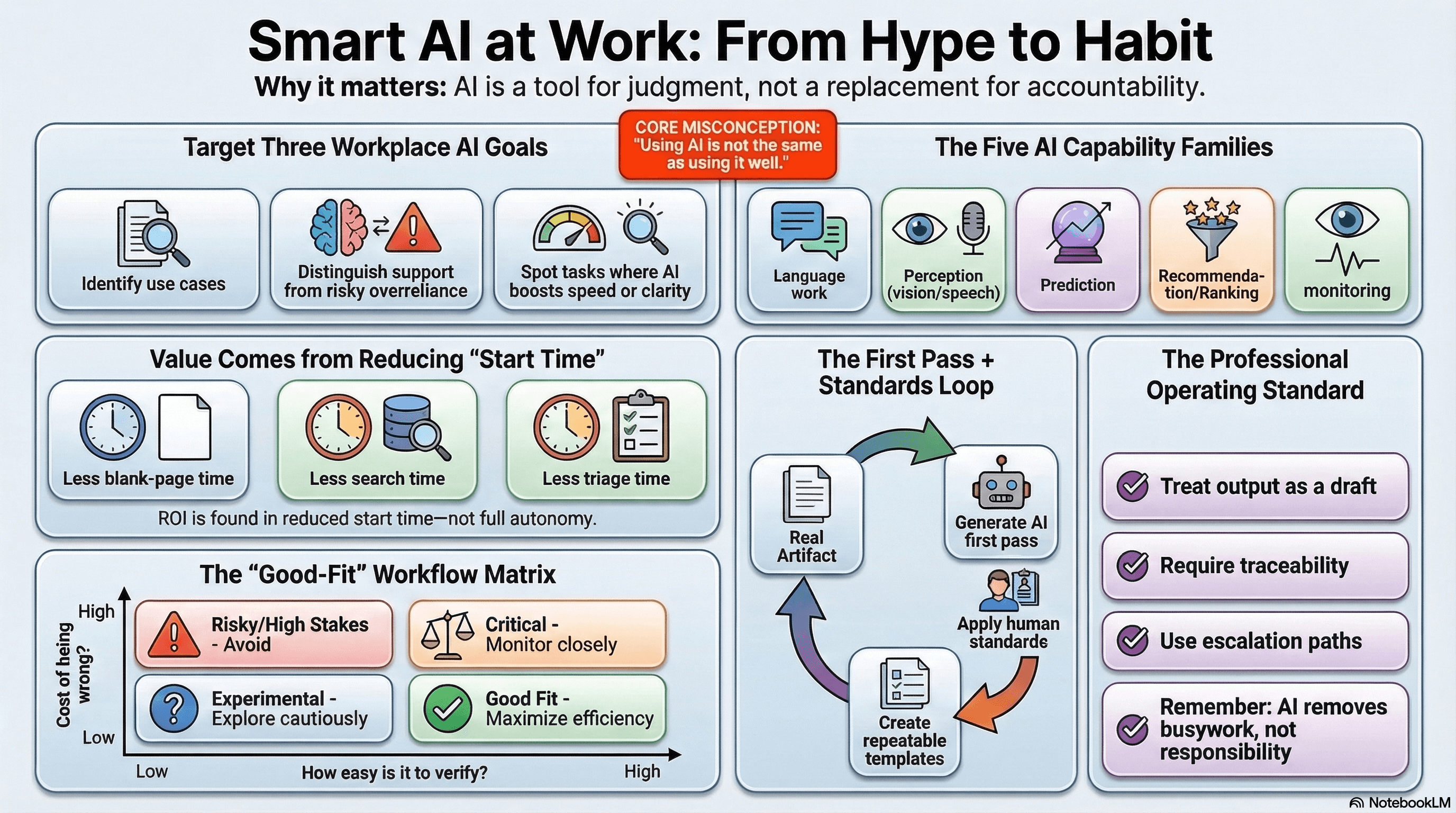
AI is already part of everyday work, whether people notice it or not. People use it when they draft emails, summarize documents, organize information, support decisions, and speed up first-pass work. This lesson is meant to help learners see AI in real tasks, real teams, and real workflows, not as a vague trend or a distant idea. The goal is not to treat AI as the answer to everything. The goal is to build judgment. Learners need to know where AI can reduce friction, where it adds real value, and where human review still matters most. When people connect AI to actual work instead of abstract hype, the whole framework becomes easier to understand and easier to use. By the end of this lesson, learners should be able to identify major workplace uses for AI, tell the difference between useful support and risky overreliance, and spot tasks where AI can improve speed, structure, or clarity.
AI is no longer something organizations might try one day. It is already built into tools people use every day in marketing, customer support, operations, engineering, HR, finance, healthcare, and manufacturing. The pattern is clear: adoption is broad, but reliable impact is harder. Many organizations can say they use AI. Far fewer have changed the surrounding workflow enough to get consistent results at scale. Recent survey data shows how fast this has moved. One major tracking effort found that the share of organizations using AI rose from 55% in 2023 to 78% in 2024, and that use of generative AI in at least one business function more than doubled from 33% to 71%. Another global survey reported even higher rates of regular use, while also showing that many organizations are still in pilot mode rather than true scale. That distinction matters. Using AI is not the same as using it well. A practical way to understand AI at work is to group it into a few common kinds of use: language work such as drafting, summarizing, and classifying text; perception tasks such as image inspection and speech-to-text; prediction and forecasting; recommendation and ranking; and decision support through alerts, risk flags, and second-opinion tools.
For many teams, the clearest day-one value of AI is simple: it helps people draft, summarize, organize, and answer questions faster. Controlled studies show meaningful productivity gains on well-scoped knowledge tasks, but those gains depend on the task and often vary by experience level. In one well-known experiment on professional writing tasks, people using an AI chatbot finished about 40% faster and produced work rated about 18% higher in quality. That is a strong result, but it came in a setting where the task was structured, the output could be judged, and people still had to decide what they would actually submit. Customer support shows the same pattern. In a study of 5,179 support agents, access to a conversational assistant increased issues resolved per hour by 14% on average, and the largest gains, 34%, went to novice and lower-skilled workers. Experienced workers saw little effect. That tells us something important: AI can help close skill gaps by giving less experienced workers a stronger starting point, but it does not replace judgment and it does not help every worker in the same way.
What turns these gains into repeatable habits is not prompting in the abstract. It is process design. A useful pattern for learners is a First Pass plus Standards loop. Start with a real artifact such as notes, a rough outline, a policy draft, or a list of requirements. Use AI to create a structured first pass, such as a summary, draft, email, outline, or decision memo. Be clear about the format, the audience, and any assumptions. Then apply human standards by checking for accuracy, fit, tone, and audience needs. That step is not optional. Finally, make the process repeatable with templates, checklists, and known-good prompts so the time savings happen again next week, not just once. If learners leave this lesson thinking AI saves time because it writes for them, the lesson has not gone far enough. The real skill is knowing when a first pass is safe to use, and building a review habit that is faster than starting from scratch but strict enough to catch quiet errors.
In creative and task-specific work, AI is most useful as a fast generator of options and a reducer of busywork. The point is not to let the tool be creative for you. The point is to generate possibilities quickly, choose the strongest direction, and refine it against real constraints and real audiences. Software development is a clear example because the outputs can be measured. One controlled experiment found that developers using an AI coding assistant completed a defined programming task 55.8% faster than a control group, and field experiments inside real companies also found higher task completion rates among developers using AI tools, with larger gains for less experienced workers. But task-specific AI can also introduce new risks, especially when the output looks polished. Code tools often optimize for code that works, not code that is secure, and studies continue to find insecure suggestions in real use. The human risk matters just as much: when the output looks confident, people may trust it too quickly and review it too lightly. The same pattern shows up in other settings, including inspection and quality control in manufacturing, where AI can spot patterns at scale and apply the same standard over and over, but people still need to review results, document decisions, and stay accountable for the final call.
Decision support is where training needs to become more disciplined, because this is where people are most tempted to hand off responsibility. Decision-support AI includes risk scores, prioritization, forecasts, recommendations, and triage. These tools can be useful because they help people focus attention, move faster, and surface issues earlier. But they become risky when the logic turns into one sentence: the model said so. Across major governance and regulatory frameworks, the message is consistent. Trustworthy systems should be reliable, safe, secure, accountable, transparent, explainable, privacy-aware, and fair. Risk management should be ongoing, not a one-time check before launch. These frameworks also make another point clear: human judgment is still needed to decide whether AI is appropriate in a given context, which standards matter most, and what happens when the system is wrong. Europe’s AI Act takes a risk-based approach and places stricter requirements on high-risk systems, including areas such as hiring. In the United States, regulators in lending, employment, and healthcare are also drawing a clear line that existing rules still apply when AI is involved. A practical habit for learners is to ask three questions every time an AI system recommends something: What is it optimizing for? What data and assumptions does it rely on? What happens if it is wrong, and who is accountable?
The practical skill is not just finding a place to use AI. It is breaking work into tasks and identifying which tasks have the right mix of volume, structure, and verifiability. Two questions are enough to start: How easy is it to verify the output, and what is the cost of being wrong? That is the core judgment learners need. Tasks that are easy to check and low in consequence are often good places to begin. Tasks that are hard to verify or high in consequence require stronger controls, or may not be good candidates at all. Drafting and rewriting can be a good fit when the work is high volume, low stakes, and always reviewed by a person. Summarizing and structuring work well when the source text is available and the summary can be checked quickly. Classification and routing can help with ticket labeling or FAQ tagging when labels are clear and feedback exists. Recommendation and forecasting can support churn risk, fraud flags, or prioritization when the final decision remains human and the system is monitored. Automating steps such as template generation or code scaffolds can also work when the output is testable and failures are contained. Across all of these, the same rule applies: the better the task can be checked, measured, and corrected, the better the starting point for AI.
Two design choices matter when learners try to turn AI use into a professional habit. First, choose workflows with measurable outcomes. That is why customer support and software development appear so often in strong studies. Time, volume, and output can be tracked. Second, build governance into the workflow itself instead of adding it later. Organizations that see stronger results are more likely to define when AI output requires human validation and how that review should happen. This is also where a no-hype operating standard matters. Modern generative AI can sound fluent even when it is wrong, and that is not a rare edge case. It is a known limitation. So AI output should be treated as draft material or a working hypothesis unless it can be verified quickly. Where possible, teams should require traceability through source excerpts, document references, and logs. High-impact decisions should have escalation paths, including human review, human alternatives, and a clear way to fix errors. Privacy matters too. AI is only usable at work when people know what data can be shared, what cannot, and what rules apply to storage, logging, access, and retention. The clearest principle to end on is also the most important one: AI can remove busywork, but it cannot remove responsibility. The more consequential the decision, the more AI should shift from answering to supporting, with stronger requirements for verification, documentation, and human control.