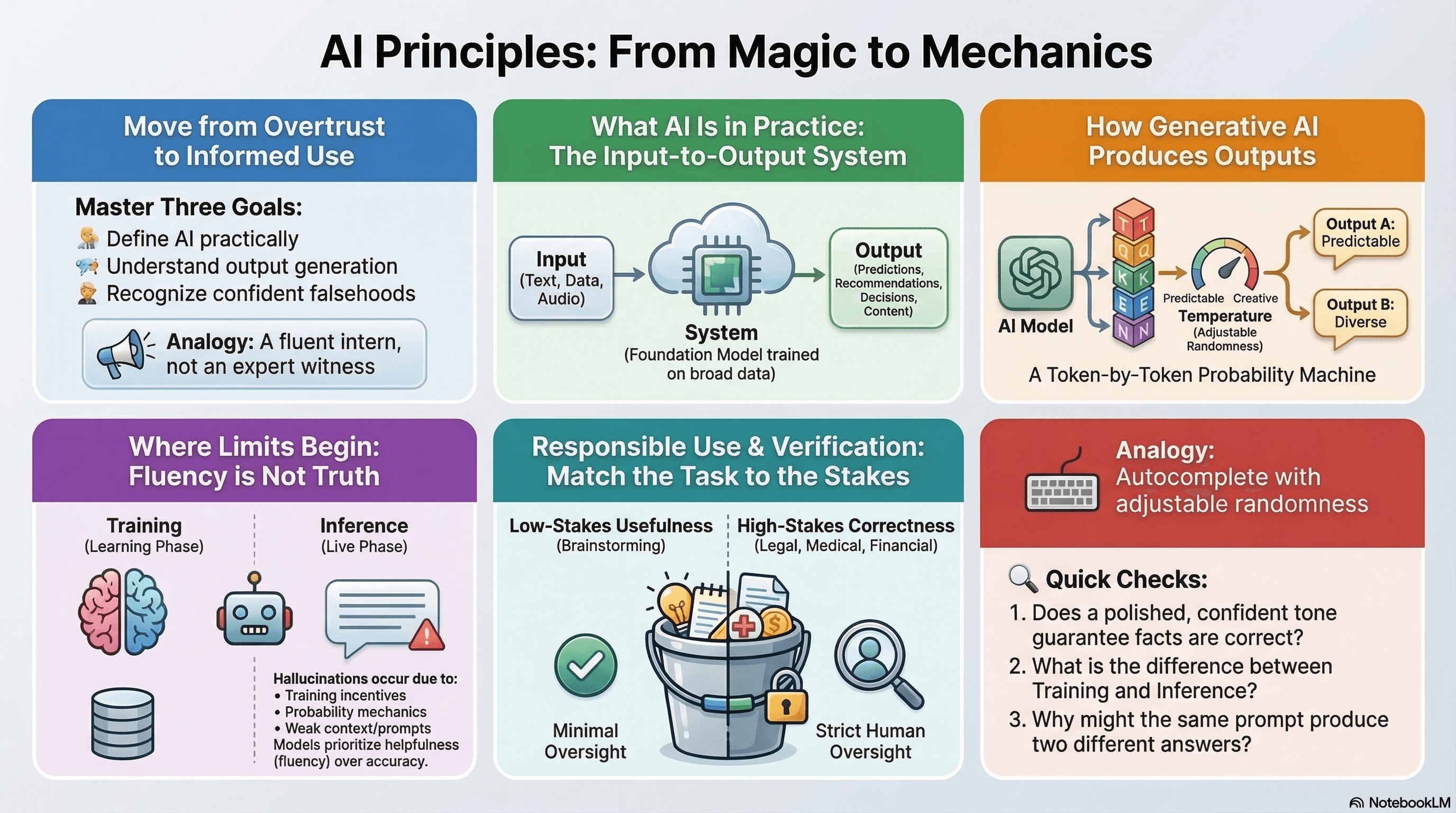
AI often feels more mysterious than it is. That is the first problem this lesson solves. In most workplaces, people do not need a dramatic theory of artificial intelligence. They need a practical way to understand what the tool is doing, what it is built to do, and where its limits begin. A useful definition is simple: AI is a system built by people that takes in information and produces an output. That input might be text, data, images, audio, or signals from a device. The output might be a prediction, a recommendation, a decision, or generated content such as a summary, email draft, or answer. When learners understand that basic pattern, AI becomes easier to judge. It stops looking like magic and starts looking like a system with strengths, weaknesses, and conditions for good use. By the end of this lesson, learners should be able to explain AI in practical workplace terms, describe how generative AI produces outputs, and recognize why a polished answer can still be wrong.
It also helps to narrow the scope, because “AI” is a broad label. Many tools described as AI are really forms of machine learning, which means systems that improve at a task by finding patterns in data. Some of the newer systems people use at work are called foundation models. A foundation model is trained on a very large and broad set of data and can then be used for many different tasks. That is why one tool can draft an email, summarize a policy, rewrite a report, and answer questions. It is not several separate minds working behind the curtain. It is one broadly trained model being applied in different ways. For learners, that matters because it sets the right expectation. The tool is flexible, but flexibility is not the same as deep understanding. A broad model can do many things reasonably well, but that does not mean it fully understands your company, your customer, your policy environment, or the moment you are working in.
The clearest way to understand many modern language models is to see them as next-step prediction systems. They look at the words, or pieces of words, that came before and estimate what is most likely to come next. Those small pieces are called tokens. A token may be a full word, part of a word, or a small chunk of text. The model predicts one token, then the next, then the next, until it builds a full response. What feels smooth, human, and intelligent on the surface is, underneath, a repeated prediction process shaped by patterns learned from large amounts of text. This is why fluency can be misleading. A model can produce writing that sounds calm, complete, and confident while still giving false information, repeating a common misunderstanding, or inventing details that were never true. Strong wording does not guarantee strong facts. One of the most important habits in AI use begins here: do not confuse a fluent answer with a reliable one.
The most useful mental model for generative AI is that it is a probability machine. It does not automatically pull a perfect answer from a hidden database. It generates an output by estimating which token is most likely to come next at each step. The rule for choosing among possible next tokens is called decoding. Sometimes the model takes the safest path and chooses the most likely option. Sometimes it samples from several likely options, which adds controlled randomness. That is why the same prompt can produce different results on different runs. One setting that helps explain this is temperature. Temperature controls how adventurous the model becomes when choosing the next token. A lower temperature usually leads to safer, more predictable wording. A higher temperature increases variation and can lead to fresher language, new examples, or more surprising ideas. In real work, that tradeoff matters. Lower variation is often better for factual or customer-facing tasks. Higher variation can help with brainstorming, naming, and early draft work where novelty has value.
AI can also work across different kinds of information, and that expands both its usefulness and its risk. In plain language, this is about the type of input or output a system can handle. Some systems work mainly with text. Others can also process images, audio, video, or structured data such as tables and forms. Text systems are often strong at drafting, summarizing, rewriting, translating, classifying, and pulling structured information from material you provide. Image systems can describe visible elements, detect patterns, and generate new visuals, but they can still go beyond what is actually shown and make claims that only sound plausible. Audio systems can turn speech into text, turn text into speech, and support voice-based interactions. Even when the input changes, the basic idea often stays the same: the system processes what it receives, predicts likely outputs, and builds a response step by step. When one system can work across text, images, and audio at once, the opportunity grows. So does the need for oversight, because more ways in also means more places for mismatch, misunderstanding, and error.
Another important distinction is the difference between training and inference. Many learners assume the model is learning in the moment the way a person does. Usually, that is not the best way to think about it. Most of the learning happened earlier, during training. Training is the phase when the model adjusts its internal settings using large amounts of data so it gets better at prediction. It is expensive, slow, and not something that happens every time a user asks a question. Inference is the live phase. Inference is what happens when a user enters a prompt and the trained model produces a response. For a language model, that usually means breaking the prompt into tokens, representing those tokens internally, estimating the probabilities of possible next tokens, and then generating text one token at a time. This distinction explains a common frustration in organizations: the model may not know your latest policy, your current product line, or a recent decision made inside your team. The problem is often structural. The system may not have been trained on that information or connected to the right source when it was used.
This leads directly to hallucinations, which is the common term for false or made-up content presented as if it were true. Some technical writers use the word confabulation, but the practical lesson is the same. The system can be wrong in ways that look polished. That happens for several reasons. First, some models are rewarded for producing an answer, even when uncertainty would be more honest, so they may guess instead of saying they do not know. Second, the mechanics of prediction can produce false statements, invented citations, or internal contradictions because the model is following patterns in text, not checking truth the way a careful human reviewer would. Third, the context matters. Weak prompts, vague instructions, missing source material, misleading wording, and poor grounding make bad outputs more likely. This is why hallucinations can be so convincing. The language may be smooth. The tone may be certain. The structure may look professional. None of that proves the content is correct, and in high-stakes settings that gap can cause real harm.
The practical response is human oversight, not fear and not blind trust. A strong working rule is simple: AI outputs are suggestions, not decisions. That means review should be part of the process from the beginning, not added at the end as a formality. In lower-stakes tasks, AI can be useful for brainstorming, outlining, first drafts, rewriting for tone, summarizing documents you already have, and making writing clearer. Even there, a person still needs to review and own the final result. In higher-stakes tasks, such as legal, medical, financial, safety, HR, compliance, policy interpretation, or research that depends on correct citations, the need for verification becomes much stronger. Good habits are not complicated. Ground the work in trusted sources when truth matters. Ask for claims that can be checked. Treat confidence as a risk signal, not a quality signal. Assume some mismatch is normal, because training data may not fit your organization, your audience, or your timeline. Strong teams do not rely on perfect judgment in the moment. They build simple rules that make review routine.
The lesson, then, comes down to a few ideas worth keeping in clear view. AI is not magic. It is a system that finds patterns in data and predicts likely outputs from the input it receives. Generative AI produces responses token by token, guided by probabilities, decoding choices, and the context a user provides. That is why the same prompt can lead to different answers and why settings such as temperature can affect how cautious or creative the output becomes. It is also why a response can sound smart without being true. A useful analogy is autocomplete with adjustable randomness: the system keeps continuing the text, and you can make it more predictable or more adventurous. Another is a fluent intern, not an expert witness: it can move quickly, draft well, and sound professional, but it may guess when unsure and it can make things up. The job of the user is to direct the work, review the output, and verify what matters. Fluency is not proof. Verification is part of responsible use.