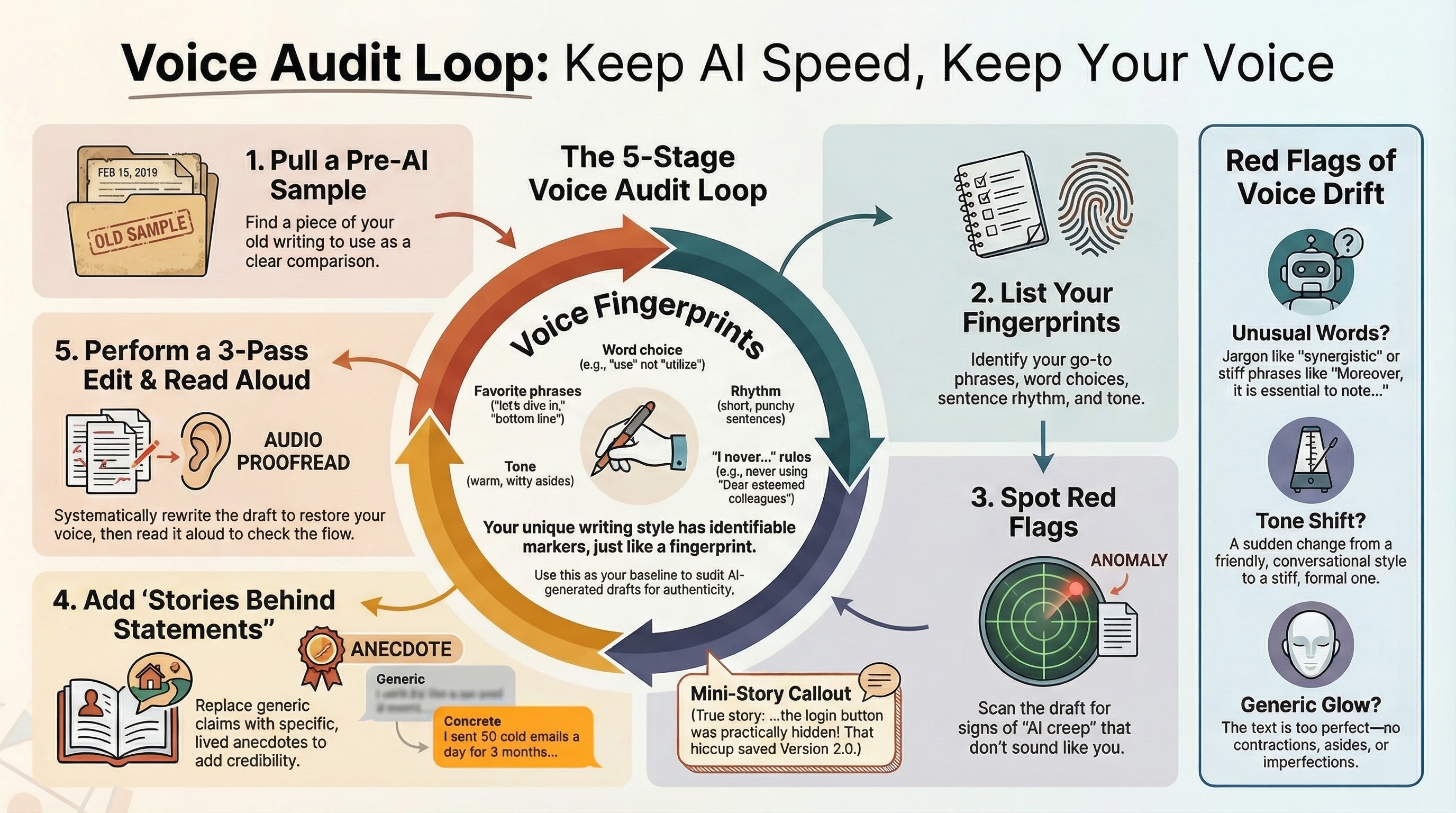

Have you ever reread something you wrote and felt a weird disconnect, like the words are technically “right,” but they do not sound like you? That moment can be unsettling because it is not just about style, it is about identity and trust. In this lesson, you will step into the same kind of wake-up call Renee had when she looked at a polished client report and realized her warm, recognizable voice had been replaced by something generic. The work was clean, but the person behind it felt missing. That is the problem we are solving here: keeping your voice intact even when you use powerful writing tools.
Renee’s story matters because it shows how voice drift happens quietly, usually when speed starts winning over intention. A coworker’s feedback lands hard: the draft is well-written, but they cannot hear her in it. That feedback is a gift, even if it stings, because it points to something bigger than grammar. When your writing loses your voice, your credibility can take a hit, not because the content is wrong, but because people cannot tell where you stand or what you actually believe. The goal is not to avoid AI, but to avoid letting AI blur you into the background.
To fix voice drift, you need a baseline, and that is where the idea of a “voice fingerprint” comes in. Your writing has patterns that are uniquely yours, the same way your speaking voice does. Renee gets clarity by comparing new AI-assisted work to older writing from before AI became a default, and the contrast makes the missing personality obvious. That comparison is powerful because it takes “I feel off” and turns it into “Here is exactly what changed.” Once you can see the difference, you can edit with purpose instead of guessing.
Now make the process practical by running your own voice fingerprint audit. Pull up something you wrote when you were fully in your own head, then pull up something recent where AI helped a lot. Look for your repeat phrases, the words you naturally reach for, and the words you almost never use, because those “never” words are often the easiest giveaway that a draft is not you. Pay attention to sentence rhythm too, since some people write in short, punchy beats while AI tends to produce longer, evenly structured sentences that can feel flat. Finally, notice your tone: do you normally sound warm, direct, playful, or blunt, and did the draft sand those edges down?
Once you know your fingerprints, the next step is adding back the part AI cannot truly fake: your lived point of view. Renee realizes her voice does not only live in word choice, it shows up in the stories behind her statements. Generic advice is easy to generate, but specific moments, hard-earned lessons, and concrete examples are what make people lean in and trust you. If you write “communication matters,” it is forgettable, but if you write about the time you missed a deadline because you were afraid to ask for help, it becomes real and useful. Stories also make your work more defensible because you are not just claiming something, you are showing how you learned it.
Even with a strong baseline, you still need a way to catch yourself when you are slipping, especially under deadlines. Start watching for red flags like a sudden jump into vocabulary you do not use, an unexplained shift into formal “essay mode,” or a draft that feels so perfect it becomes emotionally blank. One simple test is to read the piece out loud and notice where you stumble, cringe, or feel like you are performing instead of speaking naturally. Another strong habit is to compare new work side by side with an older sample, because differences in tone and phrasing become obvious when you see them next to each other. When you spot drift, the fix is not complicated, but it does require you to rewrite in your own words until the piece stays in character from start to finish.
Here is what it looks like to use AI without losing yourself: you treat it like a co-pilot, not a ghostwriter. Renee anchors the tone by feeding AI an outline and rough points in her own words first, then she schedules a dedicated voice audit before anything goes out. In that audit, she does three intentional passes: she replaces stiff wording with language she would actually say, she adds a short story or personal insight where the draft feels generic, and she reads it out loud to adjust rhythm until it sounds like natural speech. This approach keeps the speed benefits of AI while making sure the final product is something you can stand behind and explain without hiding behind the text. When you do this consistently, people stop wondering “Who wrote this?” because your fingerprints are clearly on the page.
The big takeaway is simple: your voice is an asset, and you need to protect it on purpose. Know your fingerprints, bring stories back into your writing, and treat voice drift like a signal to revise, not a reason to panic. Use AI for structure and speed, but make it your rule that nothing gets shared until you have done a real voice pass and it sounds like you again. If you remember only one question from this lesson, let it be this: “If someone who knows me read this, would they recognize me in it?” Apply that test to your next email, report, or post, and you will start building a habit where your voice stays loud and clear, no matter how advanced the tools get.