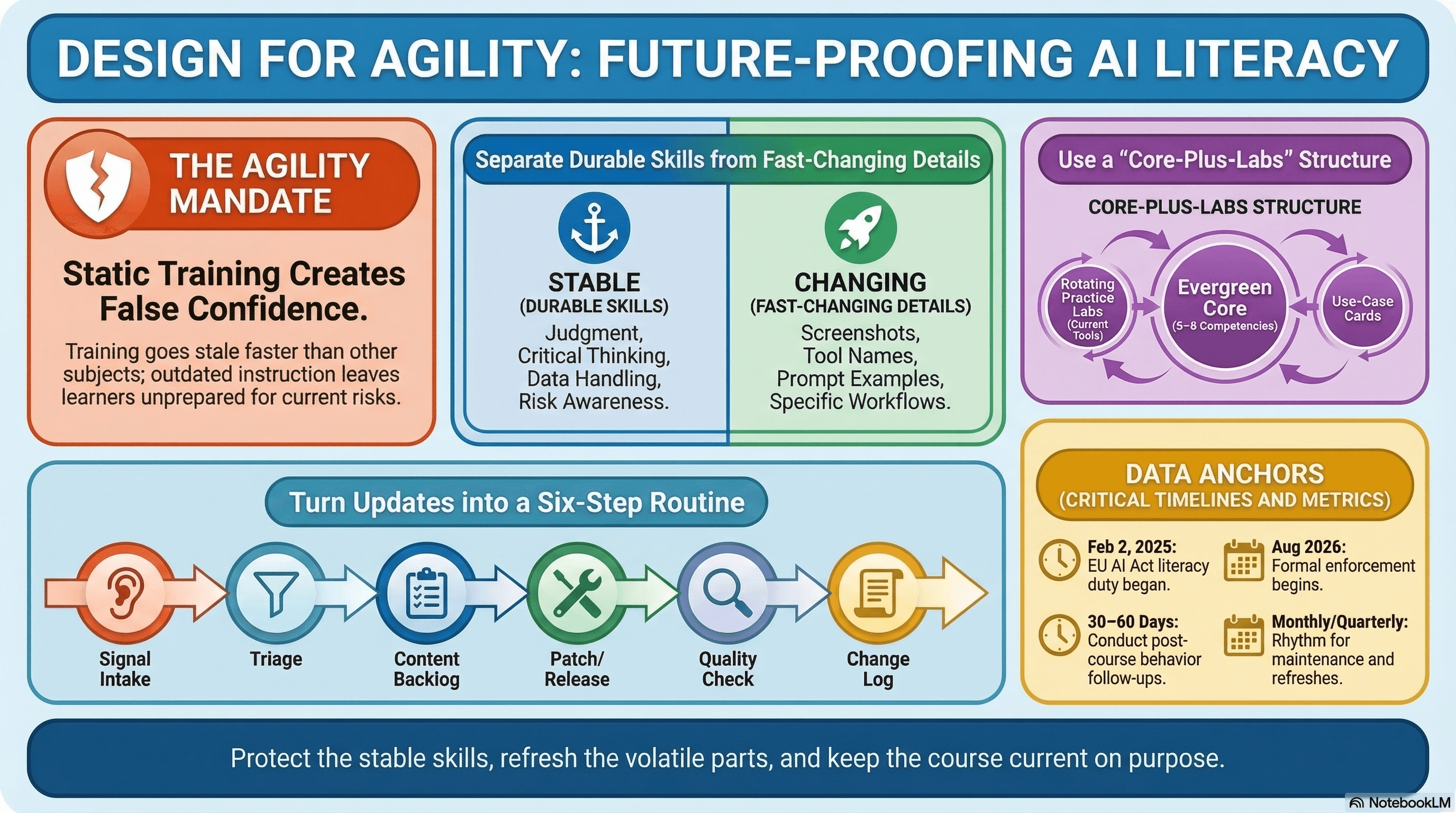
AI literacy training has to be built for change. AI tools change quickly, workplace expectations shift with them, and internal policies often tighten as organizations learn where the real risks are. That means a course that looks strong today can become dated much faster than other kinds of workplace training. This matters because outdated instruction does more than miss a few details. It can give people false confidence. They may leave the course thinking they are ready, even though the tool, the workflow, or the rule has already changed. The goal of this lesson is to help learners understand why AI literacy programs must be designed to adapt, why modular course design makes updates easier, and why regular improvement is what keeps training useful over time.
The need for agility is already here. AI literacy is not a topic organizations can treat as optional or delay until later. In the European Union, for example, the AI literacy duty under Article 4 of the EU AI Act has applied since February 2, 2025, and formal supervision and enforcement begin in August 2026. More broadly, the same pattern is showing up across workplaces and education systems: AI skills are now a moving target. New tools appear, older habits lose value, and new risks show up in real work before many organizations have had time to update training. That is why AI literacy should be treated like something you maintain over time, not something you finish once and forget. The aim is not constant disruption. The aim is to build training that stays useful even as the environment around it keeps moving.
Agility in training does not mean changing everything all the time. It means making change easier, cheaper, and more controlled. The best way to do that is to separate what should stay stable from what will probably change. Stable parts include judgment, critical thinking, evaluation habits, data handling, and risk awareness. These are durable skills. They still matter when a tool changes its layout, when a new model appears, or when a feature gets renamed. The fast-changing parts are different. These include screenshots, feature labels, tool steps, prompt examples, and role-specific workflows. Those pieces often age quickly. A practical view of AI literacy is that people need the skills, knowledge, and understanding to use AI in an informed way, with awareness of benefits, risks, and possible harm. That definition points training toward sound judgment, not memorizing last quarter’s tricks.
To make training easier to maintain, three design choices matter most. First, build in small test-and-improve cycles instead of trying to launch one perfect course and freeze it. A strong program is built, tested, reviewed, and revised in short rounds. This makes change normal instead of disruptive. Second, organize the course into self-contained modules. A module is a lesson unit that can stand on its own. When one module changes, the rest of the course does not have to be rebuilt around it. That saves time and reduces cost. Third, reuse shared assets such as examples, checklists, rubrics, and assessments. Store them in places where people can find them, tag them clearly, assign owners, and add review dates. Organizations often pay a heavy rewrite cost later because they skip that early structure. A simple test helps here: if you cannot replace one part without breaking the course, the design is not truly modular.
Agile programs also treat change as routine maintenance, not as a crisis. Many teams wait until the course feels obviously broken, then rush into a stressful rewrite. A better approach is to manage training updates the way good teams manage product releases. Some changes are small patches, such as fixing an outdated screenshot, replacing a broken example, or updating policy language. Other changes are larger releases, such as adding a new use case, a new assessment, or a new sequence of lessons. A lightweight process helps keep this work focused. You need a way to spot changes, decide which ones matter for safe and informed AI use, place those changes into a clear backlog, update the course in the right lane, check quality afterward, and keep a basic change log. That record matters because once learners notice stale content, they begin to question the credibility of the whole program.
Examples need special attention because they usually age faster than explanations. A useful explanation of judgment or risk may last for a long time, but a tool demo or prompt example can become outdated very quickly. One practical solution is to build examples as use-case cards with a fixed structure. Each card can show the role, the work task, the inputs that are allowed, the quality bar, the common failure modes, and the date the example was last validated. That structure makes updating much easier. Instead of searching through old course pages or slide decks, you can find the exact example, see whether it is still valid, and refresh only the part that changed. For example, a marketing manager drafting product copy might be allowed to use an approved product sheet, public positioning language, and a tone guide, but still needs to avoid unsupported claims, vague language, or invented features. When the work is defined clearly, the example stays useful even if the tool changes.
A strong program also uses feedback that leads to action. Many training teams rely too much on satisfaction surveys, but those mainly show how people felt in the moment. They do not show whether learners can apply the skill later on the job. Better feedback works at more than one level. It looks at reaction, learning, behavior, and results. Reaction tells you how the learner responded during the course. Learning tells you what they understood while they were in it. Behavior shows what they actually do later at work. Results show the effect on quality, speed, safety, or other business outcomes. Timing matters here because not every signal appears at once. What matters most is whether the training changes real behavior. People are more likely to use what they learned when the training matches the task and the workplace supports the behavior. That is why good programs use low-stakes checks during the lesson, performance tasks that look like real work, and follow-up questions 30 to 60 days later to find out what actually stuck.
Modular design works best when it is tied to outcome checks. Modularity alone can turn into a well-organized library of content, but not necessarily a strong learning experience. Assessment alone can turn into a rigid course that is hard to update. You need both. A practical structure is to build evergreen core modules, rotating practice labs, and policy overlays. The evergreen core covers stable ideas such as capabilities and limits, evaluation habits, data handling, human review, and risk awareness. The rotating labs focus on current tools, workflows, and team-specific use cases, so they can change more often. The policy overlays cover internal rules, legal requirements, approval paths, and escalation steps, and they change whenever the rules change. Even then, the real measure is performance. Learners should not just review content passively. They should practice the kind of thinking they will need at work, such as diagnosing a flawed output, rewriting a request to meet privacy rules, comparing outputs against a rubric, or explaining when AI should not be used at all.
The practical lesson is simple: build for steady usefulness, not for perfection. Microlearning can help because short lessons are easier to access and easier to update, but short content is not automatically effective. What matters is whether people can do their work better, more safely, and with better judgment afterward. A good playbook starts by defining five to eight stable competencies that should survive tool churn. Then it separates stable content from fast-changing content, builds a core-plus-labs structure, stores examples in a clear registry, reviews the program on a regular schedule, measures only what supports real decisions, checks performance more than once over time, and documents what changed and why. The core idea of this lesson is that the world will not slow down for your course. A strong AI literacy program protects the durable skills that matter most and refreshes the fast-changing parts before they become stale. The goal is not a perfect curriculum. The goal is a course that stays useful.