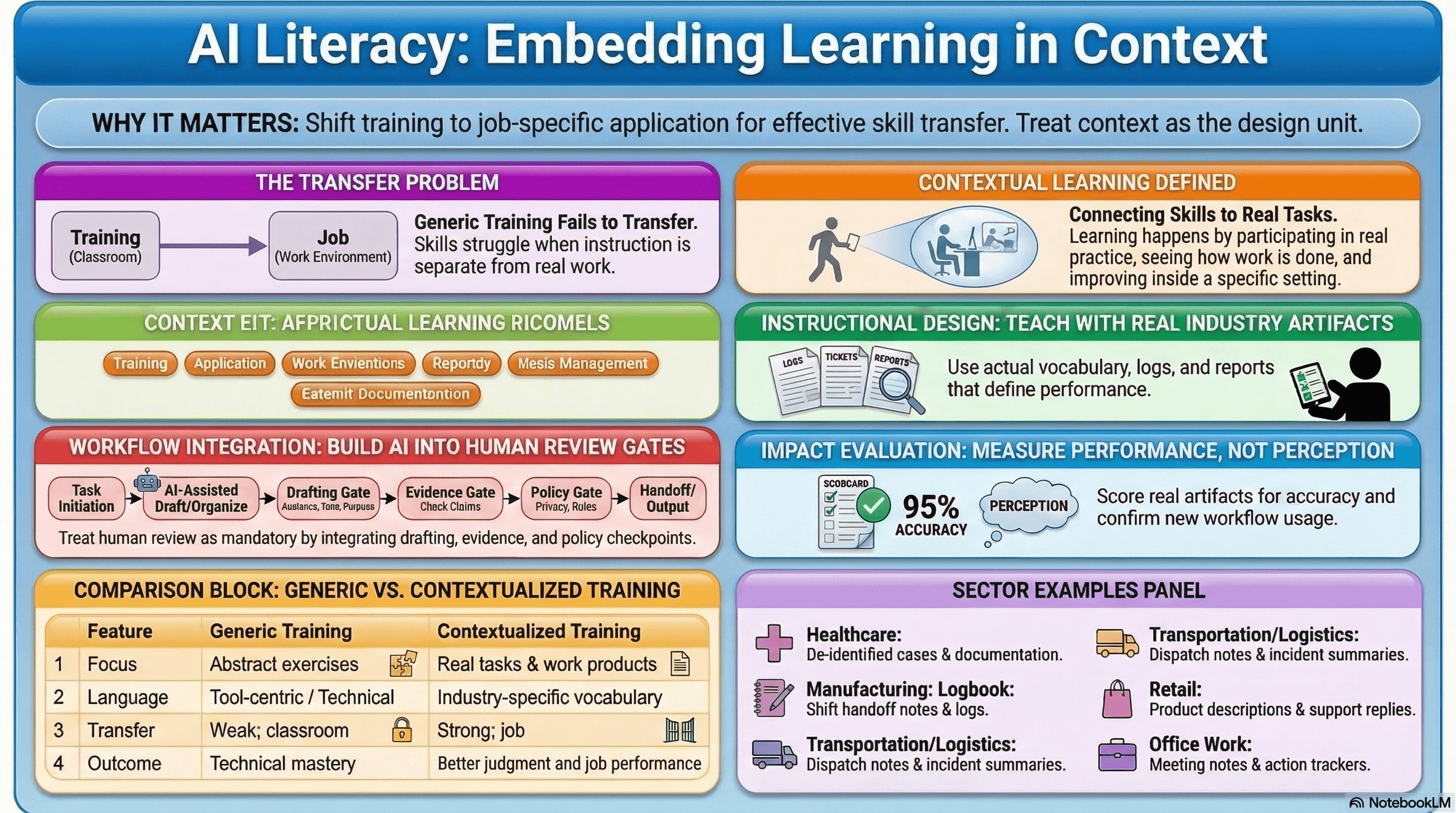
AI literacy becomes far more useful when it is taught inside the language, tasks, and pressures of real work. People may understand a tool in a training session, but that does not mean they will use it well when deadlines are tight, policies matter, and the stakes are real. This lesson focuses on a simple idea: context is not an extra layer added after training. It is part of the learning itself. When AI instruction is built around the documents, decisions, limits, and standards people already deal with, the skill feels more relevant, makes more sense, and is much more likely to last. The goal is not just to help learners talk about AI. The goal is to help them use it well in the work they already do.
This is where generic AI training often breaks down. Learners can repeat ideas from class, but they struggle to apply those ideas in the flow of the job. Workplace learning research uses the term transfer to describe whether a skill carries into real work and holds up over time. Transfer is what matters. It is not enough for people to enjoy the training or remember a few terms. They need to perform better when they return to their actual role. Research shows that transfer depends on more than strong content. It also depends on how the learning is designed, what support the learner has, and whether the work environment makes it easy or hard to use the skill. If AI training stays separate from real work, transfer stays weak. If you want people to use AI well on the job, you have to teach AI inside the job, not off to the side.
That matters even more because most workers who need AI literacy are not building AI systems. They are using them to write, summarize, organize, compare, draft, and review. That means the real skill is not technical mastery. It is judgment. AI literacy includes knowing when to use the tool, how to check the result, what needs human review, and where the limits are. A person cannot judge output well in the abstract. They need to know the audience, the purpose, the risks, the policy rules, the workflow, and what happens next. In other words, they need context. A generic demo may show how the interface works, but it does not teach someone how to use AI safely and effectively in a real workplace where privacy, accuracy, tone, and accountability matter.
Research on contextualized instruction points in the same direction. People learn better when the task feels real and clearly connects to something they need to do. Context raises motivation because learners can see why the skill matters. It also improves retention because the learning is tied to a situation they recognize. The deeper point is that learning is not just absorbing information. People learn by taking part in practice. They watch how good work is done, try it themselves, get feedback, and improve inside the setting where the skill actually matters. That is why approaches like cognitive apprenticeship fit so well here. Cognitive apprenticeship means making expert thinking visible. A skilled person shows how they approach the task, explains the reasoning, supports the learner through practice, and then removes support over time. This matters in AI literacy because the hard part is usually not using the interface. The hard part is deciding what to trust, what to question, what to revise, and what to reject.
The strongest way to design this kind of instruction is to begin with the work itself. Start with common tasks and the work products tied to those tasks. Then define what good performance looks like. In one setting that may mean accuracy and completeness. In another it may mean a clear handoff, the right tone, or full compliance with a rule. Once that standard is clear, AI can be taught as support for the task, not as a separate activity. This is where industry-specific language matters. If a team works with logs, tickets, reports, forms, customer messages, shift notes, or policy drafts, then training should use those same formats. If the work involves safety rules, compliance checks, approval steps, or brand standards, those should be built into the exercise from the start. That is how learners begin to see a direct line between training and performance.
The examples become much clearer when they stay close to the field. In healthcare, that might mean using de-identified case material and real documentation formats, while teaching what must be verified and what cannot be entered into unapproved tools. In manufacturing, the better examples are shift handoff notes, maintenance logs, defect descriptions, and standard work instructions, because the real goal is not creativity but clarity, traceability, and consistency. In transportation and logistics, useful training might center on dispatch notes, delivery exception reports, incident summaries, or customer updates, with attention to timing, escalation rules, and chain-of-custody concerns. In retail, the context may be product descriptions, support replies, return notes, and inventory issue tickets, where brand voice and policy limits matter. In office work, the right materials may be meeting notes, action trackers, policy drafts, stakeholder emails, and status updates, along with review habits such as checking facts, numbers, tone, and decision rights. Generic prompts may teach the tool. They do not teach the work.
AI literacy should also be anchored in workflows and human review. A workflow is the sequence of steps used to complete a task, and that sequence matters because people do not use AI in a vacuum. They use it somewhere inside a process that already has inputs, handoffs, decisions, and quality checks. A strong design starts by mapping one common workflow and identifying where drafting or organizing happens and where judgment matters most. AI is usually safest when introduced first at production points rather than decision points, unless strong review is built in. Human review cannot be treated like a warning label placed at the end. It has to be part of the task itself. That often means creating review gates: a drafting gate to check fit, tone, and purpose; an evidence gate to confirm claims against approved sources or system-of-record data; and a policy gate to confirm rules around privacy, data handling, disclosure, and approval. When review lives inside the workflow, people treat it as part of the job. When it sits outside the workflow, people are more likely to skip it.
Good instruction also depends on alignment with both the workplace and the learner. On the workplace side, training has to match the real environment people work in. That includes which tools are approved, what data can be entered, what must be de-identified, what must stay in internal systems, and what level of review is required. In regulated settings, people should use only the information needed for the task and avoid anything that conflicts with privacy commitments or legal duties. If a training example uses sensitive data in a way that breaks policy, then the training is not practical. It is teaching people into a problem. On the learner side, alignment means pacing instruction to match readiness. Novices often need worked examples, clear modeling, and close support. More experienced workers may need less help with the workflow and more help with judgment, exceptions, and edge cases. This is also where cognitive load matters. Cognitive load is the amount of mental effort a task requires. When learners are new to both AI and the workflow, too much complexity at once can overwhelm them. Clear models, step-by-step examples, and gradual release help people build skill without overload.
A strong lesson design should leave learners with something they can use again on the job. One practical structure is simple. Before the session, gather a small set of real work artifacts, clean or recreate them so they meet policy, and define clear quality criteria such as accuracy, completeness, tone, and required fields. In the session, begin with context: show the workflow, show the artifact, and show what good work looks like. Then teach through a worked example by demonstrating an AI-assisted draft and making the review visible. After that, move to guided practice with a similar scenario that uses the same language and the same constraints. Add a policy checkpoint so learners identify what information was used, what would be allowed in their workplace, and what would not. End with a transfer plan in which each learner names one real task they will try next, the tool they will use, and the review gate they will apply. To see whether the lesson worked, look beyond satisfaction. Check the quality and compliance of a real artifact produced during training, confirm whether the learner used the workflow and review gate on an actual task in the following weeks, and look at whether the workplace supported that behavior with approved tools, enough time, and manager or peer support. If you want AI literacy to lead to better work, treat context as the unit of design. Start with the language people use, teach through the artifacts they handle, build around the workflow where the task happens, and make review part of the work itself. That is how the learning becomes practical, how it sticks, and how it leads to better judgment and stronger performance.